You're watching...
How the U.S. Army Trains To Be 'Top Dog'
Details
-
Description
Using counterinsurgency to create solutions in Afghanistan
- Duration 3:52
- Date Aug 10, 2011
You're watching...
Using counterinsurgency to create solutions in Afghanistan
Also in this playlist...
Auto-advance: ON
Auto-advanceThis transcript is automatically generated
And PR want to ask you read this word coined in counterinsurgency.
Explain to us what that means.
But you're attempting to do.
It's not just defeat the enemy.
But also defeat the symptoms that allow the enemy to exist so as counter insurgents we try to look.
Holistic -- at the situation look at the people.
Look at their issues with the insurgents and what they're attempting to do and then as counter -- there's a very heavy kinetic piece.
You've got to take out bad guys and that's a big what we do on the battlefield but at the same time until you address the grievances of the population.
Provide development and government solutions ultimately there has to be a political solution.
Counterinsurgency recognizes that -- tries to empower the positive governmental actors to get that done and there's a security opponent there's military components there's economic component.
But counterinsurgency tried to take a larger look at the battlefield and and create solutions that a host nation can ultimately stand behind.
So in other words your training.
The American and allied forces are your training the Afghan forces in counterinsurgency.
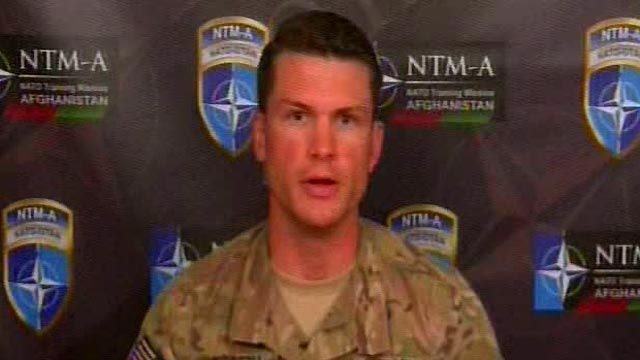
At the -- at that at the training center we running Kabul we -- both.
From 2007 to 2010 our focus was very much on coalition forces.
On making sure -- units coming into the country.
Were understood had a common operating picture had a common.
A language and framework for how we were gonna do counterinsurgency operations -- -- 75%.
Used to be coalition and into 2011 we transition to track bird over.
And lead and now 80% of the folks that we trained both in Kabul and we have regional training teams throughout the country 80% of -- now.
About 121000 since January and had been Afghans trained on counterinsurgency because ultimately they're they're the center of gravity -- -- the focus is their ability.
To address the needs of the population secure the population secure in the streets.
And and -- at the top dog on the street here in Kabul and throughout Afghanistan this week you know what as we move toward.
Toward the transition were able to handed over to them and they're able to secure.
Secure every neighborhood in the areas they need to within Afghanistan.
Okay -- bell bank Kevin Hesse where you -- if it makes common sense it sounds like -- -- isn't that what we were doing all along.
-- is -- counterinsurgency.
Doctor and different than what we've been doing in Afghanistan really for the last ten years captain.
Well I think -- It in many ways we were doing it much more -- -- and comprehensively now we're coordinating across.
At a counterinsurgency -- we not only teach counterinsurgency but we work with USA ID.
And something called -- district -- stability framework where we bring in.
The military USC ID.
Government actors economic development folks and try to get them all around the same table and -- units to coordinate across all sectors to make sure that when everyone's doing.
Is synchronize when everyone's doing is coordinated so that we don't have -- an entity building a project somewhere that the battle space owner doesn't know about so they're not working at cross purposes.
And and really the focus now is on is on Afghans and their case and in the capacity and capability made sure they understand that as a force their primary job.
Is to look inward and protect their own population inside Afghanistan provide stability at the village level at the district level that the government actors and we can connect.
-- to the sub national level and really create an environment where.
The it's the Iraq -- -- give me the Afghan government that is secure -- of people and not coalition for so we've really oriented.
Toward Afghans toward training Afghans to ensuring they're capable.
Of doing it themselves they understand the counterinsurgency approach that conventional means force on force tanks and aircrafts isn't necessarily how you deal -- insurgency.
It's small mobile forces that protecting integrate with the population.
And maintain the rule of law and support government institutions that's what we're shifting toward and that's the goal of what we're trying to train of the counterinsurgency training center.