You're watching...

After the Show Show: Martin Luther King Jr.

Details

  • Description

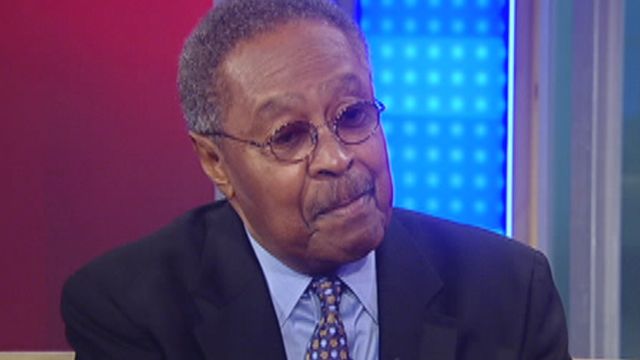
    Clarence Jones shares his first hand perspective on Martin Luther King Jr.

  • Duration 9:25
  • Date

Clips

Also in this playlist...

Editor's Picks

Auto-advance: ON

Auto-advance

Transcript

This transcript is automatically generated

Boy there's a special that wasn't an absolute.

-- went -- -- -- NASA.

Well enough and he's she is got -- moderating.

Today's events OK and she is said.

And and and it.

Get the exact quote the -- for -- second from her and she is said basically that He wasn't unique.

In his goal but He was most eloquent.

Did okay if that's correct that -- up.

That's right -- right wasn't I think that's it was a unique in his school for the pursuit of justice and fairness that's correct except it was his.

His and his method his means of doing -- that is a lot of people wanted to -- social justice wanted to have a equality and fairness and end of poverty.

Except that she.

He -- with a very.

Astute political person by that I mean.

He recognized that no matter how compelling.

And how persuasive.

The case for the end of racism the quality was for African Americans.

There was no way in hell excuse the expression that 12% of the population.

Was going to impose its will on the majority of the population.

The only way.

In which there was going to be a fundamental change is when you've got the majority of the population white people.

To come to see that it was in their self interest sense that the compelling case for fairness and justice.

That we were seeking was in this Celtics it's also okay.

I mean I thought there -- -- interesting what we're talking about while the speakers respect get the dedication.

That in some ways we can apply those same principles right to occupy Wall Street don't demonize.

The rich people on Wall Street.

Bring none is as partners it's their money and ingenuity can help all of us if we don't make them well -- -- -- marginalized.

I -- I.

The -- demonization.

Arises from the anger the demonization arises from a sense of helplessness.

I think the demonization also arises from.

The fact that.

It's it's one thing to be able to say what you are against -- what you are.

And and and and what to what -- it's one thing to complain and have a bill of particulars.

-- -- wealth disparity joblessness and so forth.

But it helps.

And I hope that sooner or later in the -- Wall Street.

That they will Begin to develop.

Some ideas of a constructive program to address the very things.

That they complain about solutions solutions otherwise and I think the president to -- reported this -- otherwise when you leave a vacuum.

Of which you propose.

Anyone can come in or not -- anyone but people can come in with solutions that might.

That might initially appear responsive.

To was to your complaint -- -- -- could be self destructive to which you seek to -- to address.

So perhaps it contrasts from the Arab spring Juan Williams I don't know if you know warm -- this -- a -- -- -- -- morning.

He said that doctor king's fingerprints were all over that absolutely is absolutely correct -- and what regard well.

Because.

He got what it -- yeah not a violent that's correct -- correct.

When you when you looked at some of the slogans.

And some of the sayings that we're in talk here square and the need to for example.

The only two.

None Egyptian.

Or non Arabic quotes that were -- -- Mahatma Gandhi and king the only two.

Pictures that we're not.

Aaron were Gandhi and king.

And with the power of the technology of the social networks.

The leaders of the movement somehow came to understand.

That if they were going to build a broad base of support for their objective.

They had to do it.

Using passive resistance.

Using nonviolence.

Imagine.

The different response.

That both the United States -- -- and the world would have if in their opposition.

They became violent if very.

If if they responded.

Violently they would of lost -- days -- lost the support could no that was the that was the genius of Martin Luther King Jr.

That genius was not some.

Fairy tale belief.

It was a deep abiding belief based upon his deep religious belief and Christian love.

He -- believe fundamentally.

That even in the worst at that time.

White racist Mississippi subject.

-- that is that as an example.

That deep with in that person.

There is something called a soul and they conscience created by -- something up that's sold -- the conscience and so the challenge is.

To get that person.

To publicly come to see publicly to look to confront the consequences.

Of their actions to see.

What they are doing to.

Of the people.

He really Jenny we believe that if you if you He would say you can come in to my house.

And you can insult me and I'll still love you you could come in and to take me out on the street and beat me and I'll still love you.

You can take me out on the highway and threatened to kill me and I'll still love you can kill me.

And they -- OK you can kill me and I will still love him.

And ask for forgiveness -- -- this wasn't this is just wasn't -- theatrical technique and truly believed to be believed it.

And one of the things about Martin king's leadership.

Is that He never ask.

Anyone.

To do or follow him.

To do anything that He wasn't prepared to do himself and and when I talk about these nonviolent Civil Disobedience.

Demonstrations.

He was the first one to lead them.

We've talked about confronting.

The the power and the bully club -- the club than to believe club with the police He would be at the front of the line.

He would never ask any what anyone to do something that He was not prepared to do himself.

And people.

Who supporters is activities.

Begin to understand.

That this was a different kind of leader this was a leader.

On the question of political.

And leadership integrity.

It was not negotiable.

You know you there are there a lot of people who are used to say.

And and in the New Yorker.

-- -- But to sell wolf tickets -- -- how bad you know.

Oh what laden and I'm gonna do this when two of the white men did this to me I'm a put my foot up -- behind okay -- and token that's one thing to say that on -- -- street.

And seventh avenue you know it's another thing to say it got to Tupelo Mississippi.

We understand in 1960 all right this and so and so Marten Luther king junior.

Had a profound.

Who love.

For this country.

He had a profound.

Love.

Four.

The possibilities of what this country could be.

They I have a dream speech by -- -- was sold in the future tense I tell people.

That He had a much more prophetic.

Believe in America than America indeed -- of itself.

How do you know -- -- -- -- tolerance and not say what that might be one of the other big difference.

It's between his movement and between what we're seeing -- not -- Wall -- is a love for this country but we're not seeing that in fact someone polled that group and suggested.

People don't like this country some of equated it with al-Qaeda but.

No I wouldn't go no I wouldn't say that I would say that what you're saying some of those is that there's a there's an anger there's a frustration.

What we don't see.

What we don't -- probably what should be said.

Is that well I'm I'm angry at the level of foreclosures while I'm angry and believe that the banks have gotten a better deal and so forth.

But at the same time.

-- -- love my country right okay.

And the reason -- -- because I want it to be better and that would help that if an ego.

-- the -- the reason I'm here because I wanted to be better that's great it's such a pleasure strange time we -- thanks so I thank you very much -- -- scientific to this morning spent a great line here thanks so I thank you -- to fill out at the time all -- lot of us here today we'll see you back can actually candidacy.

Here.