You're watching...
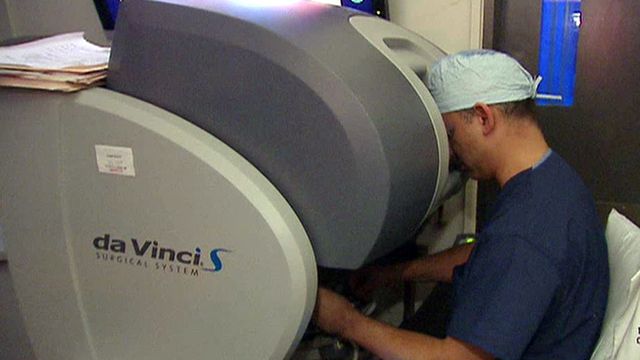
Research Finds Academic Centers Better at Robotic Surgery
Details
-
Description
Drs. Samadi and Siegel weigh in
- Duration 2:10
- Date Nov 27, 2011
You're watching...
Drs. Samadi and Siegel weigh in
Also in this playlist...
Auto-advance: ON
Auto-advanceThis transcript is automatically generated
-- back now so -- house calls this new research on prostate cancer.
The funds there -- some better outcomes for patients who go to teaching hospitals.
Vs potentially going to a private practice doctor -- how important is this what is -- -- This is a really landmark study in this field because previous studies have not shown that academic centers necessarily have an advantage.
In terms of outcome that you go there you're gonna get better not necessarily.
But I believe with a high technology like this.
It has to do with where you can do the most cases and where you can hire the best people and where you can use the most advanced techniques I don't wanna make my partner here -- But there's a reason that he has well over 3000 cases and he has an incredible team working for him and he does it all himself.
That's how you get a better outcome so I laugh every time I see a study that says well.
This technique can live longer this technique you don't live longer and I'm thinking first the -- quality of life secondly it depends who you go to which the art of medicine.
And this case with the prostate.
This man is the person -- go to but he also teaches this technique.
-- market is always very kind when it comes to this I think with any kind of technology you really need to have it.
Fifteen other dedicated to this as a missionary the centers -- -- -- dedicated to this have large volume of cases.
And also the patients have to really do did due diligence and find out who is doing their surgery.
Is it doctor going from room to -- Morrissey there the entire time and I've been always a big advocate -- one team approach.
Knowing open surgery known laparoscopic and bringing this technology has been instrumental to us.
And based on this I think we're seeing that there's less complications and academic institutions that are doing this day and and they doubtless thought laws and better out over -- patients -- upon location location location -- -- -- for the doctor.
And I found that you can ask the doctor showed you know how many times have you done perform this operation or the team -- -- -- or the hospital that they have depth of those states also track mortality.
And complications on different procedures but sometimes it's hard to put it down in Paper it takes a long time before the statistics back up the actual performance that's interesting that could be a -- we'll definitely ask the question of how many procedures and 3000 that is impressive and.
Meanwhile.