You're watching...
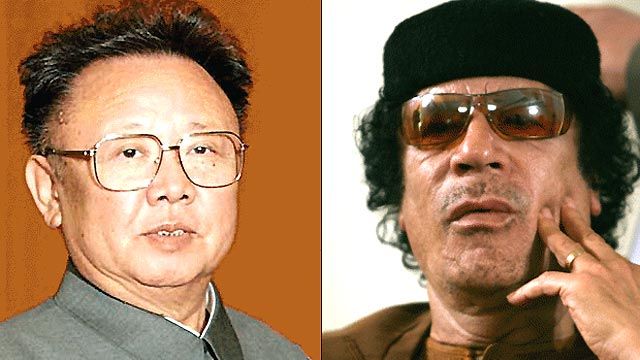
2011: A Bad Year for Dictators
Details
-
Description
Impact of fallen leaders this past year
- Duration 7:19
- Date Dec 20, 2011
You're watching...
Impact of fallen leaders this past year
Also in this playlist...
Auto-advance: ON
Auto-advanceThis transcript is automatically generated
Information now on the -- in North Korea's dictator Kim Jong ill and the US response to a new regime -- in this -- rogue nuclear nation.
Diplomatic efforts are reports of those efforts to resume nuclear talks are now being put on hold in Washington will wait to see what happens.
Under this new leadership and her Kim's son and and what -- -- when he takes control we were thinking about this year this year 2011 and it has been certainly a test here.
If -- dictator especially in North Africa and the Middle East in Libya -- popular uprising led to the downfall.
I've Muammar Qaddafi rebels backed by NATO topple the dictator after 42 years -- power -- story for this year.
And Yemen longtime president Ali Abdul -- to lay it remains under pressure he signed a deal to hand over power he could still face trial he's been an ally of ours for about thirty years in office.
And in Egypt revolutionary forces swept -- he Mubarak -- -- one of our allies.
From the Presidential Palace into prison he of course is on trial at this time.
He -- rally is a former spokesman for the US State Department and wow what a complicated.
And dynamic -- it's -- as far as some of these overseas affairs PJ had a nasty a simple question.
That for a complicated issue how -- makes sense of everything that happened this year what is the big take away for what's going not in the world's.
-- think Jenny said it exactly right it was a tough year for dictators that is good for the United States and the world in the long term.
You know but obviously they'll be Iraqi road as these.
Various countries -- you -- -- you know Tunisia to that list as well.
Move from dictatorship to democracy.
They'll eventually get there but it's not going it's going to be a bumpy road.
Just last week I spoke with ambassador Ross Dennis Ross whose advice.
I five from presidents and what's going on in the Middle East and he says it's really important for our country to understand what's at stake.
With these moving governments in -- to achieve whatever our interests are in these in these areas the world.
How would you put our stakes -- states to be had in these different areas of turmoil and how do we take advantage of this change is happening.
I think you have to look first of all and and draw from her own experience you know -- experiences unique and and it may or may not apply directly to other countries but.
You're trying to get to where governments are responsible they are accountable and they're serving the needs of their people I mean.
North -- a perfect example if you look at north and south.
From a from the standpoint of the people and their talents in their industry and so forth there should be no difference between the performance of one of the performance of the other.
And yet the gross national -- than the per capita income of South Korea's 30000 dollars give or take.
And the per capita income of North Korea is about 18100 dollars give or take -- and and the only difference in the two is the nature of their government and their society.
No one is a vibrant democracy in a vibrant market economy.
And the other is the last Stalinist regime on her so though the quality and character of governments do matter.
I think we have to be patient because you know in the short term for example in the in the Middle East and North Africa.
You know these societies will become democratic.
They actually probably could become in the short term less liberal moon and so we're gonna have to be patient as they work through.
Building the institutions of government learning how to govern.
And for those who were opposed to government learning how to be effective opposition you see that in Iraq for example were -- Al-Maliki on the aftermath of the US withdrawal is now going after one of his vice presidents and the leader of the Sunni bloc they have to come together.
And function as Iraqis not function as.
Kurds Sunni and Shia with different -- And we'll see if they can do that -- to see you mentioned that story that -- rest.
Broke during our show yesterday -- -- ad showing an arrest of a high profile Iraqi official we all wondered what really is going on there in this country as it tries to sort out.
What's happening is interesting to look at some of the the personal connections between some of the -- that we mentioned for example North Korea Kim Jong-Il we knew that.
There are reports that North Korea was working with -- react to develop -- nuclear weapon in Syria and and there was a diplomatic relationship there with -- leader and -- apparently president aside as well now this leader Kim Jong-Il is gone and I wonder with that the death the Qaddafi is well.
-- -- all these these different relationships.
Are changing between these countries that are are anyways PJ.
Sure and I think that the good news here is that lots of the dictator and we we've we've just reflected that there are dictators who thankfully.
Are gone they're also dictatorships that are on the defensive or even.
You know under siege certainly certainly Syria sir is in that category and an even for a country like Iran.
You know the the -- had a bad year they're they they probably came into this year thinking they have momentum they've been put on the defensive because of what's.
Happened elsewhere in the region they found themselves in this awkward position of supporting protests and democracy in Egypt.
But denying their own people democracy in protests -- in Tehran so.
As these groups are focused on just simply survival.
That necessarily means they probably have you know -- less time and energy to be able to cause mischief.
Elsewhere.
So -- I don't think that moment hope writing on what -- the idea I don't situation we're going to twenty tell there was reflecting on the speech that President Bush.
Gave in 2002 when he mentioned the axis of evil course Iraq Iran and North Korea.
That's sweet place in those positions if you -- looking at an axis of evil for 2012 now ten years after that speech.
Who would you put in focus in his three positions.
Well if you if you look at the Middle East and North Africa now you would you have thankfully competing visions.
For the future of the region you do have what's happening I think we should watch you know Tunisia as being the country that -- turned first.
And is advancing.
The fastest obviously we see and unfortunately Egypt where.
On the one hand there were the inspiring protests just under a year ago and now you see the Egyptian military that.
Now seems to have shifted from being part of the solution to perhaps part of the problem but but -- you as you look at the emerging democracies.
You know -- -- you know did political movements built yet came up from the ground up.
You then you look at the two countries that are under siege in the Middle East Syria and Iran that are steadfastly resisting change so I think as we look to.
Where do you want to take the region but we have to continue to keep pressure on that alternate vision an alternate vision of Iran and Syria.
If if they advance in constructive directions going forward there's -- -- to be very optimistic about the Middle East.
If if they are able to resist and push back.
These elements so the transition stop that Tunisia.
Egypt Libya who knows what's happening in Yemen.
You know then all a sudden you you have the risk of retrenchment.
And disillusionment in the region and with disillusionment then comes the opportunity for.
For the a groundswell for it.
Maybe -- -- -- for fort problematic actors like al-Qaeda -- that hearing the extremist to get a second bite of the apple.
-- interesting -- mention that in the Syria and Iran because we -- would have some of our guests mentioned Pakistan those who have.
A nuclear weapon are -- and so we'll continue to have this conversation PGA we appreciate you joining us well as I said your perspective.