You're watching...
New Undersea World Discovered Near Antarctica
Details
-
Description
How creatures survive extreme environment?
- Duration 3:10
- Date Jan 9, 2012
You're watching...
How creatures survive extreme environment?
Also in this playlist...
Auto-advance: ON
Auto-advanceThis transcript is automatically generated
Scientists discovering a brand new world of sea creature is on the ocean floor near Antarctica.
New species of pale colored crabs and and how many.
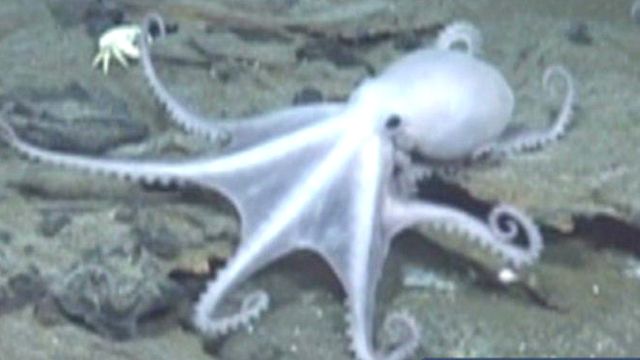
You know octopus is now a decision to occupy -- and a discovered that right John thousands of feet underwater so.
How -- the creatures thrive in such -- harsh region as the South Pole wait till you hear about where they're living Ian MacDonald.
Is a biological ocean on for the water temperature down there and some of these some of these videos came to us from about 8000 feet down.
The water temperature is I understand it is 32 degrees.
But they have a heat source an energy source down there.
Well that's right the water temperature is actually -- freezing but because it seawater it doesn't really -- mice.
But the amazing thing is that the water them fluids that are coming out of these hot -- Are at temperatures of 725.
Degrees that's hot enough to melt lead.
So this is truly an extreme environment but it's one that supports an amazing ecosystem.
We were looking at some pictures and video of these yet he crabs.
There there's kind of an interesting.
Nickname for them and they have kind of an interest -- characteristic can you tell us about that.
Yes they do there there one of the latest discoveries and him among that sea creatures that are able to.
Make use of bacteria that feed on this this hot fluid.
And -- say yeah Eddie crabs have chest cares if you like.
And they grow colonies of bacteria in America in the hair on the under part of -- and abdomen I should say.
So what they do is they cling to the surface of the events and there's just enough for -- cool down fluid coming up.
To enrich the bacteria and then made use these colonies of bacteria in there are growing on their bodies as a food source amazing.
And it's my understanding they've been nicknamed the half crabs in in deference to David Hasselhoff the Baywatch star who's known the story -- -- chance.
That's -- -- -- -- -- and you're gonna make it said scientists don't have a sense of humor.
That's right these things I've never been seen before in part because it's just so difficult to work in those latitudes off off Antarctica.
That's right they -- events were discovered back in about 2000 but it took that scientists from the British show Southampton oceanographic institute almost a decade to get back there.
And they went back with a simple camera system and they if they realize that they were on to something and then they were able to return later with their ROV.
The nicest and they really scored it's really exciting to see this.
And what's what's interesting about this is that there are -- communities known from many other places in the ocean.
But the Antarctic vents are cut off from the rest of the ocean by the strong currents that surround the Antarctic continent so that larvae from -- -- this events and things like that places like that.
Can't make it to this out to the Antarctic -- -- what's exciting is that.
Other animals have evolved mechanisms for making taking advantage of of the bacterial production that occurs of these bad stuff was an example of evolution at work and we've never seen him before didn't know was there.
Fascinating -- -- McDonald thanks for bringing us those pictures appreciate.