You're watching...

Does religion have a place in politics?

Details

  • Description

    Will voters turn to religion when deciding who to vote for?

  • Duration 3:55
  • Date

Clips

Also in this playlist...

Editor's Picks

Auto-advance: ON

Auto-advance

Transcript

This transcript is automatically generated

Let's be clear it believe it evangelical has been used in the media is as a political term.

And evangelical actually is a theological term and actually of people group with a history.

And so you know when you're talking about political evangelicals what you're really talking about.

Is a -- voting block and that has been cooked up by the religious right in the 1980s and really kind of taken since then by the media.

Now if you're asking about deep theological.

Evangelicals and I think you're gonna find a whole different thing.

Because you know the evangelical church as a whole right now.

Is experiencing.

A broadening of the issues that it cares about.

And the reason for that is because white evangelicals feel logically evangelicals are actually in decline.

But there's a rise in evangelicals luck of color.

And so what you have is a broadening of the issues that actually matter -- with a hint that the theological.

Evangelical round.

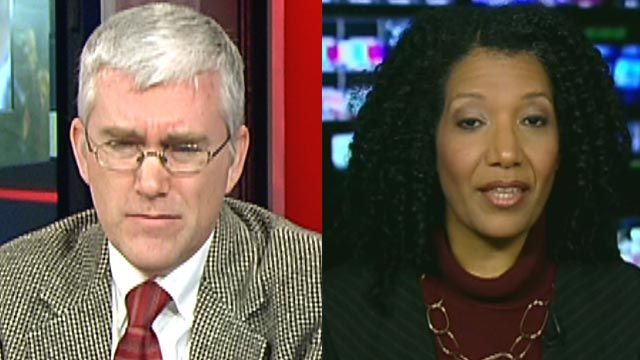
And David what do you think about in terms of you know just in terms of you know -- evangelicals have this great influence in the general election.

But they can't party they can't help but have a an influence in the general election there.

Figures I've seen -- -- closer about a 40% of the electorate and that would include black evangelicals and and left and right evangelicals but the probably about a third of the country to be quite conservative evangelicals.

That's a lot large part of the country.

And that actually taken over Catholics in terms of percentage at least -- that's that's -- -- sees it let me get -- via.

The exit poll -- South Carolina -- primary where -- Newt Gingrich actually one.

And they ask your question how important.

Are there is -- candidates would just -- the whites generally displeased with the how much that matters.

A great deal -- -- percent somewhat 32% not much 19% and not an all 24% and I am glad mark that down and say basically.

57%.

Say it's either great or somewhat a big deal and 40% say it's not much or at all Lisa what do you make of these numbers.

-- it's it's fascinating because what you have is you have.

A situation where a 150.

Evangelical leaders gathered in Texas and -- -- to back Santorum.

In South Carolina and yet.

Team rich gets 46%.

Of the moment.

So what does that tell us it's process there is no such thing as an evangelical voting block right now.

In fact the people in the pews have -- clues to the evangelical pope's.

I'll let David you can do we sent.

I think it tells you that the in the 1980s they were certain media outlets and organizations and that every evangelicals tend to listen to and used to organize themselves.

But in the last ten years it's just fractured.

I used to be able to go to Jim Dobson Jerry Falwell one or two other people and then he would speak for the group and now they're phrase web sites and media outlets and so forth.

That's -- much more laughter.

Think for themselves.

There is this and and impression there is this for exceptionally sense that when you are a really great religious person you were voting Republican.

And that's not necessarily true I mean.

Is that we can understand.

Absolutely actually here's the thing is that an -- glad that David brought that.

You know they're used to be.

A plethora.

Religious right leaders that convinced.

Theological evangelicals that what it meant to be evangelical is to be conservative.

But here's the irony.

Evangelicals.

As a people.

-- -- -- In the midst of -- reform movement.

And so we will -- as a as a theological movement in order to reform.

The church and society.