You're watching...
Russian scientists reach ancient Antarctic lake
Details
-
Description
What will subglacial water reveal?
- Duration 5:06
- Date Feb 9, 2012
You're watching...
What will subglacial water reveal?
Also in this playlist...
Auto-advance: ON
Auto-advanceThis transcript is automatically generated
Russian scientists are celebrating a major breakthrough after years of drilling under very harsh conditions near the South Pole.
They finally have reached a giant Blake buried under miles -- vice.
Some are comparing the difficulty of what they've accomplished to reaching another planet.
Tom Jones is a former astronaut for NASA and Fox News contributor will be talking with him but first.
Let's talk -- Robin bell on glee she all -- just for the Columbia University LaMont Doherty earth laboratory observatory should say.
He joins us on the phone from London.
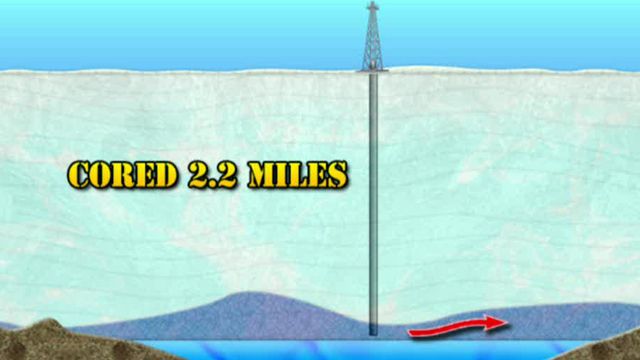
There's so this lake was I guess only discovered in the last twenty years or so it's the size of Lake Ontario but it buried under two miles of ice.
We're right exactly how to style device and so even though it's minus fifty at the top it's only like.
28 degrees at the bottom.
And the excitement the scientific excitement about finding this thing are actually getting a drill rig down to it.
Is that the water that's buried there has been buried for any office.
Well it's been got -- of course some -- between fifteen and 34 -- years and that's a long time.
Now the Russians have been pulling up these core samples why why has it been so difficult to do this I mean we've known how to drilled deep for a long time.
Well two reasons one billion wanna contaminate the -- period wanna get any of the drilling fluid which is kerosene into the pristine lake.
The other thing is hits the ice is really warm and it -- things up really quickly -- Hard.
All right so they they drill down they've finally have reached the water that is not solidified not frozen.
What are they hoping to learn what are you hoping to learn from that water.
Well I hope they're gonna learn what can actually live in these environments underneath two miles -- and it's kind of like the environment in outer space like in the moon has been around Saturn -- -- -- So there are indications of microbial life in this water.
Well we have simple that we think are also from the lake but -- they've been kind of contaminated so we hope these will be the first clean samples from the lake and we hope it will.
-- firstly inflation don't want.
Can live you know -- -- 32 -- tonight.
Robin bell police you -- just thank you let's talk about it with Tom Jones Tom some are suggesting that this is.
-- the accomplishment the scientific accomplishment here and maybe the technological one is equivalent to landing on the moon.
It's certainly an impressive engineering -- John it's equivalent to having two work in the the South Pole of cold this is one of the it's almost the coldest spot on -- on the planet it's been as low as 128 degrees Fahrenheit there.
During the winter so for the Russians to overcome the surface -- challenges and then make it down through over two miles of ice.
To tap into like -- stuck there is really impressive and it's the kind of challenges facing us as we search search for life elsewhere in the solar system.
Like those moons of Saturn and Jupiter Europa and -- what we think and we have proof that there are subsurface oceans.
We'd like to think that with water and energy sources and the chemical nutrients or the chemically ingredients that are necessary for life -- get.
Microbial life on other planets like that.
A 128 degrees below zero at times -- the coldest temperature ever recorded on -- -- and that that would be pretty difficult conditions in which to work.
I I guess part of the problem is the simple matter that it is so cold and against Israel in there and it freezes up again I -- the whole.
Fills up again and freezes.
True and they've got to keep this drill stringer this drill -- open for over two miles of -- thirteen thousand feet down to the lake.
And then you've got to penetrate into this pristine lake water without injecting as are our -- geologist told us.
-- contaminants into that -- so that's a very carefully.
Planned effort over -- more than ten years to make it this far.
Next season we'll get actual samples out of the bore hole to see if there it is -- -- life or even something more complex.
Yeah I mean if there is life it would be absolutely amazing because under two miles of ice there would be no light penetration know some light.
And obviously in those harsh conditions.
Not conducive to life as we know what is this -- kind of well.
Is similar to conditions on other planets.
We find it two in unexpected places all over the planet the Atacama desert in Chile so we have an expectation that if we find things in like -- -- stock.
Where there's no photo -- going on maybe it's a chemical energy source maybe it's Hot Springs down at the bottom of the lake that.
Might keep keep the life that was trapped there ten million years ago alive if that's true.
Then we would expect that these same conditions might prevail on these outer planet news or.
Down underneath the surface of Mars and we might expect to find microbial life there Tom Jones a former NASA astronaut and a frequent guest of ours and Robin bell before -- Thank you both.