You're watching...

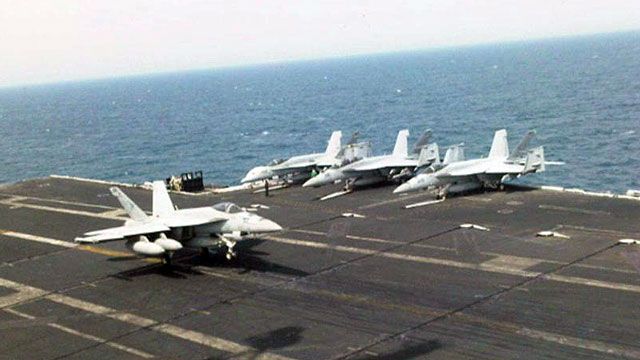
A view of the gateway to Persian Gulf

Details

  • Description

    Assessing position in Strait of Hormuz

  • Duration 5:23
  • Date

Clips

Also in this playlist...

Latest World

Auto-advance: ON

Auto-advance

Transcript

This transcript is automatically generated

Well right now the Strait of Hormuz is one of the most precarious waterways in the world to see gate way to the Persian gulf where 40% of the world's oil supply passes through.

Our -- sits on one side -- Saudi Arabia Kuwait and Iraq on the other.

-- blocking the Strait of Hormuz even temporarily.

Would -- 15 of the world's oil supply to be bottled up in some predict the price of a barrel of oil could double to more than 200 dollars.

Our next guest is just returning from a stay on the USS Carl Vinson.

Chris Stevens was embedded with the navy's fifth fleet the fleet that polices the Strait of Hormuz and he joins us now as a former.

He's a foreign affairs columnist for the Wall Street Journal nice to have you back stateside in on solid ground -- good to -- -- you know it and of course -- story takes greater importance because the ongoing discussion with Iran and I understand why you were on the aircraft carrier you were being shadowed.

By in -- riding in.

-- tell us a little bit about that.

-- at the time I was actually on the USS Bunker Hill which is in the aegis type cruiser that was the the carriers escort.

And at a certain point through the morning -- You could see off far off course -- -- about 3400 yards away.

A I doubt the cows are the kind of typical ships of the area mostly commercial ships this when you knew was a rating because it was flying an Iranian flag.

It had a radar which was far too expensive for most -- own.

And a cat shadow shadow NASA came within a mile.

Now the officers who have been going to visit to the golf for many years told me this is typical behavior on the part of the Iranians.

Did did the worrisome thing is that there have been incidents over the last year in which the Iranians have come very close to some of our capital ships.

And the fear is that an -- even a small boat.

Could do enormous damage to a very large US ship just think of the USS Cole back in in 2000.

Sure and we've had people come on the show -- different analysts that I've talked to us about.

You know what could actually lead to war with Iran and senate pointed to the Strait of Hormuz.

And a miscalculation.

Or a -- -- decision that -- launches into a bigger war with a country I'm just curious as we've talked so much about Iran.

-- together on the show having been to the Strait of Hormuz at this time in our history you what are some of your observations now that you're back home and thinking about the situation with Iran right now.

Well the first observation has to be said we have a magnificent.

Navy certainly magnificent officers and sailors highly competent.

And nothing kind of can duplicate -- replicate the experience.

Actually spending time out there with our with the sailors with with the pilots out there.

On the other hand when I was hidden in in the Persian gulf we really had four -- five ships major ships.

In theater so it was not a particularly.

Large deployment and I think this to some extent.

Speaks to the downsizing of our overall military -- 20/20 five years ago we -- close to 600 ships.

Now we have half that number less than half that number so that's a significant fact.

And a third point is that while the Iranians are generally.

Cautious around our boats they do have rogue in -- it seems to be that they do sometimes have.

Rogue elements in their -- indeed naval component of the Revolutionary Guards corps.

Who are ten who may be tempted to carry out Lomax against our ship that could precipitate war.

Ukrainians -- -- of about 5000 mines that could close the Strait of Hormuz pretty quickly.

And that's that's a scary thought to think about that especially because -- aircraft carriers and other ships.

Kerry so many ever met a quick final thought from you bread and McFarland at Reagan national security advisor was on our show and said if he.

Could give the president any advice it would be to go and park -- aircraft carriers more than one.

Off the coast of Iran and just sit there Mitt Romney had an op Ed piece in the Washington Post that says something similar this week.

A question for you is it isn't about numbers you mentioned the numbers of the ships in and wanting to see them.

Big you know what vs small and -- time like this but is it about the numbers or is it about the real threat to use those ships it.

Need be.

Well.

You know there's a saying in the military that quantity has a quality all of its own.

Now there was also be Abraham Lincoln another Nimitz class carrier park right outside of the Arabian Sea doing operations for.

Ensuring freedom for Afghanistan that's also part of the fleet but that was on the other side of the Strait of Hormuz.

I have no doubt that we have a need the end and -- -- have raw after another made this is clear to me.

That is highly capable and could take on the Iranians if we work -- if they were called to do so but nonetheless -- you have.

Relatively few capital ships.

Each of those ships becomes more important to your overall.

Fleet.

And more vulnerable to an a symmetrical type of attack and we need to train very carefully planned very carefully against that possibility.

You give us an invaluable perspective today -- I think it's gonna retire from the Wall Street Journal maybe join the navy now mean is that the next step when you think that's the thing about that that's the that's on the bucket list well you had a pretty -- -- a pretty good trial period right there that's is that they have not many people get to see Brad.

Thank you very much are we looking for your complete article.

On it in the Wall Street Journal a few days thank you.