You're watching...

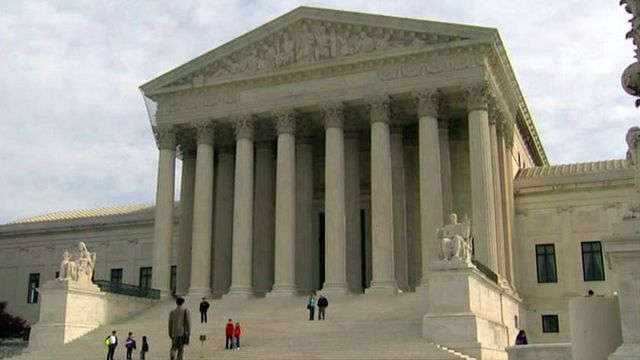
Health care law heads to Supreme Court

Details

  • Description

    Lead attorney in lower court challenge previews arguments

  • Duration 5:59
  • Date

Clips

Also in this playlist...

Latest News

Auto-advance: ON

Auto-advance

Transcript

This transcript is automatically generated

Welcome to The Journal Editorial Report I'm -- you go the Supreme Court on Monday is set to Begin hearing a historic three days of oral arguments on the constitutionality.

Of president Obama's signature.

Legislative achievement the patient protection and Affordable Care Act central.

To the issues before the court is the individual mandate which requires most individuals to buy health insurance by 2014 or pay a penalty.

26 states challenge that provision.

An attorney David Rifkin represented those states in the trial.

And appellate -- he joins me now so David Rifkin welcome you're the guy who started at all with your -- and -- Happy to say in the Wall Street Journal in 2009 and the lower.

Court case so what are you going to be looking for.

When you look and listen to the justices next week.

Well I'm going to be looking for as spirited done questioning which of course would come -- But I'll also be looking for indications particularly from justices Kennedy.

-- Scalia that they appreciate what this case is all well.

This cases all -- as you mention in your excellent editorial is about the key constitutional architecture.

That is designed to protect individual liberty and that's the dual sovereignty system was diffuse this power between the federal government in the states.

In emphatically -- from a federal government the general police power to regulate individuals merely because they exist.

Okay but the people and the administration says look commerce clause of the constitution gives congress the right to regulate commerce health care.

Is commerce.

So why is this case different than other regulation of commerce cases.

The reason -- -- always because the commerce clause while very broad is not infinitely -- basis it is one of congress is limited enumerated powers.

He allows congress to regulate things.

And activities.

Actions physical objects that it allows.

The individuals to be pulled into this regulatory work -- Believe do we stay in this and in insofar as they participate in those activities.

What interact with things what congress is doing here there regulating individuals simply because they exist for example congress could have said.

You cannot obtain any health care services in this country unless -- shorts.

-- of -- regulated conditions are purchasing health care that congress cannot do.

What congress cannot do were about regulating US individuals which is prohibited by the constitution to say because you might in the future.

Use health care services or because your failure to buy insurance.

Our results in a -- -- cross subsidize somebody else did because of boasting record can regulate you here and now.

Okay so that if there that comes down to the core of it comes down in your view to the individual mandate but some of the some of the liberal defenders of the the the obamacare legislation say look.

If you're gonna overturn -- you've got overturn all of the new deal precedents for the major new deal precedence on the commerce clause and that's something that no conservative court should do because it's just too radical what's your response that.

This is nonsense this is classical -- direction.

Howard casing is the individual mandate is consistent -- -- -- target of a commerce clause jurisprudence.

Including the new -- cases like -- -- -- bill -- And the most recent major commerce clause case like Reich always cases and have one common thread running through them.

You can regulate in a very.

A broad fashion.

Activities in first state -- in -- -- you can regulate objects you can regulate instrument tell these not a -- allow the regulation of people on such.

And very importantly -- in the every single one of -- cases.

The court acknowledges.

That there has to be a meaningful judicially enforceable limiting principle that distinguishes between the exercise of -- commerce clause.

And the prohibited exercise of a plenary police power.

Which is the part of regular individuals which only states.

And do okay you you had you live in Washington I'm sure you've heard the scuttlebutt that even among some conservatives that this could go seven to two the other way with.

Chief Justice Roberts taking some of the conservatives and and upholding the they -- individual mandate because.

On the grounds that look no Supreme Court it should intervene in such a fundamentally political matter as legislation on health care.

What what do you think of of of that talk.

I've heard the same talk I think it's partly wrong.

-- would make two observations first of all it's become important.

Not to misunderstand would judicial deference.

He -- judicial deference to the exercise of congressional authority is very real we as conservatives agree -- it.

But then legislation.

Exceeds Congress's constitutional forties it does not only right it is emphatically the duty of a court to -- strike it down.

And I'm sure that all we're just this is I can appreciate that -- -- -- -- the he would not be.

27 I can promise that -- I -- extremely hopeful.

That not only to achieve justice and injustice is commonly referred to as conservatives and very very hopeful but Justice Kennedy who is -- -- distinctive.

And that was -- in the court now.

Who who is the language in in cases like Lopez.

And bond which is the most recent case right -- term but deals were federalism issues.

This is something he is the one who referred to there's dual sovereignty system which I mentioned earlier as the most distinctive feature of American constitutional -- -- many zaps me right.

We have that this is something that's unique to this country this addition the way of protecting liberty.

By having the diffusion of power between the federal and the state government.

So it is not going to be 27.

All right well that -- what you're saying is we're all going to be watching very closely justice Anthony Kennedy as we do have so many cases David -- thanks for being here.