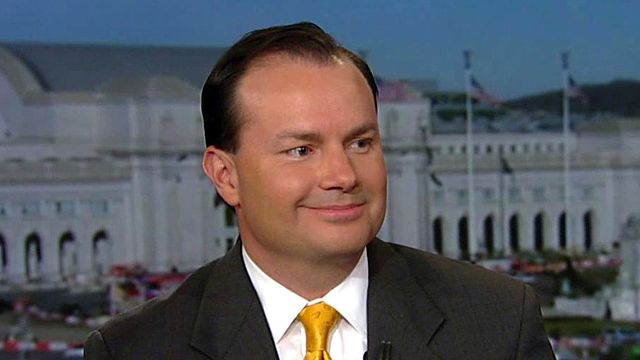
You're watching...
Sen. Mike Lee: Congress has 'overreached' on health care
Details
-
Description
Utah lawmaker talks Supreme Court arguments
- Duration 5:28
- Date Mar 28, 2012
You're watching...
Utah lawmaker talks Supreme Court arguments
Also in this playlist...
Auto-advance: ON
Auto-advanceThis transcript is automatically generated
Anderson more spots on the health care -- -- -- -- senator Michael Lee is -- a member of the Judiciary Committee who used to work as a constitutional lawyer and also clerked for justice Daniel only tell.
Say you're welcome any arguments last couple of days he saw what I saw -- your impression of the solicitor general.
I think solicitor general -- relatively good job I think he's a good lawyer I I think he's a hard working lawyer and I think you did the best job he could in this case he's got a hard case to make.
Because the fact is congress has overreached that's what this case is about that's why I think he's likely to lose.
-- let's talk about the mandate the core of the entire case yesterday was day to.
-- was watching justice Anthony Kennedy they expect to be the swing vote likely to get a 54 decision.
What did you make of what he had to say yesterday because initial questioning from him seem to suggest he did have problems with the mandate.
Yes I I think it didn't you you repeatedly indicated through his questions.
And through his body language his facial expressions his intonations.
And then his reactions to the answers provided by the arguing council that he's got problems with it and I think he made no secret about that I'd be very very surprised.
If we didn't see at the end of -- that day an opinion either authored or joined by Justice Kennedy concluding that the individual mandate is unconstitutional.
What do you make of his comments that towards the end of the arguments yesterday -- city did have concerns about the example the government kept kept talking about the young person who is.
Healthy right now they're not on the market they're choosing not to buy health insurance but when they don't and something happens they do drive up the costs of those who have chosen to get insurance.
He talked about the -- relationship and that young person to the person who has insurance.
-- that he did have a concern there.
Yeah I think he was making an argument I think he was trying to explore the limits of the government's arguments as compared to those presented by the states.
I think that is an argument but I think in totality his comments in his body language demonstrate that fact that he sees this really is a government overreach.
And it's beyond Congress's power to tell individuals they have to buy health insurance.
There's been some speculation.
That the slimmest of margins the possibility that the Chief Justice -- persuade -- in some way on this point -- well he did have tough questions for both sides.
And do you have any doubts about where -- vote on -- Look he did ask -- tough questions for both sides there's no question about that but if you look particularly in yesterday's argument regarding the mandate.
He used the first person singular repeatedly in order to express concerns that he has.
About the mandate and he -- by contrast when he was explaining the opposite point of view -- his question and he would refer to the government's position.
He'd say the government's position is the -- and such and so that there's a big difference in how he presented those questions.
There is a relatively little doubt in my mind -- far as of my ability to predict what the Supreme Court might do.
If I had to predict which way the Chief Justice is going I would say the Chief Justice is likely to conclude the individual mandates -- constitutional and he would be right.
Okay well today to ask the question is set her ability to get rid of the mandate if -- did it at 5463 whatever the decision is knocking it down.
Where do you go from there does the rest of the -- surviving a number of the justices seemed concerned about.
Overreaching into your branch talking about the coequal branch that congress made decisions about what they put in this law.
Do we then re write the entire law the justices asked or do we send us back to congress as a shell what do we do -- it.
Justice Scalia and several of the other conservative justices strongly suggested that there would be an issue -- problem associated with trying to do.
Surgery on the legislation in the event that the individual mandates found unconstitutional.
As Justice Scalia put it it would be a little bit like taking -- heart out of the bill and then saying the rest of it can survive.
He suggested several times you take the heart out of a bill if there is a heart in the bill which would this one he seemed to suggest he has.
Then the whole bill has to go down to leaving it to congress to decide what if any provisions to reenact.
Do you think congress is up to the task because a number of them expressed real concern and skepticism about the fact that congress doesn't seem.
-- to have a lot of bipartisan agreement on anything right now.
It doesn't but that doesn't change the fact that congress is the body that has been duly elected and constitutionally authorized to pass laws.
And the concern there is the Supreme Court could itself be legislating because it's.
Producing a new law.
It each time it -- is something else out and leave something else in it can't do that that's why I think the court should and likely will.
Find that the individual mandate is not several ball from the rest of the statute.
What did you think of justice Ginsburg's comment today that it would be even more conservative approach that was her word.
To use.
Not wrecking ball but a salvage operation instead trying to keep some of the lot together in a number the justices said that's the presumption that the court -- -- -- down part you try to keep the rest of the law.
It is the perception perhaps in other cases in many cases it has been the perception -- prevail.
I respectfully but very forcefully disagree with any suggestion that that should be the rule in this kind of case -- -- here.
You've got sort of a keystone that serves as this that this is the centerpiece the heart of the legislation.
The individual mandate if you take that out everything else collapses around it.
It as a matter of simple economics it's very difficult to imagine how the Affordable Care Act can function as a cohesive whole.
And I don't think it can and I think for that reason the court should could and should and likely will find that it's -- inseparable.
We will see senator Mike -- thank you for coming and thank you can't seem.