You're watching...
What does the Pope's trip mean for US politics?
Details
-
Description
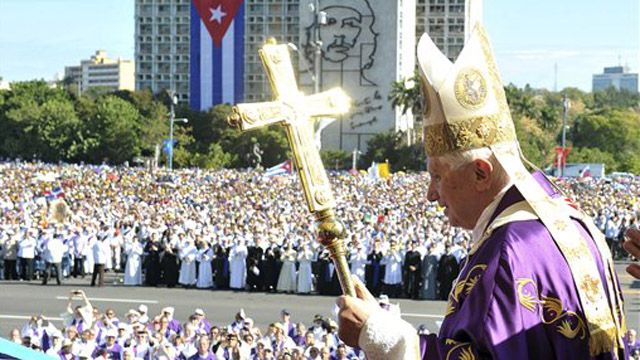
Lisa Sharon Harper and David Innes discuss the Pope's trip to Latin America
- Duration 19:46
- Date Mar 30, 2012
You're watching...
Lisa Sharon Harper and David Innes discuss the Pope's trip to Latin America
Also in this playlist...
Auto-advance: ON
Auto-advanceThis transcript is automatically generated
And welcome back was reported the headlines one of the largest student religious groups at Vanderbilt University.
Will be leaving campus at the end of the year in a dispute over the university's nondiscrimination.
Policy.
Is the university waging a war on religion that's the first topic for the -- panel today.
In DC at least -- Sharon harper she's the co author of left right and Christ.
Evangelical faith and politics welcome Lisa.
Thank you good to be here and here yes that -- -- -- and here in new York daily and is the other co author of that same book and he's here and -- in this studio with me how how you doing.
There is left frightened perhaps.
You know from the veteran universal went -- I want to ask you to question what you respond first police activists -- the -- Vanderbilt University issue.
They have is nondiscrimination policy now that is in place.
That says all student groups must accept every student and that every -- every student group must be eligible.
To be a leader in the group.
Just your reaction to do.
The policy first of all but then also to the Catholic groups saying it's going to sever its ties with -- -- -- university.
Let me just first say that you know we think characterizing this as a war on religion and let me just say this is not a war -- religion there are countries all over the world.
Where Christians are literally hunted down and killed because of their face.
This is not that this is not -- this is not that.
What we're talking about here is we're talking about finding a proper balance what is the appropriate balance between both clauses in the First Amendment.
Both the freedom of conscience clause and also.
That the difference doubtless -- have religion.
At any one religion in our society and so with that in mind the Vanderbilt case is interesting I mean at first personally I was a student intern ranks of the Christian fellowship and on -- with them for ten years.
And I'll say that there are real needs to have.
Religious based.
-- demarcation of of how we actually chose our leaders.
And there aren't even in the Bible there are different ways that the Bible says this is this is -- -- leaders should be chosen.
And so we tried to go according to that -- is definitely buyer face so.
I think -- this might be an overreach by Vanderbilt.
I definitely do I think it does actually prevents.
Religiously based organizations.
On the campus from exercising.
They're free and they're their freedom of religion that they've interview room with them.
-- -- Well that I don't think.
The First Amendment has much to do with that this isn't government action this is this is a university.
But I I think what you're seeing is the -- didn't moral -- -- -- -- university toward radical egalitarian system.
Pressing forward -- it can't it can't be here.
People -- it with other points of view from that but but I think it's safe to historic problem.
Of -- politics to the extent that it.
It distances itself from -- it makes it doesn't value liberty.
Wanting to conform everyone to its political orthodoxy so like -- people in the sixth in the seventeenth century.
-- suffered terribly in Scotland.
That king wanted everyone to affirm that he was the head of the church its golf and anyone who didn't take an -- Affirming that -- was hunted down and killed and -- the Catholic has happened had the same problem under Henry the eighth.
Politics is -- -- to the extent doesn't embrace liberty and there's that you -- seeing the same -- a political principle.
Being pressed on these people how dare you not embrace these political principle of both of non discriminatory radical egalitarian it's.
But don't let nobody cared about the nondiscrimination.
The discrimination that was sort of in these groups and in this sororities and fraternities certainly a hole that that.
That system in -- can you can't have everybody in.
There's just there's there -- certainly some practices that these groups of uphold.
But it started with the Christian legal society when they -- when they expelled a -- because of their religious ways and that was the tipping point and the whole issue of religious freedom is really not the issue and in a sense of what I'm hearing is it really Isabel this particular issue.
I mean and Lisa do you see that I mean is she -- -- -- you know let me.
Abortion is very controversial but nobody would have create a policy over this over abortion.
Do you do believe that.
Yes I do believe that I think that I mean I think that.
What we have to really come back to his what is the role.
Faith in society and the role of faith in society.
Is to ground us to give assists and seven or seven of a compass that points in the right direction -- my great moral direction.
And on campuses all over the country -- -- really these are serving that purpose.
We have a real.
Guidelines that must be able to be followed with in different religions.
And if that is corrupted than I actually disagree with DC I think this is a matter of of our our constitution because what makes us great as a country is the ability to have free exercise of religion.
And -- this establishment of religion.
So on that campus as the campus decides who can be a leader who can not it's actually it's it's establishing its own set of of religious rules if you will.
On that all groups have to follow and I think that that's wrong so it's establishing.
Maybe if their religion of secular rarity -- of -- of a secular religion if you will and that's just not that's not constitutional it's it's not how -- -- what makes it's great.
Right I evident what went -- -- subject we have it's up to this point is that that.
University of that event of a university is a private universities -- they're not subject to state laws but the Tennessee lawmakers are working to.
On legislation that would prohibit state universities.
And extending non discrimination policies to student religious group so obviously this state is engaged getting -- again -- to better developers say.
But certainly the -- of donates and our contributors to Vanderbilt will probably -- -- -- -- as well I would I would imagine.
But our second -- today it has to do Pope Benedict because he is wrapping up he's wrapped up his Latin America trip.
To Mexico and Cuba.
And what does this mean what does -- mean his tour mean for US politics and policies.
That -- does -- preset father -- was just very kind of talked about that but.
What is it what does it mean when you see the the leader -- -- the billion to billion Catholics.
In Cuba a country that doesn't have a great relationship right now if you -- the US and it was.
Officially atheist up until it's a little while ago weeks ago had.
Well I think this is really fascinating actually because what we find is that even in Communist Cuba.
You have a million Catholics in a million people of faith.
The Christian faith is is alive and well all over the world.
Christians are everywhere and and so it actually -- agreed to it is it's a great encouragement to me because I see that.
That even in a place where where religion where it was actually declared a secular stayed until just recently.
You know that even -- faith can drive but the reality is is that you know.
We know that's.
That that the real question is a question -- -- what is the kind of economic system what is the kind of governmental system that helps humanity to flourish.
And it's been proven again and again that that communism as a system and totalitarianism.
Especially does not help -- -- human spirit to flourish.
But I have to -- in America we also don't have a lock on that either you know we have the reality is is that our inequality in our system.
Is is also threatening the human flourishing in our own territory in our own land yet David -- even.
Think Lisa makes it beautiful point about the persistence of the Christian church.
Here it is in Communist China flourishing it was flourishing in eastern Germany is from pushing for 2000 years to tell you something about it's fortunate and -- -- -- But I do whatever is impressed -- -- what impressed me about the pope's message was he talked about liberty Emma but not just liberty he talked about liberty and love.
Liberty must be a means to our exercising our love and that's when you can't decide if -- was true flourishing.
Yeah I'm an at and I think you're right that -- that one of the things that I actually.
Fold this into is the conversation about the health and human services mandate and the Supreme Court.
Hearing arguments that challenge its constitutionality in this is.
I don't wanna say it's comparative to -- -- Communist Cuba but there is a sense that those who oppose the HH mandate are saying.
That government can't impose.
Something on its its citizens can't mandate it can't force them to buy something and a sense.
It starts to feel like.
The Cuban situation -- isn't saying that government has to -- is going to tell you exactly you know your parameters for a certain kinds of things.
Always a way I don't -- listening -- I'm actually saying that did America's turning like Communist Cuba but I think there's it is an interesting element here.
Police and I -- don't release anything of his farther away and you are right next to me at least -- Faith leaders have rallied this week for the -- -- mandate for the that the mandate itself but for the obamacare for the health care bill.
And they are in stark contrast with the Catholic Church has done is that they're really lobbied against it because of the mandate.
What and how do you see the space element of playing out.
Well it's interesting I mean I think that what would it really comes down to -- a question of what kind of society do we really want to be.
Just this week there's a report actually yesterday on CBS -- know the fox reported on it today a woman named Anna Brown.
Was taken to the high she she went to three separate hospitals looking for help for her sprained ankle.
She was -- homeless woman she was turned away from three separate hospitals because she couldn't pay.
At the end of the third one they actually arrested her because of for trespassing.
On -- on private property.
And then she -- they took her to jail and fifteen minutes after they locked her in that jail cells she died.
Because of blood clots that went from her -- to her lungs.
That's unnecessary this is a woman with a sprained ankle.
Fundamentally the right to health care is really about the right to live it's the right to life.
And in our society.
Right now we have a situation where.
The only those who can pay for life gets to live those who cannot afford to pay to not get to live.
And I think that what we're looking at here is we're looking at the -- is simply if this is simple.
Necessity that those with the means.
Have the ability to take responsibility.
So that.
Not so that everyone.
Well not be strapped.
And and actually hindered in their freedom David David -- thing.
Well.
People on the left think that if the government does something means two things one it will be done well.
Too it'll be free.
And it's just not true there's seamless we -- according to cost when the government's in charge we.
The government rations somebody I read a story that somebody in southern Ontario where I'm from where they have government health care.
Went into the hospital some terrible morality and they said we can't take you were full go to that hospital she died in the parking lot.
There are restrictions.
On on the goods and society.
And it does matter how how we distribute them.
But you see -- happen here in America to them and what why do you think that happens here.
Until woman that as I understood it.
The people war ended in castle to emergency room and they are obligated to treat -- is that not right is that not true Lisa.
That actually that is true -- so it makes it all the more questionable why would she be turned away from three separate hospitals.
In Saint Louis three separate and the less time arrested.
For trespassing and all that she was doing with seeing my ankle is hurting this could have been solved with two.
Ask friends but the woman died.
-- bears investigation into have been right right that sounds bizarre that this doesn't happen all the time.
This is needed to happen all the time it does happen all the time DC and you know it does.
The reality is that in our country's 31 million that he or without its help in her ankles.
Thirty million people right now are without health insurance and that that's just unacceptable totally on the greatest country in the world's.
-- -- -- -- David rings -- -- really actually an interesting point is that there are probably a lot of young people who are those who could sort of speed of strap on -- and -- -- your belt and actually pay for.
Health insurance and they don't within the other side of that there are a lot of issues along with a health care system.
There's a lot of of over over over from overcharging.
The tort reform all of these little things that actually could have helped that the health care system and Lisa wouldn't that have been a better option.
Then just overall -- overhauling it altogether when that -- -- -- standpoint -- -- -- -- a better option.
Oh absolutely not if you only did tort reform than what you would have -- you would have a portion of the system that was actually address but you would not have.
Holds a whole slew of other other questions and issues for example if you just asked if I actually DC let me ask you because most politicians will answer this question.
What part of the mandate would you actually take away would you take away the ability for for -- parents did to.
Keep their their children on their health insurance until they are.
A lot older than they are right now which do you take away the ability to have people.
In short you have preexisting conditions.
That these things they can shorten life if we say that we are for life and we say that we are pro life.
I would think that we would want to do everything we can't -- -- the lives of fellow Americans.
Didn't want -- just that will quick as a way to move on to another playing good question presupposes that the government should be involved in in the healthcare industry.
At all Hamas and I think -- -- if they're that good he provided a lot more efficiently.
Through truly free market it properly regulated.
Than anything that we have now what that's on the table for.
Propose or that we just replaced.
No -- you -- a bit later saying there is you want it now I'm sorry guys need to say this.
DC what you're saying is that you want to put it.
People's hands in the hands of the market so if the market says that the price is too high and these people can't pay it oh well.
That's what you're saying.
On the market as a way providing for the good products at a at a fair price and but the market -- not guide the market as a market it has not gotten he was saying he's not the government's not -- either and I think that's -- -- you -- -- you when you -- -- -- -- -- -- -- possibility.
You're right the government is not got but the government does have eight intrinsic responsibility.
To make sure that at the very least.
That that the basic needs of its citizens are provided for and and and protected and life is the most basic of the -- Okay Lisa let's move on and accept it because they gotta -- I -- a couples a couple of minutes they were talking about how religious is your state of the recent Gallup poll shows Mississippi is the most religious state.
While Vermont and New Hampshire in the least what do you make of these polls because.
This actually has implications in the campaign of 2012.
It is in essence -- -- -- -- question because.
You know what I hear someone you know who is self professed to be religious and -- and a poll taken in her living room at home.
You know I think that's great but I don't necessarily trust that.
You know the book of James tells us that True Religion is True Religion is taking care of the orphans and the widows who are in distress and so I think we really should be asking.
What states actually have the lowest child poverty rate.
And when you look at that.
Mississippi -- self professed itself to be the most religious state actually has the highest child poverty rate at 33%.
And New Hampshire who came in on the on the bottom.
Has -- lowest child poverty rate at 10%.
And so I -- so I say you know it's not about the religions that -- professes it's about the religion someone does get.
David your.
Your thoughts on the well it's interesting that.
And -- James passages and seeing it sounds like we -- you transfer the responsibility for religion to a secular government and take -- away from from people as far as health -- is concerned.
Back -- not at all well not at all the incited me to get us off track.
But -- is -- -- S that -- Mississippi one of the poorest states in the union and and it's one of the most religious states.
You you give people lot of wealth and they tend to two veer away from religion this is this is this is well known.
But at least we're devastated by -- -- the wind is gonna close pretty -- -- I think he's -- luxury nameplate and police Sharon harper.
Author of right left left right and cry and price left frightening crash K great thank you so much to me there's a -- right there about -- Provide.
One of those things that I wanted to -- when Lisa was here and I am sorry that she's we -- athletica.
This because of the technology that we've got here.
But but one of the issues though in terms of you saying that in -- government's responsibility to care that the poor and that there are more.
-- pour in for children in places like Mississippi.
And some of southern states have been mentioned here so those religious states.
One of the other things that we also know about the -- -- that one of the great.
Indicators of a child would be improper property is if there's a father of the household there's not a problem household so there -- social aspects to the poverty.
That a simple poll like this -- not address.
Yes I don't know what the state of the family is in Mississippi.
But we know there's a lot of poverty there and it may be that because there's lot of poverty there there's a lot of government intervention there.
And then that results in in.
The broken families -- or something of the sort.
I -- -- The -- what is -- -- head -- the the family research council Tony Perkins I was meeting with Rick Santorum other pastors and he said.
The crisis in this country are some of this effect.
The crisis of the family.
Marriage.
And things of this sort of socialism.
Conservatives evangelicals are not talking lot of us could socialists use these days but they're always there.
And as yours as he says social issues pertaining to economic issues pertaining to health care that -- to child poverty there.
Serve and then I think at a prison time yeah I think there's a -- of you if you start dealing with the the manifestations.
Of the foundational problem.
It will never get fixed and if you deal with the foundation.
You'll actually get rid of some of these -- problems with about Scandinavia if the issue is you know even.
Children not having their fathers in their household or the children being born out of wedlock I think that the numbers like seventy plus percent of of the African American children born out of wedlock.
And the numbers are rising for other races as well that's a situation that you gotta look at.
-- I think it's a national security issue we should have a whichever.
Government agencies that or office that examines every law for its effect on the family.
A for the sake of our national security for the sake -- our our our economy and for the sake of of the people the governor supposed to serve I think.