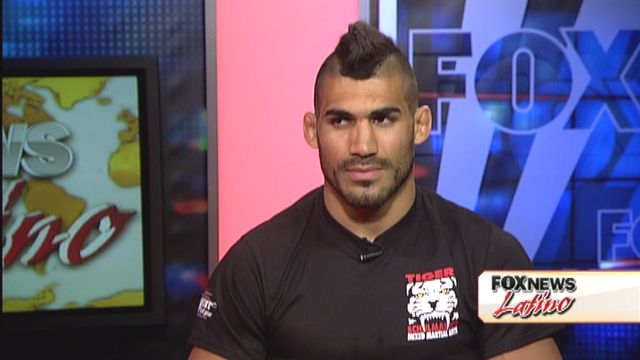
You're watching...

Lyman Good on his Upbringing

Details

  • Description

    The former Bellator welterweight champion on his upbringing and how he prepares for a fight.

  • Duration 7:40
  • Date

Clips

Also in this playlist...

Editor's Picks

Auto-advance: ON

Auto-advance

Transcript

This transcript is automatically generated

So lineman taught me you were born in Spanish Harlem here.

Going up with your mother two sisters.

How did you come mix martial arts.

-- -- for starters in I think the the atmosphere and environment I grew up in in Spanish Harlem was the big reason behind it.

And it Duffy takes a lot to be able to kind of thing notes -- a lot of the things that are predominant.

In an area where it's full of violence gangs drugs you know.

It takes -- flattered to be able to say -- -- those things especially when you're young and there's not much else to look forward to -- other than those you know those things that are.

So -- -- but it's an adaptive and to become part of for me it was a really is as far as being a fighter and the ring percent mrs.

Moore I just saw myself as a fighter and life in general you know a lot of other things.

Going on at the same time as far as not having -- people in my life to help me figure things out since my dad.

You know other things also that kind applied to that as well apply to that element of being a fighter.

But I think just circumstances that I went through as far as going up in the rough area like that was part of the reason why -- sort of became a fighter and you know not so much an arrangement.

It is you know in spirit in the night.

He talks a lot of you.

And your dad not so -- me tell me for somebody -- natural mother which in my life.

Seems like she's younger people -- -- tough you know I see my -- -- picked the epitome of strength.

You know I look at the things the things that she went through as far as -- single mom and her being able to raise three kids on our own single handedly without even showing -- -- of effort on her face.

You know she goes through things and has so much will and so much heart and desire.

For her children that she did everything without even expressing a single ounce of pain in her face and I see that as a source of strength for me.

I see that as a reason why I should grow up to try to be the best they can be -- good sound for her.

-- on -- -- partner for her life is lot of help her become dislike a show on its own person you know not just her but the -- as well.

Now this is this isn't life taken all we talk about -- -- this is because Nielsen said that you're a living Spanish Harlem -- -- -- living in the same house and you grow up there.

Besides that he traveling slots.

Prior to fight I am kind of traveling around some -- -- one single place percent.

But three months -- before a fight I'm sleeping at the gym -- train out of the New Jersey.

Outside of that -- -- fight it in on site then I'm pretty much is staying in there and Spanish Harlem.

You know kind of traveling around here and there -- don't really have a particular place that I call home.

But if you -- you know Spanish Harlem is my home matches.

Because it's a place that I grew up and I think even if I live somewhere else but -- -- -- another state another country.

And it was considered Spanish Harlem as a big part of my heart you know because it did become a reason and it -- -- sense -- -- -- -- today.

Let's go from family to the cage you became the first -- -- welterweight champion 2009.

Loss of title 2007.

To -- Oscar.

Well my question he really is are you looking.

-- that -- Certainly -- you know there's a lot of lot of thinking going on you know behind the scenes as far as he wanted to have that retribution -- go out and try to claim my belt again.

But I think -- caught up too much an idea of China you know just go for gold is something monetary or something you know just kind of like an object.

-- kind of lose my name reasons for what I'm doing what I'm doing.

You know I think if I just go out there and his.

Always try my hardest and -- -- trained you know at my best and always have been same mentality I've always had.

Even before I was a champion I feel that though ultimately lead me to become a champion again.

Toss it -- prepared for -- you've been known to be doing some pretty unorthodox.

Comes prepared the next flight.

Mean we're talking sleeping in the cage for several weeks at a time.

Why did you do it and how does that actually help you.

They -- makes a -- and what their physical capabilities are in the cage.

It's more mental than anything else 10% of it is physical.

Because everybody's flesh is the same your blood as the same blood that runs through.

My -- the same as my opponent everybody has bone and flesh and that can only be pushes that limit -- -- human.

The mind is very flexible it's something that really tests the full capability of a fighter.

And I think when you do unorthodox things such as sleeping in -- -- -- kind of mentally prepares you for a fight.

I think for me particularly just made me very very aggressive very dominant almost like a dog.

Who's been locked in a cage you know and -- kind of rattling the cage every day poking at it.

And they let it out you know -- is gonna become very territorial.

So to me that was kind of like my thing as far as sleeping in the cages very meant to form -- preparation for the fight.

Which I think is a very big benefit going out there if you had to go toe to toe with one -- right now.

It would.

President took my belt than -- because I notified -- could -- one.

But you know I think the reasons.

There -- circumstances surrounding.

My performance that thing.

And on top of that you know you always want that rematch against that person that's kind of like -- stories that's going -- you -- you know you could beat somebody please.

Didn't perform the way you wanted to that night -- in my circumstances.

Just you know I think a lot it was injuries because those had -- my shoulder separated shoulder and torn pec muscles and everything.

And these kind of leading up to -- -- -- sitting in the back my mind as far as how well might do against somebody has caliber.

You know so.

It kind of mentally lake took away from -- -- -- -- -- little mental.

-- Garza went out there and I do what I could you know but just out of one in have that revenge you know that retribution you still always want to go back if I depressing you lost to before.

So why does putting more of the emphasis on the injured and on the fighter -- fought for you loss.

-- I've put no reasons other than you know I don't blame anybody but myself as far as loss I would never say.

You know I lost as it is -- that it's still fighting doesn't matter and I had a lot of -- to prepare for the fight so in the end it's really just he was a better fighter that night.

You -- also very passionate martial arts shrugged.

And it's something that she did so.

Do you enjoy -- huge -- -- coaching part even more than fine.

There is a pleasure to be having both.

You know it's very different because to be a fighter takes being selfish and to be a teacher and instructor tasting selfless very giving and to have a certain level of confidence in yourself.

To wanna bring other people to be even better than yourself ninety I think that takes -- certain type of person -- to do that.

People who -- use only selfish and if so selfish.

As soon a bad -- because that's not a bad thing.

But to be a fighter you have to be selfish I think about you have to put -- -- aside friends aside you know indulgences aside everything has to be about.

-- -- in your preparation for the fight.

And obviously you can't have a mentality as an instructor and an -- -- you have the sole existence for others as opposed to yourself.

Sounds like it's more but that's really who you are.

For others.

Seems like that's -- line.

It's -- fair statement.

Yeah but I think that's that's because of camera you know that -- -- also hope raised and my mother Romo is.

You know there and -- -- and be difference it's kind of like this part of my fabric from wire to natural thing.