You're watching...

Is President Obama vulnerable?

Details

  • Description

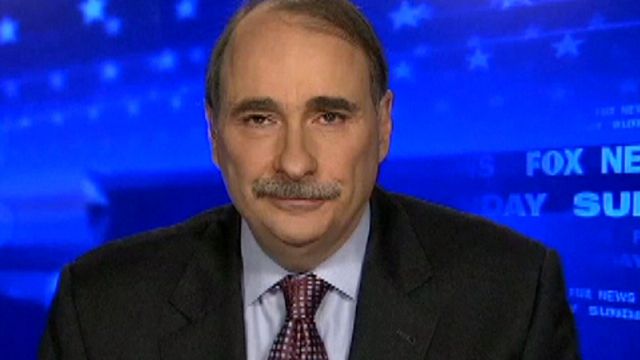
    Obama chief strategist David Axelrod on 'Fox News Sunday'

  • Duration 13:20
  • Date

Clips

Also in this playlist...

Fox News Sunday

Auto-advance: ON

Auto-advance

Transcript

This transcript is automatically generated

And hello again from Fox News in Washington.

First I want to thank all of you who sent me notes on the loss of my father.

Some of you had that my dad for a moment summit watched him on television for years.

But he meant something to you and your notes that meant so much today.

A lot more on my father later in the program.

Now on to the 2012 battle for the White House would shifted to the general election this week.

When Mitt Romney became the presumptive Republican nominate.

We'll talk -- one of his senior advisors in a moment but first the president's chief campaign strategist David Axelrod is in Chicago and David.

Welcome back to FOX News Sunday.

Thanks Chris and let me have my condolences.

To all the others that you've you've received my sympathies are with you and your family thank you thanks so much I -- -- start.

With what Barack Obama promised back in 2000 -- You don't have any fresh ideas.

That you use stale tactics to scare voters.

It if you don't have a record demand none.

Your opponent is someone people should run from a.

And here is what President Obama has been saying recently about the Republican budget.

Budget so -- -- the right it makes the contract with America look like the new -- is really an attempt to impose.

A radical vision on our country.

It is thinly veiled social -- Bironas.

This from the candidate of hope and change.

Well Chris come on and.

You -- bad to say that you don't want to.

Engage in empty scare tactics is different than saying we're gonna take a look at the proposals on the other side and critique them.

That's what campaigns are about.

That's what democracy is about the fact is the Republican budget.

Is the wrong direction for this country more massive tax -- for people at the top more cuts in things that we need to grow our economy like education like research and development like energy.

More cuts in our basic Soviet social safety net so child care tax credits education.

Credits for our kids.

This is not the direction our country should go to so of course we're gonna critique that that is part that is part of the process and it is a legitimate one.

There at that that's absolutely true but when you talk about social darwinism.

Radical making the contract with America look like the new deal.

First of all you don't know that it's massive tax cuts for the wealthy because and this is a fair criticism but -- Ryan budget they say that they're gonna come up.

With closing loopholes for the wealthy.

And when you talk about these massive spending cuts the fact is all it is doing is reducing the rate of growth and spend.

Listen Chris.

A decade from now we'd be we'd have a third less spending for example.

On Medicaid and that will hit people -- disabilities it will hit people in nursing homes very very hard millions and millions and millions of people.

Will not be able to get the services.

That they need in terms of -- -- -- yes they say that there will offer offsets we have not heard one.

Offset the president has proposed.

Closing of loopholes we have not heard that.

From my congressman Ryan and the Republicans so you know you talk about hope I guess your hope is that they -- Before it's coming sometime in the future but the fact is we haven't heard them.

In the last week the president has made a couple of major speeches and devoted his entire.

Weekend media address to the buffet rule when the president introduced.

The buffet rule last September he said it was a matter of fairness and and this is the -- we also stabilize our debt and deficits.

For the next decade but here's the math the Buffett rule that millionaires should pay a minimum tax of 30%.

Would bring in 47.

Billion dollars 47 billion dollars over the next decade while the president's budget adds.

Six point four trillion dollars to the deficit over the next decade.

David according to one asked him that the money would GAAP.

From the -- role would cover just seventeen days.

Of the increased deficit under the Obama budget.

First look -- the the president's proposal.

In total would cut the deficits by four trillion dollars over the next decade and put us on a path.

To where they have the -- -- stabilized and were able to to manage it where where it's just 3% of the totally economy which is where everyone agrees we need.

We need to be in terms of the Buffett rule I remember when 47 billion dollars seem like a lot of money it is a lot of money.

There is a question.

When you reduce the when you eliminate the bush tax cuts of four the very wealthy that adds another.

800.

Billion dollars so this is a piece of a larger.

The larger pile along with one point five but really you outraged it's been great about -- now look let let me tell you something Mitt Romney is out there arguing that we should cut.

Planned Parenthood because we can't afford it funding for women's health programs because we can't afford it that's 300 million dollars a year he says we have to cut foreign aid.

By a hundred million.

Dollars a year.

And that's because of the because of the deficits.

So you can't argue it both ways this is a significantly -- There -- there's going to be a lot larger in my my budget if I may David I am gonna get into a lot of that would that the last in the next segment.

But you would certainly great that when the president introduced at last September and he said the Buffett rule would -- stabilize our debt and deficit.

Over the next decade that wasn't true.

Know what he said was it is part.

Of an overall plan that will stabilize our debt and deficit that -- -- -- -- what that nobody can argue nobody nobody can argue Chris.

Nobody can argue that it makes sense for people who are making a million dollars a year or more.

To pay less than the average middle class worker in this country so it both helps us stabilize the deficit and ensures a modicum of fairness in our tax system well and -- if they rely mr.

Gillespie and you want to argue otherwise.

Then I I -- that so -- it.

But for those 47 billion dollars had -- into -- hilarious.

And an app on your questions for Ed Gillespie I -- to have to ask you some questions you just talked about the president and that is not fair for rich people to pay a lower tax rate than middle class people the president introduced as are released his tax returns this way.

It turns out that he paid a tax rate of 28 point 5%.

Which is a lot less than the thirty presented talks about a -- -- it is lower than what his secretary pay is.

And the question I have not fit if -- hey David the the question I have for you is if the president feels so strongly about tax fairness.

Is he going to contribute.

Money too -- to the treasury and have a special department just for this to help with a deficit.

Listen -- first of all of the reason that his tax.

Rate was so low was in part because 22%.

Of his of his income was donated to charity mostly to these Fisher houses around.

Veterans hospitals so.

That Enron make and -- a lot and Jared yeah well that's nothing yes but they're not not not -- and yes but but there's no proportionality.

-- but here's the larger issue.

The president's proposal would have him pay a higher rate of taxes in the future governor -- his proposal would have him pay a lower tax.

Rate in the future so.

That's fundamentally different we're arguing for a system that is is is fair.

He is arguing for a system that would exacerbate the great gaps that we have in our system.

Today so I don't -- not gonna contribute money -- the drive straight up with a deficit assuming that's not the way we operate our.

Our tax system okay if we don't run bake sales it's not about volunteer -- we all -- -- According to the system.

And the system allows that look I -- the fact that Mitt Romney pays 14%.

On twenty billion a twenty million dollar.

Income is not the issue the issue is that the system permits it and he would perpetuate that and he would enhance it.

Let me turn to the economy three presidents.

Have sought a second term since 1976.

Let's look at their economic record.

Jerry Ford had unemployment -- seven point 8% and GDP growth of five point 4%.

For Jimmy Carter unemployment was seven point 5% on growth minus point 3%.

For bush 417.

Point 4% unemployment 3.4 percent growth.

The latest numbers for Barack Obama eight point 2% unemployment.

And one point 7% growth in other words this president.

-- the worst unemployment rate in the second worst growth rate of those four president's given that record.

Why does he deserve reelection.

Well first of all I think.

You ask me that same question about seven or eight months ago and the numbers were.

-- were much higher than that and obviously we're where those numbers are coming down.

We have created -- there's no doubt that we walked into the greatest economic crisis since the Great Depression everybody agrees on that in the six months before we took office.

We in the country lost four million jobs in the several months after that the country lost four million jobs in the last 25 months.

We have seen four point one million private sector jobs created if you look at the bush recession which was much.

Gentler in 2001.

That began in 2001 in the recovery from that recession.

What we've created seven times as -- many jobs.

In 33 months in the last 33 months.

Than than he did in the end after his recession so I think people look at where we -- And where we are but the bigger issue Chris.

Isn't where we -- where we're going and are we gonna create an economy in which the middle class can grow not shrink him in which wages are growing.

In which hard work is rewarded responsibilities reward and everybody from main street to Wall Street plays by the same rules.

Are we gonna make the kind of investments we need to get that sort -- -- value education research and development or are we gonna shred that and just have an economy where people at the top do very well and every.

-- -- -- -- -- -- -- -- -- -- -- -- -- -- -- -- -- -- -- -- -- -- -- -- -- -- -- -- -- -- -- -- -- -- -- -- -- -- -- -- -- -- -- -- -- -- -- -- -- -- -- -- -- Fox News came out with a new poll this week I want to put up on the screen it shows Romney with a slight edge over the president although they're basically tied.

And the president's approval -- it back down to 42%.

With 51%.

Disapproving.

Even win all the batteries that.

Romney has taken during this long primary season he's basically running neck and -- with the president.

And and -- guy as at this point well below the the 50% approval reading which is generally considered crucial.

For a president seeking reelection my question is isn't Barack Obama very vulnerable.

Well I don't think we -- spend a whole lot of time on your poll Chris because in February.

You had the -- -- the partisan spread was eight points different than it is now and unless you believe that there are seven million less Democrats in America today and six million more Republicans than -- -- In February I wouldn't put much credence in the store for other public polls that I had a much different result in the same month time period Spezza and by the way in your poll.

The all week we're we're we're you have is plummeting by doing better among independents and we didn't February there isn't a person in America knows -- about those who would say.

That could possibly be true.

That said -- we've always said this was going to be a close race it's a closely divided country.

We won 53% of the vote in 2008 with the wind at our back of course it's going to be close.

But at the end of the day I think the American people.

Wanna choose a vision that holds out the greatest possible.

Opportunity for them and for the middle class they wanna see our economy rebuilt in a way which are not bad but that battle that will give them their best chance -- and I think I'm -- that's not backing not go back to the policies that got us into this mess.

In the first and that has that's about as Daytona -- -- this planet I want to ask you in the final question I'm out in one paragraph two or three sentences.

What's the choice in this election.

The choice in this election is between an economy.

That produces.

A growing middle class and that gives people a chance to get ahead in their kids a chance to get ahead.

And an economy that continues down the road we're on we're a fewer and fewer number of people do very well and everybody else is running faster and faster just to keep pace we need to take that first -- that is that honors our our fundamental economic values the values that made this country great and we need to do some things to promote that kind of economy we can't sit back.

And and go back to the same failed policies that -- so disastrous.

In the last decade -- right.

We're gonna have to leave it there David thank you so much for joining us here.

Always a pleasure to talk and I gotta say year old Arctic -- are in mid season -- general campaign.

Form and I just want to also said he has to go around and listen to our interview would -- Gillespie I think you'll say it's fair and obsessed.

The -- -- saying -- my regards to -- well.