You're watching...

There's gold in them there...asteroids?

Details

  • Description

    Dave Brody, Jeremy Kaplan, and Jon Scott discuss the likeliness of this exciting space venture

  • Duration 7:31
  • Date

Clips

Also in this playlist...

Editor's Picks

Auto-advance: ON

Auto-advance

Transcript

This transcript is automatically generated

He's dot com Dave when I saw the headline this morning about this announcement I thought this is not -- But there might be some possibilities here as -- if.

You were living in 1955.

And somebody said in thirty years you're gonna have a pocket computer that will basically bring you the library of the world.

Would you thought that was nuts yes.

So -- a struggle and I.

And let's not think we all suffer from having grown up with a space program that's that's proceeded in a particular way.

And just like to mainframe computer business was the only game in town all of a sudden someone came along and said.

You know we can put some components together in the garage and do some things that normal people -- wanna have done that industry doesn't need to have done right away.

And -- paradigm was changed -- revolution was begun.

This could be could be.

The beginning of a similar revolution in how we do space so we're talking about essentially privately funded up a privately funded venture.

And the indications are that they're going to announce sending rockets up sending mining equipment up.

To asteroids and mining asteroids like other asteroids and and there are restaurants there are great big -- that live in a belt between Mars and Jupiter.

And then there are some smaller ones that are called earth approaching -- -- near earth asteroids.

These are the ones that could come and give us a real headache -- ones whose orbits cross -- -- So that's both that is of goodness.

And that is as they crossed over to the earth the good news is there an earth like.

Corporates which makes it.

Very economical to get to to figure out what they're made and to bring things into useful or it's possibly even all the way to the ground with -- -- And -- at an economic goal is a relative term it -- and it makes it less inconceivable.

That we could get to them.

However they are still flying it that's tremendous speeds we've never been -- -- before.

And it's going to take an awful lot of technology.

And innovation to -- -- do -- that's said.

There's a lot of potential there there's -- minerals that barely exist here on earth.

They're the repositories we have of these things they're called rare earth minerals exists on earth because of -- impacts.

So we have a tiny amount of them here there's a vast amount of them flying around at supersonic speeds twelve of them here here is what.

Again I've.

Read the article hurt initially with amusement because they talk about.

Sending asteroid or sending out spacecraft up to -- asteroids for things like iron and nickel and water even we have.

Any of that stuff on -- yes we do what we don't have a phone in water and space.

So if you want to expand into the solar system if you want to become a multi planet species you wanna build your own habitats in the states who have built Las Vegas.

-- is an entertainment destination.

The critical factor is the critical things missing is water pipeline but on earth.

But it cost you an awful lot to build great big rocket to move.

The amount of water off the surface of the earth out of the deep gravity well versed in someplace where you can use it in space.

These objects are extremely tiny they have virtually no gravity well as I mentioned they are an -- like or that's.

So they're really easy to move that -- from where it is.

Where you want to be.

And maybe where you want to be is where they already are.

Maybe you wanna go to one of these targets change -- from its rock like -- to something that looks more like Las Vegas in orbit and popular hit all right so who is talking.

About doing this Jeremy who who we have backing this mission.

Well the adventures called planetary planetary resources ink we don't know very much about it were all everyone's looking forward to learning in the next couple minutes -- -- watching your live of course.

Newest backed by a guy named Peter -- you -- -- a very very well known.

Space exploration guy we -- had a bunch of big names attached to it although what they're doing exact hearings to be seen some of the guys from Google.

Their names and put it on there Larry Page Eric Schmidt from Google and James Cameron of course who Titanic director of the UN declaration -- him right.

Beyond that's.

What's gonna -- we know is NASA.

Astronaut as well.

Tom Jones on -- -- yes.

Analysts TJ and before it was an astronaut and before he flew B fifty -- with the nukes under the -- He was on believe it is gradual working illustrates that is I think -- University of Arizona.

So TJ comes by this honestly I think this is a lifelong passion.

For him and he's not on an act of NASA astronaut anymore but he's relatively young guy.

He could presumably be on -- human critical isn't this an asteroid some day.

Well these guys talk about -- not human missions to asteroids yet they're talking about robotic missions which probably -- we wanted to hear objections here.

All right so let's -- -- -- robot up to catch an asteroid and you know what speed are these things moving path and do we even have the capability of intercepting.

Well -- -- pretty good clip to through space right Texas only 365.

And a quarter days to get all the way around the sun.

In orbit with a diameter of 93 million miles so we are all else.

I suppose this subject right and -- will be the moon it's orbiting Lawson as we orbit.

As we orbit the sun.

Asteroids are in -- newer ones that these concerts and all of -- that are similar to the earth so it's exactly like to NASCAR.

Drivers.

Had very high rates of speed but the relative velocity between them is very very slow.

-- so you use that speed to.

While you have to objects that are traveling an enormous rates beaver relatives -- each other and everything is -- in space -- it is not such a problem.

The delta -- the change in velocity.

You need to get from one to the other is that closing distance between right.

So this now becomes a much easier proposition than you think it is despite the fact that everything is with America this -- -- what I will say his.

When you change the massive amount to -- -- -- one wants to be easily be really careful about how you change the mouse of an object that already crosses the orbit.

Here and there may be some regulatory questions.

But come into place amusements when this becomes practical I think what these guys are gonna tell us today is personal agendas are gonna look.

Because if you are prospector you want to characterize -- population stuff that's out there so they're going to fly on private telescope.

-- lower carbon telescope easy simple mission to -- look out there and see what earth approaching asteroids have we not identify.

Specter graphically one might think you need.

And will they share that data with the science community as massive as we don't know if they're -- In -- safe you know our claim are asteroid because -- we'll find out about it.

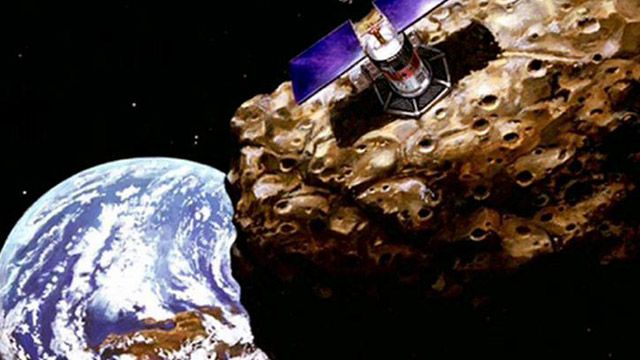
Do you -- here is an artist's rendering of what this might look like there is the good -- earth in the background and some kind of an astronaut asteroid in the foreground.

And with that -- -- looking.

Well I guess its -- remote mining device sitting on the surface.

Not a very big asteroid or maybe it's a gigantic space craft -- -- Really -- well that's the point you probably don't want to deal with a gigantic.

One you only need a little wanted to make a lot of money that's what I think planetary resources business cases is based on.

It's somewhat analogous to what the oil industry does strike oil industry.

Invested billions of dollars in.

Robots to prospect the floor of the -- so that they can dig down below the floor of the ocean.

Thousands of meters in order to haul up petroleum reserves that they think are there and I wildcat this is -- -- --