You're watching...
Feeding America: The current state of US hunger
Details
-
Description
Ross Fraser on how the program's launch is helping them keep their local food banks stocked
- Duration 10:40
- Date Apr 27, 2012
You're watching...
Ross Fraser on how the program's launch is helping them keep their local food banks stocked
Also in this playlist...
Auto-advance: ON
Auto-advanceThis transcript is automatically generated
Okay let's move on with a very important topic in a way to I want to recruit all of you to help this morning so I put this out their first and then talk the guest.
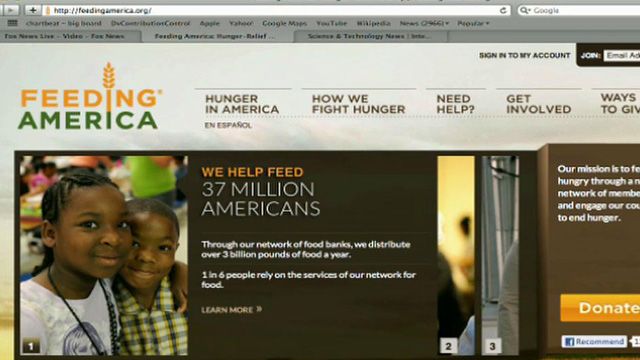
The website is called feeding America -- war.
And it -- the current state of US hunger.
Joining us now to talk about it -- -- the Ross Frazier he's the director of media relations for feeding America good to see you Ry good morning to you you having me on here absolutely.
First of all when you talk about the state of US hunger.
What is it all right.
We're -- and the people who are food insecure.
Polluting -- -- secure food insecure.
Which is -- -- in the USDA uses.
And basically that means people who do not have access to three square meals a day.
And that they're putting something in their stomachs but it's not always the best food for them not nutritious food often needing food that -- and fat and sodium so we want to make sure that every one gets has access to adequate amounts of nutritious food.
So what we're looking is we have a network of all the food banks in the country.
-- here in New York City harvest and the food bank for New York City.
It any given that we we have about six million people.
Who come to one of -- the food pantries -- soup kitchens that we provide food to six million people here in America.
Week after week.
We're we're going to see about 37 million total people come to us for hope this here.
So there's enormous need.
You know who else is healthy lives millions of -- longer.
It's interesting when you look at the numbers I -- many of them are our children so I wanna be careful when I compare Arkansas I wanna do apples and oranges my.
I I'm wondering if when we look at numbers -- we see that unemployment number loom above 8% do you see a difference in that term absolutely are.
Demand for food has increased by nearly 50%.
Through in just the past four years so in other words we were.
Well.
-- -- five million people a year now we're treating 37 million about seventeen million of those are children.
If you look at the food stamp program about half of the recipients of food stamps -- children in households with children.
So there's a tremendous need and where we're deeply concerned about children especially.
Because if there inadequately nourished as young children they don't develop properly.
So lack of nutrition can -- their and their mental physical and emotional development in ways that could never be prepared.
While.
-- he gave me the chills when -- -- a 50% increase in demand for food up for the past four years.
So -- for for many reasons you're hoping that the unemployment numbers come back to normal.
Because that's a lot of people to -- what about the ability to feed them has that changed.
Well it depends on where we are where you are geographically what -- the worst areas with the highest the worst areas are in the south.
Unfortunately in the you have so so minister poverty right you have the most poverty.
Poverty and hunger are not synonymous but when you have areas with vast poverty what -- what I think would surprise people is that.
In rural areas hunger is often more prevalent than it is an urban environments in the big city.
And where they can grow -- where they can grow through because it doesn't make -- so well because they can grow the food but they're -- we've got the food that's being grown there.
-- you how to you know areas where you have counties where.
There are few jobs or the jobs and pay a lot of money you have a lot of people who were underemployed or unemployed.
And then getting services to them -- an event.
Because you're serving people in sparsely populated communities.
Here here in New York City it's much easier everything is condensed you can walk through food pantry can -- -- -- -- you can take the subway well you can eleven Mississippi.
Let's stick with the rural -- for just the second farmers are now getting involved in a new campaign to fight hunger in rural America though so there is some rescue.
-- -- -- -- -- -- Invest an -- and this is a brilliant idea what we're always looking for -- new ways to get more food to people so Howard Buffett who is the farmer and philanthropist.
Came to us and if you.
Works with our archer Daniels any relation medium yes -- -- Warren Buffett's there we go yeah.
And he hasn't foundation and he's worked for many years and with hunger developing nations -- he's become interested in helping feeding America.
And looking at domestic hunger.
So as I said rural areas -- the hardest to reach.
So what he came up with it is a program.
Where we're going to work with eighty.
And it's called invest in makers of a farmer grows thousand acres of corn he goes stadium to sell -- corn and says I want to give one acre.
Back to my community and so they earmarked one acre of corn -- -- -- or whatever we whatever it is and that's process that.
-- -- is donated that the proceeds from that go back to the community -- so it's if the food is grown in Macon Illinois it is about to make -- Illinois so -- -- literally growing food and that you're feeding your own neighbors.
How -- there's -- way for farmers to help the people who live in the community where the -- Ingraham that's amazing that's brilliant idea.
How we learn more about that particular program go to our website feeding America dot org and you'll learn all about invest an -- And how you can participate we're always looking for people to become hunger advocates as well.
If people can can volunteer if they can talk to their neighbors about hunger.
Or if they can communicate.
-- what's very important and our keeping the federal nutrition programs funded.
So if they can communicate with -- policy makers and legislators.
And tell them that they believe that we have a moral obligation to feed everyone at risk of hunger in America that will be much appreciate -- we.
-- live -- that's going on right now we're an interactive programming -- and I want it just.
Linden your two or -- all of them now.
Richard Brett writes government needs to stop hindering the farmers the stupid new regulations no food shortages so far jobs are the answer.
Put America back to work -- they can afford to buy their own food.
Charles -- says if you have a lot of money pick a Stanley.
Our -- several families to help we can help each other more than any government can -- help us get out what I'm hearing and I haven't heard anything and maybe I'm wrong -- This is not a government thing now I mean these are people helping people announcing this investor they had -- from.
-- feeding America is not a government organization we're -- everything and it's working.
No we're feeding six million people that's mainly -- This the government ever offered to help well we get food many of Newton mass.
I know you never gonna come by and see how it works.
That are.
Many of them do we have a lot of supporters and the federal government a lot of senators and congressmen who are big advocates and the work that we do.
We have others that we that we would love do come to a food -- food pantry and learn about.
The work that we do -- the people that we serve.
So there are various tremendous needs and many different ways that people can help in terms of food funds advocates -- except -- -- Bryant calmly in New York race.
And I want to -- comments.
-- the departments of agriculture and labor are trying to restrict farm kids from working on their own.
Family farms they just can't mind their own business actually that was struck down the president decided that they weren't gonna go down that -- yesterday.
Armed but rural America there anything we want to make sure we -- -- them.
-- -- -- -- -- -- How much would you say.
We need to do just in terms to get back to where we were four years ago I mean is it just about jobs are there are other issues at play here and we don't have enough land that we.
Yet it's about jobs -- -- where it's about jobs and that's about the federal nutrition programs it's about with this safety net.
You know there's a lot of talk in Washington about needing to balance the budget and reduce government spending.
And I and one of those things that's been talked about this cutting the food stamp program substantially.
And and we can't have that happen.
I think the food stamp program is often misunderstood by people -- the average benefit is only -- 132 dollars a month.
The supplemental program most people -- -- on food stamps for nine months food stamps little money back into the economy and so if you.
There there's an interesting argument if you have a a small town that's in -- deep poverty.
And you have a thousand people on food stamps and they're each getting a hundred dollars.
In food -- -- the 100000 dollars.
Coming into the all of you don't understand -- said about a 100000 dollars coming in the community keeps the grocery store opened keeps the people employee who -- at the -- -- Keeps the farmers who -- the aides to vigorously -- the man who's driving the truck.
So food stamps do benefit local economies.
And if we cut those we're going to affect that economy and people will lose jobs is a result.
Right now one in seven Americans are on food stamps.
Which is astonishing.
One in seven Americans -- This is an economy that in terms of where we've been in this country if that's some flinty old school 1950 -- it's been it was.
Again.
Bear in mind you know this is all -- mostly because of the economy tanking and there's been proportionate.
Good job losses in the economy falling many more people are on food stamps because many people need -- help.
We have won six Americans at risk of hunger.
And one in eight Americans this is astonishing one in eight Americans actually come to feeding America.
For help feeding -- themselves or their families.
At some point during the year.
Wow so at least once during the year -- maybe more than once families need.
Help again feeding America dot org is the web site.
-- Ross Fraser good enough to come by on this Friday and tell us how we all can help is there anything specifically wants to do.
Yes -- -- -- learning about hunger I want you to learn that people are hungry through no fault of their own.
That -- really exists in America we have a moral obligation to make sure the people at risk of hunger.
Can get adequate nutrition we need to keep the safety nets strung.
And if you care about your neighbors who were at risk of hunger you need to pick up the phone and call your senator and congressman and tell them that.
-- -- -- all right thank you summit here we're gonna take.