You're watching...

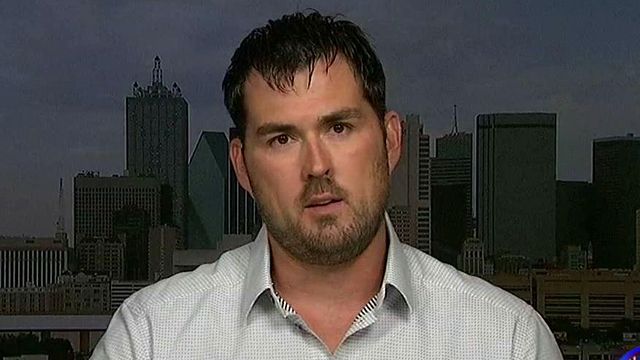
Navy SEAL recounts Iraq war in new book

Details

  • Description

    Navy SEAL recounts a gripping tale of sacrifice in new book, "Service: A Navy SEAL at Work"

  • Duration 4:44
  • Date

Clips

Also in this playlist...

Editor's Picks

Auto-advance: ON

Auto-advance

Transcript

This transcript is automatically generated

There's -- story segment tonight you may know that name Marcus look for all he's a navy seal -- the big best seller lone survivor which chronicles a brutal shoot out and Afghanistan.

When Imus show -- a new book called service and navy seal of war it's about Iraq he joins us from Dallas tonight.

Chris what would you do in Iraq Marcus.

Business as usual pop primary mission and -- and I reckless to disrupt that eliminates an activity.

Well you gotta tell us you gotta take is there because most people never ever beyond doubt Phil -- do what you did.

So you're trying to -- -- what does that mean.

In -- -- in the city is a lot different from fighting and in the and the mountains because Avery you have behind every corner every windows as a fighting position and basically we're an -- backyards and front yard that matters so.

You know urban combat is is.

And my opinion it was a it was a lot a lot crazier than up in the mountains.

-- US dollars to go out.

You we did you have to go into situations where you didn't know.

Who yeah in the mountains you know the enemy is there issue -- in the -- But you do you guys this you've got to kind of distinguish who the bad guys are from the civilians because of all that stuff.

That's a tremendous amount of pressure.

Right.

Stuff for the collateral damage the women the kids you know because they they intermingle in between and them all the time I mean it's not like they've pushed them aside -- -- battle gonna go down.

They they bring -- -- so that's one of the the things that we have to contend with and dynamics and a lot more difficult actually.

Now a lot of people coming back from both Afghanistan and Iraq a lot of service people very very well train service people having trouble adjusting back here in the United States.

Did you have any trouble coming back.

I did in the beginning -- -- the hardest part for me it was it was getting out I mean they they.

I got cut from everything that I knew you know that lifestyle that I -- -- you know -- Been training for since I was a kid and I've been around those guys and also and it's over with they get tossed out and today.

And in the civilian world which is is not bad -- is not that I'm I'm I'm not ignorant you know I mean I can figure things out but.

When you go from a pace like that and then it kind egg goes from a hundred miles an hour enough and you just kind of sitting there with.

With your head -- and trying to figure out you know what to do then and now -- to do -- so -- -- It's cause a lot of problems for a lot of guys I would imagine I don't get thing about it.

Beyond the rate is about 41%.

Post traumatic stress syndrome.

People coming back from the battlefield that's an enormous and I think we had that in Vietnam as well but they just didn't diagnose it as well that that.

That's that's an enormous problem is it not.

I think it is probably not -- got invaded.

The wars a lot of people probably didn't anticipate that the -- we're gonna last this long I mean you got 181920.

Year old kids who joined the military for college education and next thing you know there's -- -- there.

For ten years fighting a -- -- I think that might have have something to do it.

I will say this -- I mean you gotta.

One of the things that happen to me is is -- I got away from all the people who were telling me that I had a problem you know I mean.

If you sit around and listen the people telling you you know your messed up you know this is what's wrong with this is that -- -- I mean that's -- -- to get to you.

You know I -- completely shifted focus on my hand and and put my focus and my family -- -- what I was doing today.

The got to help me push through what I was dealing with and I am I gonna say that I got over an -- -- -- but.

When I have probably not talk to the guys and how I was over there with -- and you know we talked back and forth and maybe they know something that I didn't know they how they solve you know there -- issues in any kind of works itself out but yeah I mean.

Force that's that's pretty high ratio of you know it a lot of.

People suffering but I think you just gave them some good advice.

No try to get away from the naysayers warns that if you all in all this you do and it's.

And try to get in -- guys develop a network of support which is what they do NA and a lot of other things last question real quick.

When you're training in the Navy -- I mean -- obviously -- -- to be a warrior -- a train you to be as effective as possible on about a -- Do they ever -- you hate it it's all going to be over some -- when it's over you're gonna have to take certain steps to decompress did they give you any of.

At -- at all.

I absolutely and I mean -- They do a really good job what what with us I mean I was kind of a different case but for the most part only.

What after we train up we go out we come back there's a there's a big decompression time to time for us to -- To come down off the high and and and turn everything back around before they were kind of releases into the wild so that's one of the things is different between our community.

And a lot of the other conventional forces by the book his service -- navy -- -- markets.