You're watching...

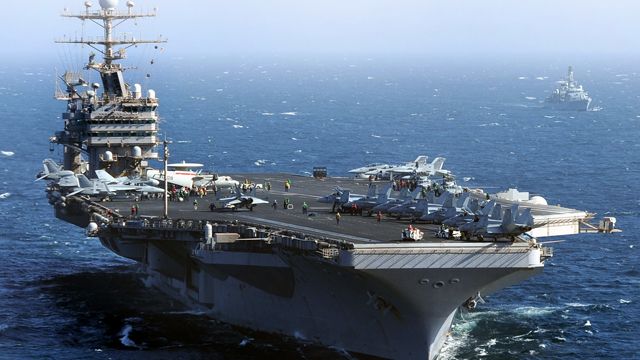
How budget cuts will change US Navy

Details

  • Description

    Chief of Naval Operations, Admiral Jonathan Greenert, on what's next for US fleets and partnerships in Asia-pacific

  • Duration 9:10
  • Date

Clips

Also in this playlist...

Editor's Picks

Auto-advance: ON

Auto-advance

Transcript

This transcript is automatically generated

I welcome back to Defcon three I'm sure its fleet week I was fortunate enough to catch up with the navy's top sailor and I met him aboard the US.

USS wants this that.

Amphibious assault ship another recess to ship that they navy sends.

To combat areas with Marines on board at this time the top navy guy was on board -- Jonathan greener -- the chief of naval operations.

And so when I -- -- -- his views on fleet week and the mission of the United States navy.

Have a listen.

And responsibility and buried under snow war.

And yet we all -- American -- for us here.

President lets you just say hi -- -- but also do it by trimming the budget and how does that affect.

Well.

We've got to be ready we got to be ready to today's -- today so what the way it affects me -- I can't he can't have.

-- -- -- So we've got to -- our our our fleet correctly and that's number one too quickly do we have today has to be ready and thoroughly it has operated forward.

So we have to find the correct innovative ways to beat out and about.

They say quantity has a quality all its but the best quality armed forces forward and that's that's what we work very hard.

-- -- -- -- -- -- -- -- -- -- -- -- -- -- -- -- -- -- -- -- -- -- -- -- -- -- Our national disaster whether it's a war here there -- absolutely and our focus is moving toward the Asia Pacific.

And the Arabian gulf we are still everywhere else but our focus has to be again Asia Pacific region -- -- sad that we are gonna start petting days are gonna look at that theater network futurist and at the same time -- anybody read the headlines these things as well potential crisis.

In the Middle East potential crisis and the first -- are you gonna do about.

Well we can't do both we are set in the Arabian gulf we we have we have thirty ships there today we've had thirty ships there for about 789 years.

As we migrate in through thirteen through seventeen as we build.

Through our fleet will have 34 ships -- -- we talked about its operating forward and innovative ways that make sense.

But also the Asia Pacific we have fifty ships there today we've had fifty -- -- about.

Ten years will have 59 ships there by the end of this decade so again it's it's operating hornets forward -- rotating crews.

Innovative ways beginning.

America's sovereignty and -- forward operating our our when I was on the right especially at a 600 -- maybe we don't today -- how we compensate.

-- hasn't gotten any small no it hasn't.

Well I would I served during that 600 ship navy and I would say we weren't nearly as ready as we are today with the ships that we have -- underway.

I'm very comfortable that any shift we sent forward can do any mission that we promise that we can do.

As a junior officer back in those days I couldn't say that it's clearly.

And its capabilities on him comfortably today.

Any other piece is we rotated.

Forward most of the time and what does that mean that what that means is we've employed for six month period from Norfolk from San Diego from me or from Seattle.

And it takes warships in the United States to keep one forward.

Because one is there one comes had come back shortly -- getting ready to go once probably in the maintenance.

But if you forward deploy leadership's if you force station and they're there.

And therefore that innovative way of making the most of the fleet that we have today.

So the -- and -- in good position arm -- assets abroad and -- forward -- yeah.

So where are we going to.

But -- we've been in Japan for over fifty years probably our number one ally in the nation certainly -- specific -- The Singapore.

Country has government has offered us due to forge relationships there Rota Spain has offered us through College -- ships there.

And Bahrain as well so I think -- in Guam.

And we will rotate Marines.

Out of Darwin that is a deal that and you went from restaurants throughout isn't exactly and you parliamentary.

Yeah exactly.

For taking all of those -- looking for other opportunities to do the same.

Makes the most use of the navy did our citizens providers.

-- -- -- -- -- -- -- -- -- -- -- -- -- Go to war the warships -- in Manila harbor a hundred years ago and everybody was nervous -- everybody was scared renowned American portion of those -- anywhere in the world.

Came up clamoring yesterday shoreline so they can get medical checkups so they can get -- eyeglass prescription they have set and.

Back always we have I -- we use our hospital ships to rotate each year and western Pacific or to South America.

You know it's more than just -- -- It's taking their medical caregivers and teaching them it's building partnership capacity that's where we resonate with the nation.

Their civic group and also our people they love that thing you know medical care worldwide is a universal thing like music and other things.

And there's a real language in a real connection there and we connect with the world and rebuild that partnership past.

Relations 31 of the things that you talked about it I was stressed is that we now have a navy or on military that really does work with our allies -- -- -- -- that.

What does that translate to.

But what -- translated as partnerships.

You know -- heard you say what's the one thing means and that's now relationships.

Somebody you can pick up the phone in a crisis -- got a problem here.

You know I know each other we've got to trust and confidence.

And and you don't call anybody.

You know for the first time in -- crisis and say I need something.

And really be -- So we need to build that trust -- tough.

Worldwide with partners.

And and it -- -- and -- necessarily an alliance that we're treaty.

It can be ad -- it's just understanding.

What we both -- the most important things maritime security kind of cars.

Counterterrorism.

And those are all the nations -- -- maybe some performed throughout the world -- this.

Anything to protect the homeland and around the world that's correct and noses emissions that is I talked to my -- at -- you know hundred plus.

We get together about once every two years we just got together in October visit our counterparts at all and NATO allies this guy is -- -- -- about a hundred.

We got together and those are the those -- the topics we sit down and we say you know there's a common approach.

The kind of person.

What are the common with the concepts that we were used so that we're not thinking about this the first time -- -- -- ships came together on different flags.

And you know you mentioned here fleet week we're here today.

Fleet week with the international partners we're having that conversation you build it.

Getting to know which.

And one last question okay come to New York obviously it's a very special thing for New Yorkers to see you -- -- it's.

Analysts say thank you New York has for years to -- we've got the Brooklyn navy yard.

We've got all the many stations here in New York.

We are just build our navy vet every year they opened their doors there.

Sorry you can't but I on the hill Tennessee in uniform I just -- -- and they're not in uniform you know.

Somebody you walk in of people say I got them I got them I -- -- -- it was my ears.

-- -- -- civilian clothes it's amazing phenomenon and this is what drives the kids it's a shot of adrenaline.

And this is that's what they want they just want to know that they're relevant people care.

You find an event as the motivating factor when there -- men and women and listen realist and -- service that is you know -- you know my eyes and my son never served in the navy and I say well how big components you think.

We need to be to keep you in -- and -- his -- -- don't -- -- you know we just wanna be Todd who want a skill that we know we can use later in life.

We want to know we're doing his role and importance of the world they can't.

The world cares.

And -- career.

It's certainly -- here and these kids care about -- -- Well I -- I just cars I think we're -- Sex and the City I'm sure you've never -- -- -- anything -- that I'm afraid.

I have got to -- our brands -- that the best we can mirror.

We'll anyway.

You can stand back and thank you very much Kate at easyJet and runs out in greater.

Chief of naval operations which means he has -- stars on the shoulder and every sailor in the end I say it's -- salutes him.

Well that was my area with -- -- and greener.

I could tell you I may have all of that chief of naval operations leaders in the last probably forty years he's one of the most impressive.

He's obviously very capable -- -- as you can see he's quite articulate he's -- fully -- tough questions answers them well and gracefully.

I want to point out to this one just about every major award for leadership.

The true best sailors love and he's a man.

Who has commanded.

Throughout his career and people who work for men and women just think he's the top and most most motivational.

Inspiring leaders have ever had so I predict.

That the new chief of naval operations admiral -- prayers have been numerous an awful lot -- And in the future years ahead.