You're watching...
Colin Powell on Life and Leadership
Details
-
Description
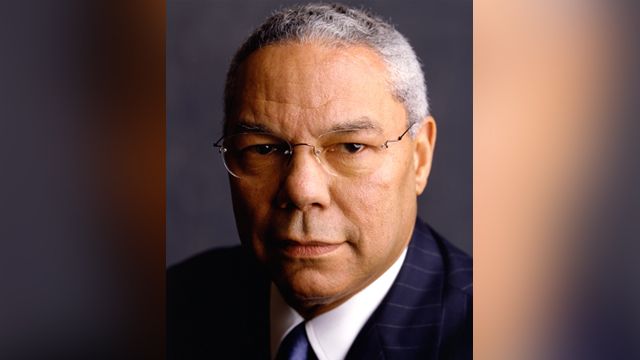
Former Secretary of State Colin Powell speaks with Alan about the key moments that shaped his career.
- Duration 18:01
- Date Jun 7, 2012
You're watching...
Former Secretary of State Colin Powell speaks with Alan about the key moments that shaped his career.
Also in this playlist...
Auto-advance: ON
Auto-advanceThis transcript is automatically generated
Are starting tonight with general college both Colin Powell you know I -- I always look at the names and think Colin even though it is -- -- the book -- called it worked for me in general Powell what's the story of the pronunciation of your name.
Well it it's and -- in the book and the of this story is that I was -- column that the proper or poorly acceptable British pronunciation of the name but.
Earlier World War II news -- hero and American pilot who.
Lost his bomber but before losing -- bomber after bombing the Japanese maybe he -- crew bailed out they wrote the plane down he died.
And his name was Colin Kelly -- the pronunciation was columnist Susan I Irish variant doesn't.
I was living and Kelly street and -- the Bronx section of New York City all my friends certainly Konami code nobody cared what.
The difference was until I became national security guys -- by apparently called a column reference comic Poland and the press would not accept that -- like you guys does not accept.
This -- -- -- cheerful.
Look I'll pick one X and -- -- Chicago code and have more friends and -- that is left and that's the story.
-- -- of it I'm glad thank you for the explanation remic.
What I love about this book was you start off with some precepts that you've had I guess around hanging around your office in your desk for a very long time.
And you talk in the book is the book goes on about -- -- applied them in your life and why thirteen of them.
When the reporter.
Guy's name a date Lojeski -- a piece -- Parade Magazine back him.
1989.
After -- became four star general.
I was doing an article about media -- -- secretaries well he got the gimmicks like you need to close this article -- and the secretary said they have.
He's got only little these little sayings and aphorisms tucked under his this blast go ask about a and there are a couple of dozen.
David asked -- read off a few and I ran off thirteen of those with a clean once.
And that became the Powell rule sheet print to -- we've been returning him now for 23 years -- -- -- you're going out.
And they just took off and -- I was working.
New book.
It dawned on me you know it's all these years people keep asking about these simple one phrase rules let me explain and tell you tell folks.
Why idea why use that -- not only that I use them when I was a young officer.
But I've applied it throughout my life so they affect my life might put -- -- secretary of state national security advisor chairman.
And they're pretty straightforward simple but I thought I'd better explain and so I took those thirteen simple rules and converted -- -- -- chapter of -- thirty pages long.
But the -- that has you as the book goes on as you document your life and how you've applied them in simple things like -- went.
You know you have a problem like we have a failure to deal with and move on your life goes -- -- -- -- live your life looking forward as -- point -- -- and the windshield of the rear -- -- Right.
I just that I can be useful way to go and if you read them all thirteen rules the explanation that they'll kind of linked together and -- -- -- The first one says you know I think you're gonna get better outlook -- -- for the morning things will be better and the last ones as perpetual optimism as a force multiplier.
-- all about it having confidence believing you can change things believing that.
With the followers that you have working for you -- with you.
You can make all the difference and don't -- K a year or some problem that occurred your life hold you back always be looking forward always they continue to get better you make a better.
You talk about that in your book and how you even from a very early age how to work ethic you looked forward to look there was things you want -- to do.
And the very young age you you talked about I I think and -- Jewish and Russian immigrant who was your first -- and how he's became a lifelong friend.
But you've always had that focus network ethic was there -- epiphany that.
At any point your life -- this is right wanna be this what I wanted to do was a just -- a gradual evolution.
Well you know my wife and I were talking about this the other night and I started working when -- -- fourteen years old part time jobs and I worked -- that -- -- I was a -- -- they say that I think I've moved -- program.
And I worked -- a Coke -- plant PepsiCo the plan -- I've got to -- -- cabinet makers place putting kitchen cabinet together.
And I was talking my wife about what we need to do for our young people I think every young person before they hit the age of eighteen should have a menial -- job.
And that'll teach them that they don't want them menial labor job and they'll focus on their education.
And the discipline of life.
That was really I was about seventeen years old I enter college the city college's York.
My parents and had to go to college and actually she did Clinton your parents talking to do with technology.
And and I was -- cliche and student but.
In the second semester college -- discover ROTC.
-- while.
I like the uniform approach structure and discipline and in my life by got a bunch of young kids who just slightly we were.
Immigrant kids.
And it put the structure in my life that I love it and -- -- along with the military and decided since I don't have any other great ideas I'll just be a soldier.
Well -- Protect from anything better to do settling an awful -- an interest in way to make a decision given the career.
You've had -- worked for me is a book by a Colin Powell general Colin Powell.
There -- certain points your life for people.
Really wanted you to run for president and I know this comes up all the time but get this book -- -- so many of the things that come up all the time.
Do you have those moments we say I could -- would -- should have.
I don't -- it was really only one time that was 1995.
When my first book came out.
It was an enormous degree -- interest that was on the eve of the 96 elections.
And people kept asking me about impressing me on -- and I felt an obligation to think about it.
And so I spent several weeks in the summer early fall of 1995.
But debating with myself listening to people and learning about politics it was like -- campaign.
And wood finally pushed -- over the head that said -- I don't think this is and they.
Is that there was -- morning that I woke up -- we're really really felt that I wanted to get out of bed and run for political office.
You have to be true to yourself and that's while I was -- -- soldier may no longer be active soldier but.
I didn't have the the passion of the intensity of the instinct that I needed or anyone would lead to two run for political office.
-- might say that would be a plus in today's environment.
We donated it may well be but the fact of the matter is we we should be very very glad that we have people like a Barack Obama may prevent Romney John McCain and so many others who -- them.
-- -- And are willing to put themselves forward.
And the nature of our system is that it's supposed to be heck of a fight.
You know the windows office she got to fight for it and that.
You're fighting your soldier.
On a fighter but I don't think that was the battlefield that was for beer that I could -- -- -- -- -- That's about -- and -- I suspect they put but there was no passion -- -- I didn't I didn't have.
Something that told me you should do this and my family was sport but it was really a decision.
Together my wife -- -- a 100%.
Since let's find other ways to serve and bottom line is.
-- seeking to be president to not necessarily.
Everybody's prohibition of life -- as one of the -- -- -- soldier and I said well I've just declined to run.
But I would find other things to do -- idea that it works -- programs the last.
Fifteen years I have been as secretary of state for four years talk -- always serve the country that I that I -- is appreciated by the post.
As they've -- been ideological even got a winner in today's environment must you be more ideological.
Then you are in order to survive politically and is that not necessarily with them.
Well Alan you you know the business world as well site -- and increasingly.
It's not so much ideologue ideological.
-- on ideology -- it's become orthodoxy.
You can -- -- -- -- possibly orthodoxy of the left and right or you get hammered.
You get hammered by those people who -- who don't watch it straight.
You get hammered by a cable television.
We'll table -- Has become far right for a lot in many places and -- just didn't controversy and market -- as they are in.
Bringing you news.
And increasingly.
The information revolution may be informing us a lot better certainly I use it all the time.
But at the same time it gives you the ability to stick in your own little -- your own little corner and not even think about the other side of the issue anymore you busy reinforcing.
Your own views day after day hour after hour.
Without stopping and thinking where found it rather disputes how many years ago.
-- we have to compromise -- to get this country moving forward we're here to create a constitution.
Not just to express -- views each other without making a compromised.
And that we can't even -- the past is sensible budget.
Because you can't compromise.
And I think it's unfortunate I think the American people are are starting to say waited which is so about.
And people say well we didn't -- you vote for.
Well good look at both candidates.
Most private citizen and I have always try to do this what are they both represent.
What policies in the coming in with -- bringing with them.
And not just see it as you know that a vote for Superman isn't Superman they'll think we -- super people who need to start really understanding the issues.
And -- what was best for the country and not just to sit there orthodox.
Require.
As President Obama lived up your expectations.
Yes them anyway he has -- you know though no president ever.
Lives up to all of your expectations or all the things he said he would do.
Work with for president -- senior level.
He discover that campaigning is not the same discovered it.
If he is they would never do when -- become president.
But -- you're actually president and you governing.
You discover that if he did note before and those bailed out before.
You're the system.
Checks and balances.
You've got to congress to deal with the press to deal with the free press -- And you've got other constituencies that have different points of view that he got to pick your targets carefully.
And you've got to understand that the you don't pass blocks.
You've got to convince people.
On -- molecular give to young people that know good idea succeed simply because it's a good idea.
It only succeed because the leader of the idea.
Has gotten others to join him or her and championing those ideas.
And so you have to develop a consensus consensus that comes about -- people compromising.
And the other side -- is no bad idea guy just because a bad idea you gotta bring together people who killer.
Because we know it's a bad idea but often you put yourself at risk way to do things like that.
We're talking with general Colin -- his new book is called it worked for me.
Given what you've said in previous interviews about your book and I've read the things you've seen and heard the things you've said about Mitt Romney saying rushes or several -- geopolitical flow which is.
You've correctly I think they identified as not particularly the best -- -- in the world.
I his lack of foreign policy experience your previous support of Barack Obama if I'm reading the tea leaves correctly seems like you were leaning toward supporting the president went.
Well everybody's trying to -- for -- and the of the green -- made the point.
With respect admits comment about.
The Russian Federation.
Is that it didn't appear to be the sort of true.
This is a country that is not the Soviet Union anymore half the size of the old Soviet Union.
Nobody's following -- old.
Political ideology it's got -- GDP that somewhere around the size of midsize European country.
And it these -- it has its own problems it is not a full powers.
We don't agree -- everything we might disagree about Syria might disagree about lots of things.
And maybe it's an adversary in diplomatic terms but I think it was an overstatement to.
Just stated it was a good number one principled geo strategic -- I just don't think.
That was as well thought out as.
Will you make a public announcement -- some point about who you are supporting.
Well -- I'm gonna vote mobilized politically they have learned Republican House we'll see over the course of the summer -- sure I don't I don't -- out of that because of the book tour puts standard immediate obligations to.
Making an endorsement.
You are very -- misspoke about that day you -- to speak to the United Nations and you know you always asked about this but since -- so clearly articulated in this book.
It -- threat when I read it it seemed to me is if you work done over done under perhaps -- Or perhaps opposed by the Cheney forces in the bush administrations and accurate reading of what happened.
They'll.
In the summer of 2002 are commanded to the president that -- he'd he'd need to be careful not to take this in the United Nations to see if they could solve what they're the ones who are -- -- -- These failed resolutions.
And remember if you break this country -- be taken over your own.
So the president agree and we put -- to the United Nations -- -- insulation but.
By January of 2003 the president wasn't satisfied with what the UN was doing and he decided on military action.
The congress in the fall of 2002.
Well in advance -- the president.
Passed a resolution by an overwhelming.
Majority.
Authorizing him to take military action and the president decided -- sometime in January 2000 entry have been asked me to go.
Present our intelligence to the United Nations on the just society -- But you know things were ready been -- by that the force was -- The president has made his own decision you -- didn't bounce it and the congress approved a so my job was to forget present our case of the world.
And what I did was put forward the case that the intelligence community has -- congress and give the president had given mr.
Cheney mr.
Rumsfeld.
And anything that did not.
Stand up to the CIA's multi sourcing and it used throughout a lot of stuff.
I should look this is going to be like and at least it -- a -- but I gotta have I got to have solid stuff.
And they assured you know what I -- was solid and it had nothing to do with mr.
Rumsfeld mr.
Cheney -- -- -- it was the intelligence community.
And I think everybody listen -- Iowa this when.
-- subsequently found that large parts of it particularly the part having to do with the existence since existing stocks of weapons of mass destruction.
Turned out not to be true.
The CIA months later said they still stood by the judgments they made so much earlier even -- those judgments.
Did not they seem to be corrected retrospect.
But you know I have confidence in our intelligence community.
And as we need to commission to investigate -- -- they just to and made some bad analysis they didn't get it right.
And that's so that's what happened disappointed and of course it's my presentation was the most visible -- I'm not constantly asked about it the other -- not to be.
You said in the book that there was Scooter Libby they want any more legal presentation more than an intelligence based presentation and there was Libby.
-- -- authored an unsuitable presentation you say in the book.
And -- some items you say that you had to reject keeping the vice president urged you to tilt the presentation toward liberties by ending assertions that have been rejected.
Months earlier so when -- you -- I wonder if there was really some great discord between you and the vice president -- -- the vice president had some ideas that he thought should be included in the presentation and -- couldn't do that because the C CIA would not stand behind him garlic.
And so.
What I did lose my best judgment of the the validity of the CIA material and that's what I put forward.
-- disagreements within the administration yes.
I was probably the -- who lose most -- trying to find a diplomatic solution where others I suspect.
-- were leaning more war more toward military action.
But it was the president decided regardless of what advice -- skate for all of us.
From all of us at when he made his decision and probably you'd made a decision and I wanted to take -- -- what do you take to the line.
It's all I supported -- he's the commander in chief he's responsible for the security of the country.
And I'm the one who went to the United Nations supporting.
What we might have to do -- -- to.
And I supported all the way through even though some of my colleagues suggested that I did but.
Maybe he didn't send them to the United Nations decently and I would just -- More than willing to present these fellows summation and independent certified by the agency.
-- -- fell after they've worked for me and after the book tour what's next for you.
I don't know I think it is it comes -- I'm Bob 75 years old.
Exciting life.
I'm very involved and educational work now I have a center named estimates -- because of New York.
And so are gonna continue to work at youth programs continued to travel the country.
I love going around speaking to different audiences it keeps me fresh.
-- -- keeps me upbeat because even though Washington can be sometimes.
-- depressing place I think seems to be wrong.
He's -- the countryside people who still optimistic they still believe.
And they still think we've got to operate problem we have and we're still the leader of this world wants to different.
Appreciate the opportunity -- -- thank you very much for your time if you look at the -- thank our alum I care.