You're watching...

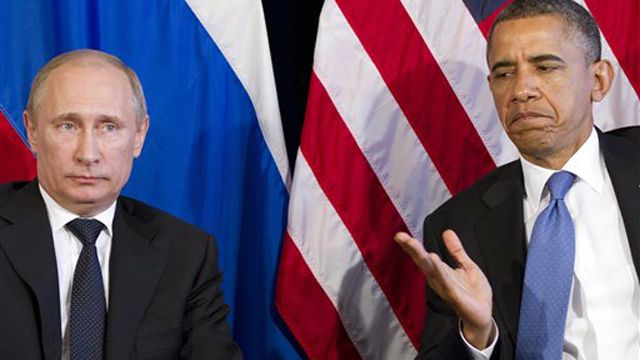
US, Russia diplomatic 'reset' efforts working?

Details

  • Description

    Inside icy relationship between nations

  • Duration 7:42
  • Date

Clips

Also in this playlist...

Editor's Picks

Auto-advance: ON

Auto-advance

Transcript

This transcript is automatically generated

Now for more on our relationship with Russia right now remember that secretary of state Hillary Clinton three years ago said.

It was time for a fresh start with -- -- take a listen.

You want to resent.

Her relationships.

Fans is yeah we look good together.

Lots of different opinions on that that recent -- and send said -- -- -- -- -- others said maybe not the right time.

I since then diplomacy.

Is certainly sent saying that a lot of folks have taken a closer look at.

These are -- few points of disagreements right now between our two countries the US continues to vocally criticized.

The Kremlin's backing of the aside regime in their reporting killing.

I've thousands Anderson at citizens.

I NATO's proposed missile defense system is close the Russian border Russia says it would be a threat to their national security they don't want that.

And they're certainly tension over battery prudence the controversial return as president.

Amid widespread reports of election fraud with all that is happening with Russia are we really hitting a -- sex with the country or.

Are we somehow -- turning.

Back to send these Cold -- stalemate that seems still familiar ambassador John Bolton is with that's -- the former US ambassador to the UN.

Also Fox News contributor -- -- answer is with the foundation for defense of democracies.

An average Hinske is an expert on US and Russian national security.

At the Carnegie Endowment for International Peace talk and she while at the big topics that -- dig right into this Matt.

Are we really -- -- relations with Russia right now or is that reset.

Off the rails at this point.

You know I think the reset is something to think about as having past three years ago.

It was an opportunity where the United States said.

Look -- look forward our interest or not that far apart cooperating on things like Afghanistan and countering terrorism counter narcotics intelligence sharing.

I'm the Russians basically said yeah okay we agreed to do that.

But the reality was that was three years ago there's a lot of water under the bridge now and you know you don't get to hit the reset button too many times and I think Vladimir -- Has come to the table today with a much more skeptical opinion of Obama than he had three years ago he doesn't feel like this is a guy whose intentions he can necessarily trust.

He thinks it's back to the battle days of the relationship.

Which he basically thinks has been that the dominant theme.

Ambassador Bolton is that -- thing that's really changed in the last three years that the leadership -- -- and that's -- really marked a tipping point press.

Now I I think.

They relations with Russia had been deteriorating for some time because they see their interest is very different from the US.

So when the Obama administration came and said it was gonna press the reset button -- you can always have better relations if you give in to the other side's position.

-- when Vladimir Putin was president last time he said.

The breakup of the Soviet Union was the greatest geopolitical catastrophe of the twentieth century.

That's his view that the view of most Americans is that the breakup of the Soviet Union was a pretty good way to end the twentieth century and so when you.

Come that it would that vastly different world view nobody should be surprised that there's tension in the relationship.

You know -- -- ambassador Bolton and I spoke last hour about an editorial -- the Wall Street Journal that says what's happening.

As far as the European financial crisis will only -- in power -- that was one of the arguments -- by the writer.

And I'm curious just the premise of our conversation not ask all of -- -- the giant thing you're -- on this.

Do you consider -- set threat to our national security right now.

I absolutely do in fact what I would argue is that Russia is the state sponsor for some of the worst face state sponsors of terrorism.

And I think that that -- it's been ignored by the media not just on Syria but also just look at the Iran -- nuclear program.

That's probably the greatest threat that we face today the -- is getting a nuclear weapon.

And the Russians have been helping them further that project along.

And also providing them with missiles and other means to defend themselves if and when it comes time for an invasion of Iran.

And so -- I think has really.

You know been at odds with our national interest on the national security front.

For some time now.

By the question because what he -- mad and I'm curious again going back that do you consider Russia a national security threat and at this knowledge -- -- the description that you've all given.

Which has been skeptical at best probably -- negative then that I even got going into this conversation do you think this relationship with Russia right now.

It somehow beyond repair.

Look I think we're at a very difficult spot with the Russians right now but the reality if we take a broader look at the relationship is that we're still cooperating on a lot of important stuff.

It tends to be most effective to be quite frank between Moscow and Washington.

When it's below the radar and I mean by that intelligence sharing counterterrorism operations counter narcotics operations.

But the simple fact is.

Given our relationship with Pakistan today it's not in great shape it's only be northern distribution network which is the Russian transit route.

That lets us supply our troops in Afghanistan and ultimately get those folks safely out of Afghanistan.

To -- the cooperation got to continue.

But my colleagues are exactly right we've got some serious differences of interest we're gonna have to figure out a way to kind of -- -- -- disagreements.

Russia is not going away and I think the problem is if we just engage in a labeling game saying that these guys are the bad guys -- on all on the wrong side of all the big.

Important international issues you know it sets the tone and atmosphere where a guy like Vladimir Putin's simply says well I don't wanna work with you -- and he can make that choice.

Any seems like that -- the character ambassador Bolton so what do we do.

Well I think -- in the current circumstance.

Vladimir Putin who is a tough guy he's a former KGB agent he projects an image of toughness it's now.

He sees himself that's how he sees his role in Russia and his country's role and he looks -- our leader and he sees weakness he sees weakness.

Because of the economic difficulty which is not getting better he sees weakness because of our.

Declining defense budget he sees weakness in our agreement to the new start arms control treaty and our retreat on missile defense.

And I think when he sees that panorama of weakness in front of him.

He decides this is the opportune moment to push Russia's agenda and that's exactly what he's doing the antidote to that.

Is to press the American agenda and not.

Compromise is preemptively as we've been doing over the past three and a half years.

John and I wanna get a final thought for -- on this of course -- focusing on Russia and the United States but I wondering I guess you're the right person to ask about this as your from the foundation for defense of democracies.

Ever actually seeing in this.

This conflict that's isolated to Russia and United States Europe it's a much bigger conflict between those who advocate democracy.

And those who don't we see Russia aligned with Syria and Iran and we see the united -- others on the other side.

Is that what we're really say is they're bigger picture here as far is geopolitics.

Globally.

That that's really coming to surface.

Well you know I think we need his take a look at -- objectives right now it used to be that it was very ideological that they are really trying to push a Communist agenda.

That's not the case right now this looks more like a Machiavellian thing in their choosing allies that and they're being very flexible about it so they're working with -- on -- sheltering North Korea.

They're working with the Syrians and this is a major problem I don't necessarily see it as a as a Cold War -- re emergence.

But certainly you're looking at Syria playing on the wrong side of major -- -- geopolitical issues and this is something I agree with ambassador Bolton.

The idea here is not to back down that but to press our agenda further.

And they said the -- Jonathan -- -- ambassador Bolton great conversation we look -- have you all back.