You're watching...
Supreme Court rules on Arizona immigration law
Details
-
Description
High court strikes down 3 of 4 provisions, upholds key part involving police checking citizenship
- Duration 4:40
- Date Jun 25, 2012
You're watching...
High court strikes down 3 of 4 provisions, upholds key part involving police checking citizenship
Also in this playlist...
Auto-advance: ON
Auto-advanceThis transcript is automatically generated
-- a moment section to be.
Requires its state local police officers -- attempt to determine immigration status of any individual stock entertained if they officer.
Reasonably suspects the person is in the United States illegally folks in Arizona oftentimes argue that that was the heart of the matter.
A Pennsylvania Republican Tim Murphy co chair the house doctors caucus back with us and sir good morning to you again.
Thank you for going on stand by your reaction as you hear -- now.
Well I think that -- Points to the concerns we've had.
That with regard to congress needs to act the house and senate on some comprehensive.
Immigration reform.
Arizona pass this law because they were saying the federal government wasn't enforcing the law.
And they needed a number of clarification it's what this tells us is in the Supreme Court says -- still -- be clarified and that's where this and respect the ninth circuit.
With regard to whether not a police officer can with reasonable cause asked about the immigration status apparently that part is going to remain.
But that they still want the courts to rule on this and I'm sure that more suits -- more challenges will be out there.
The with the issue with regard to employment of immigrants currently that has been struck.
And -- and -- illegal immigrants can't hold jobs.
This still goes back to a frustrating part of the American people and that is for years we've been talking about let's have some comprehensive immigration reform.
How we gonna do with the millions of people you're here.
Illegally now we're gonna have to deal with this and that means the senate is -- to have to move some of the bills we send over to the house and senate can work together to resolve this.
And this and the health care -- point out the importance.
That you cannot have a congress house and senate.
Not moving things forward not sitting down together we need to be working with the president -- states and so it points against the importance of this fall's election because -- very different approaches.
With regard to how to handle these key issues.
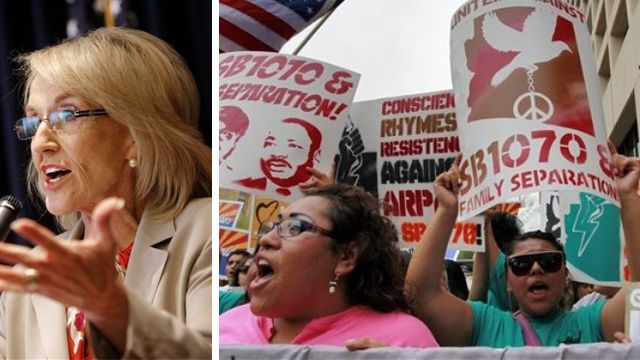
Congressman Murphy I want to bring folks back for 12 as governor Jan Brewer said that they needed SB 1070 because the federal government was not enforcing.
The immigration law and a number of these provisions look they threw all of -- in here.
Hoping some of it would stick and it may be the court.
Was stuck on the fact that that requirement that they said that lower court was wrong in and joining said that officers must check.
Must check not that they could if they wanted to.
And there was a concern about racial profiling in that respect.
What are your thoughts on that for other states who are looking at the capability.
Of controlling the illegal immigrant population.
I assume the other provision that was tossed out about it the illegal immigrants working.
Bill now rely on employers to monitor that.
Yes -- -- employers -- the must check thing I think also -- allow this system were you whereby you would bypass the point about profiling and that it's.
You record to check -- for -- -- you weren't checking some sort of profile.
And it does speak to the governor's frustration with the federal government and with Eric Holder.
The attorney general saying that he was gonna sue Arizona and they weren't -- enforce the night.
Immigration law these border states are very frustrated with the lack of approach of the attorney general's office in enforcing the laws.
Last question on this if officers begin now to check the status of those they stopped because they have a reasonable belief that they're.
Deportable.
How do they decide whether or not they're going to choose to ask someone for paperwork because it sounds like the court -- said look this is gonna stand for now until someone else challenges it.
And we're not saying they won't.
I suspect what's gonna happen as a number of attorneys going to be looking for cases where someone is.
In a traffic stop or some of the stopped by police officer in the police officer does ask for papers.
Immigration papers and this will come back before the -- fairly quickly.
What are the -- but still what would be the damages of asking someone whether or not -- have a right to be here they're stopped for even a misdemeanor.
-- it is it is appropriate by the Arizona law -- -- -- the Supreme Court saying they're not convinced it's not appropriate yet.
They're looking for further clarification because the Supreme Court as if from my my understanding what that was just red.
The Supreme Court saying it does not appear on face value that there's something that's unconstitutional about this so there is some protection for police officers here.
But it's still doesn't address the broader question which congress needs -- address and that is so would this is this should not be put on the shoulders.
Of an individual police officer -- individual traffic stop.
It does speak to the problems with the attorney general's office with and forcing this.
In working with congress and working with the states.
To make sure they deal with this -- which is a huge problem for states aren't congressman Tim Murphy thank you so much for weighing -- that's the health -- decision not.
Didn't come in this report from Shannon -- -- a lot to digest on -- --