You're watching...

Issues impacting the US Supreme Court

Details

  • Description

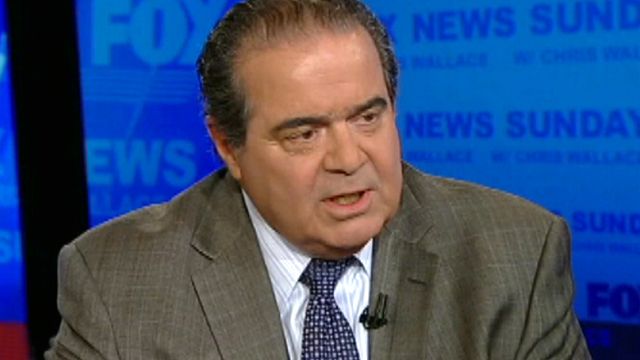
    Justice Antonin Scalia speaks out

  • Duration 23:55
  • Date

Clips

Also in this playlist...

Editor's Picks

Auto-advance: ON

Auto-advance

Transcript

This transcript is automatically generated

And hello again from Fox News in Washington.

Recent rulings by the US Supreme Court on Health Care Reform and immigration.

Demonstrated once again what a central role the court plays in our government.

The justices rarely do interviews -- talked outside the court.

About how they reach their decisions.

But a new book called reading the law the interpretation of legal tax justice Antonin Scalia the longest serving member of the court.

As well as law professor Bryan garner explain what they believe is the right way to decide cases.

And we are delighted Justice Scalia has agreed to join us today to talk about it justice welcome to FOX News Sunday.

Thank you very much mr.

Wallace glad to be here feel it in your new book you explain your approach.

To judging which is called -- -- a -- war.

Original -- what exactly as the.

A regionalism is sort of a sub species of textual is and textual is a means you're you're governed by the text.

That's the only thing that is relevant to your decision.

Not whether the outcome is desirable not whether legislative history says this -- that but the text of the statute.

A regionalism.

Says that when you consult the text you give it the meaning it had when it was adopted.

Not not some leader modern meaning.

So that.

Figure if -- was the constitution written in the eighteenth century.

You try to find what those words meant in the -- exactly the best example being the death penalty I've I've sat with.

Three colleagues who thought it was unconstitutional.

What it's absolutely clear.

That the American people never -- to.

Proscribed the death penalty they.

They adopted a cruel and unusual punishments clause at the time.

When every state have the death penalty in every state continued to have -- nobody thought that.

The eighth amendment prohibited are you criticize and it's got -- you say some of your colleagues another approach.

Using the word I have to admit that I did not know existed prior to reading your -- purpose of -- -- did I pronounce that correctly there it's a nice long -- when I didn't make it up what is an -- took issue.

What it means is.

And it's probably the most popular.

Form of of interpretation.

In in recent times.

It means consulting the purpose of the statute and deciding the case on the basis of what will further the purpose.

Now.

-- -- consult purposes well but only the purpose that is apparent in the very text.

I have to give you an example here you you -- owners won't understand the difference let's let's assume statute which provides.

That.

The winning party in litigation will obtain attorneys' fees.

The issue is whether.

That includes.

The fees paid to expert witnesses which can you know -- to the thousands of dollars.

The purpose of this would be inclined to approach that by saying you know what's the purpose of this statute at the purpose is to make the plaintiff whole.

So that the money he received for winning the case is money he can keep and he doesn't have to spend half of it on expert witnesses.

The textual this would say -- -- would not say that would say what what is the understood meaning of attorneys' fees.

And in fact it was never thought to include expert witness fees are into -- a couple of years ago we had one of your colleagues -- I think he would say is on the other side of the judicial divide justice Stephen Breyer on the show and he said.

It is impossible.

To apply the law as -- -- take a look.

The founders -- no -- commerce included airplanes.

They didn't know about the Internet or even television.

And so the difficult job.

In open cases.

Where there is no clear answer is to take those values in this document which all Americans old.

Which do not change and to apply them to a world that is ever changing.

-- Justice -- wrong.

Yes.

Yeah I bet that stats say -- you -- common then and totally.

Peroni is description of what original as a means.

What original as a means is that you give.

The constitution.

The meaning that it had with respect to those phenomenon that -- in existence at the time say the death penalty.

But there are a lot of phenomenon that aren't they wanted to just -- and for those of course you have to.

Decide what what the meaning ought to be but the criterion for deciding what the meaning today ought to be.

Is what was the understood meaning as applied to criteria at the time for example in the death penalty.

When the electric chair comes in it's a new phenomenon what -- the -- wish -- could be electric chair who knows there wasn't any electric chair.

But they they did have the death penalty and they did impose death by hanging.

So -- the originals would say is is is the is the electric chair more cruel and unusual when hanging -- And of course it isn't because it was adopted to be to be less cruel and the same thing with -- lethal injection.

Okay -- in your book you lay out.

Beyond this general argument 57.

Specific -- its principles.

For judgment drop here's number thirty yet.

You have 57 it's likely a Heinz varieties a -- should should be interpreted in a way.

That avoids placing its constitutionality.

In doubt in other words try to find a way to avoid judicial conflict.

With the legislature -- numbers -- thirty -- -- But you voted.

To strike down obamacare which the legislature in this case.

The congress was -- debated for a year and in your dissent you criticize chief Justice Roberts.

For following cannon 38 by finding that the you're shaking your -- -- that you've bought for finding that the individual mandate is a tax.

Didn't Justice Roberts do exactly what you -- a good judge should do try to find a way to avoid striking down a long.

So if you read the rest of the section you would say to find a way.

To fully the meaning that the language will bear that will uphold the constant bit of the constitutionality.

-- you don't interpret the penalty to be a pig.

It can't be a cake.

And -- and what my dissent said -- in the affordable care Affordable Care Act.

Was simply that there's no way to regard this penalty is -- tax it simply does not bear that meaning.

You cannot give in order to save the constitutionality.

Could not give the tax meaning it will not there.

-- let's turn to an issue.

You that is in the news right now with a massacre in Colorado and that is gun control.

You wrote in 2008.

That the opinion in District of Columbia V Heller.

The majority opinion this -- the Second Amendment mean -- -- assess people have a right.

To bear arms question.

How far does that constitutional right got -- a legislature ban.

Semiautomatic weapons or -- -- ban magazines.

That carry a hundred rounds.

Without with violating an individual's constitutional right to bear arms.

-- what the opinion Heller said is that.

It will have to be decided in future cases.

What limitations upon the right to keep and bear arms are permissible some undoubtedly are because there were some.

That were acknowledged that the time for example there was a tort called off -- -- Which could -- if you carried around a really horrible weapon just to scare people like and acts or something patent that was.

I believe a misdemeanor.

So.

Yes there are some limitations that can be imposed.

What they are will depend on what that what the society understood were reasonable limitations at the -- there were certain location limitations.

-- Where what about this technological limitations obviously when I'm not talking about a hand -- must get we're talking about it a weapon that can fire a hundred shots and -- that.

We'll we'll we'll see I mean.

Obviously the the amendment does not apply to.

Arms that cannot be hand carried -- to keep and bear so it doesn't apply to Canon's.

But I suppose there are hand held rocket launchers -- can bring down airplanes.

That will will have to be.

It'll have to decide -- if -- -- off to a very carefully.

-- my starting point and probably -- ending point will be.

What limitations are we the end.

We understood limitations that the society had at the time they had some limitations on the nature of arms that could be born.

So it we'll we'll we'll see what what what those limitations are supply -- -- -- There is one Supreme Court decision reading.

A lot of your writings and and and speeches over the years that seems to distress you more than any other and that is.

Roe vs.

Wade the 1973.

Decision that.

Says that women have a constitutional right to abortion -- they -- it is a lot.

And in fact while generally -- you say to accept long standing.

Precedence.

You say you'll continue to compress to overturn rough.

Question why.

Well I'm not I'm not -- -- say this distresses me more than any other did it is in my mind the clearest example.

Of being a non textual it's been -- -- originally stood nobody ever thought.

That the American people ever voted to prohibit limitations on abortion I mean there there's nothing in the constitution that sense that.

All of what about the right to privacy that the court found in 1965 national right to privacy in the constitution no generalized right to privacy.

Well in the Griswold case the court said -- -- -- do you tip in that was that was wrong.

In an earlier case the court had said the -- to look the way -- the way the Fourth Amendment reasons a person's.

The people shall be secure in their persons houses papers and effects.

Against unreasonable searches and seizures.

And the first time my court had a case involving wiretapping.

It said.

That's not covered by the fourth and then they're they're can be state laws against it -- most states have laws.

But if it's not persons -- -- papers and effects is not covered by the for the moment.

The court reversed that.

I don't know twenty years later so.

It in a wave of -- regionalism the constitution means what it ought to mean well if it simply doesn't doesn't cover that.

Which means that it's left to.

It's left to democratic choice.

As most things are even important things like -- democratic small.

Important questions like abortion.

Have you ever change your mind in a case from casting your original vote in conference to when it is finally announced by the court.

I have not only done that and I have.

Changed my mind after having been assigned to write the majority opinion.

-- and couldn't the opinion the other way be it just wouldn't know what can write and clearly if it does nothing wrong with I think when we're -- Did chief Justice Roberts -- his mind in.

The obamacare case I don't know you'll have to ask him did -- let me ask you -- you at one point in that case.

In the majority to strike down Obama can I don't I don't talk about.

Internal.

Court proceedings.

Justice wants the never ever have never ever -- And and -- those who do.

You shouldn't believe what you read about about.

Internal court proceedings because the reporter who reports that is either -- lying.

Which can be done with impunity because as you know we don't responded it's it's the tradition of commonly judges to lay back and take it you've you've you don't respond in the press corps being.

That reporter had the information from someone who was breaking.

The oath of confidentiality.

Which means that's an unreliable person.

So we either way you should not -- He should not put any stock in.

In reports about what was going on in the in the secrecy of the court Finley Peter -- the famous Chicago -- once wrote.

The Supreme Court follows the election returns.

How political is the court.

Oh I don't I don't think I don't think the court's political at all.

-- that people say that because and it at least -- in the recent couple of years since John Paul Stevens and and David Souter have left the court.

The break out is is often five to four with five.

Republican of will be generated for Democrat on the other side but it doesn't that doesn't show that they're voting their politics.

It shows that they have been.

Selected.

Because of their judicial philosophy either Republicans have been looking for you know a regional listen.

Text you'll listen.

Restrained judges for fifteen years in the Democrats have been looking for the opposite for people who who believe in Roe vs.

-- why should it be set up some properties.

That after it here you know assiduously trying to get people would these philosophies they end up with people -- these philosophies.

Willingly or not the court has certainly been dragged into the political arena in his 2010.

State of the union speech President Obama called out the justices seated -- lot of them in the well of the house chamber.

For the court's decision on Citizens United let's take a look at that.

Last week the Supreme Court reversed a century of law that I believe will open the floodgates.

For special interest.

Including foreign corporation.

-- -- Chief Justice Roberts said that he found dot spectacle.

Top.

-- you.

In my own adjective.

I wasn't there and it's yet another reason why I will not be there in the future.

But -- I stopped going to to what is essentially a political spectacle.

Some years ago as did John Paul Stevens and I think bill Rehnquist didn't go -- do you think -- -- mention that that when a president.

Directs comments at the Supreme Court when they have to sit there.

Potted plants is was one -- -- -- hearing.

And everybody else's standing they're jeering him and that's unseemly thing you can look at and then come to your own judgment.

I don't.

Publicly criticized the president and he normally does not publicly criticize me he didn't mechanics and.

-- -- I wasn't there -- -- -- -- but he's got the death ethnic.

Then there was the president's statement in April after the oral arguments in the Obama care case did not go well before the Supreme Court.

When he seemed to be jawboning the court take a look at the us I'm confident that the Supreme Court.

Will not take what would be an unprecedented.

Extraordinary.

Step of overturning.

Law that was passed.

By.

A strong majority.

They democratically elected congress.

Justice what did you think of that.

You know it's unusual but as I say I don't I don't criticize the president publicly and -- Normally doesn't criticize me did you feel.

Any pressure as a result of that to vote a certain -- now what can do to me.

It -- to any of us we have life tenured and we have -- precisely so that we will not be influenced by by politics.

By threats from -- from anybody did you view that as a threat.

I didn't viewers threat on and ensure Internet.

We heard -- -- brought it to my attention.

I doubt you -- you heard that hot as a matter of just -- does a legal scholar was the former constitutional law lecturer correct.

Was how unprecedented.

Is it for a court.

Or is the president put it there an unelected group of people to overturn an act of congress.

-- I'm not couldn't if you -- visit to Beirut.

Well look we we have overruled.

What we.

Marbury vs minus.

A very old case we we did just that and we've done it -- And a large number of cases since then it's it's part of a function of the court.

Look it is.

The most important role we play in the reason we have lifetime here.

Is precisely because now and then we have to tell the majority the people that they can't do what they wanted to.

That what they want to do was unconstitutional.

And therefore go away.

Now let's not gonna make as popular.

And you can say oh it's very undemocratic and in the small sense it -- In the larger sense it isn't however because it's the American people who gave us that power is the American people who said.

No there's some things we're not going to let future legislatures do even if they want to do it.

And we're simply applying that judgment of -- think the American people over time.

Some people say that you who crossed the line.

Last month in your dissent in the Arizona immigration.

Case you brought up the fact that the president.

After the case had been argued shortly after the law had been past the fact that the president and an unrelated decision had decided not to deport the children.

All the illegal immigrants let's take a look at your -- he wrote this.

To say as the court does that Arizona contradicts federal law by enforcing applications.

Of the immigration not that the president -- -- -- forests.

Boggles the mall to wish conservative.

Judge Richard Posner.

Wrote about your -- he gives that part of the opinion the air of a campaign.

And state.

Your response.

He's a Court of Appeals judges and yes.

And he doesn't sit in judgment on my opinions as far as I'm concerned you sit in judgment because of it that's what happens.

Well what about the argument -- for perfect perfect ten people wonder why Kate can you would you.

Push people's buttons every once in awhile.

It's fun to push buttons.

Is it -- want.

When Richard Posner comes out with a statement like that and I should fire back at that statement equally.

Provocative okay but here's the point that he's making.

The president's decision months later after the case has been argued after the law has been passed what to do about immigration.

And not okay -- you know I neither of the holy.

Neither neither have have the people who who read that quote the context in which it was was that the solicitor general had argued to the court that's the only reason.

The Arizona was suffering the incursion of immigrants that it was was that there was just not enough funding.

For immigration enforcement and the executive made decisions about where to allocate the funding.

Now I said in my opinion that even -- Is no justification for letting for for -- refusing to let.

Arizona.

Supplement the enforcement so long -- it's only enforcing federal law and not not going beyond federal law.

I said even if that were the reason.

But I hadn't I don't know that the solicitor general's representation.

Is.

Any longer correct in light of the statement by the president.

Which didn't talk about lack of funding which is simply said we're not going force these provisions of the law.

I didn't criticize that I didn't say he had no authority to do what I said he may well be right in doing it.

But if it demonstrates the point that Arizona is being.

Prevented.

From enforcing federal immigration law.

Even when the executive rightly or wrongly.

Simply chooses not to enforce.

You have a reputation and some was that we've seen -- today of being cantankerous.

On the bench and I would like to do.

If I may -- -- -- textual analysis -- torment my book.

I have talked about -- -- This is a -- to -- -- all right all right you wrote Sandra day O'Connor's decision and in 1989 abortion case quote cannot be taken seriously.

You called an opinion by Chief Justice run pleasant in 1988 case a short -- exercise in folly.

In a 2007 to -- here's what you -- about justice breyer's opinion the sheer applesauce of the statutory interpretation should be obvious.

Are you -- chorus.

You know -- I express myself vividly.

Those criticisms are criticisms of opinions not of my colleague.

I'm from a good friend of Steve Breyer I like -- -- and have Sandra Day O'Connor.

And -- whoever else whose opinions I criticize and they called one of your opinion sheer applesauce that's for its long as the so long as they can demonstrate that it's true.

I actually think apple -- is -- is something good to whom.

We it's not good and opinion could.

You're 76 years old -- you time your retirement.

So that a more conservative president can appoint a like minded justice.

I don't know but I haven't decided.

When to retire.

But I mean doesn't go through your mind -- I retire I'd like to say since you talk about Republicans -- point one kind of justice.

And Democrats another that you would want somebody who wouldn't.

I hear your view it as in -- locally I -- I would not like to be replaced by someone who immediately sets about undoing everything that I tried to do.

For 25 years 26 years.

Sure.

But I mean I shouldn't have to tell you that.

To -- you think I'm a fool.

I was then the White House briefing room -- 1986 when Ronald Reagan.

She remembered me there now -- I don't read I was over there if you look at that picture I was over to the leftists -- that -- there.

When Reagan named -- the court and over the years at various points you've admitted to being discouraged is starting to repeat yourself.

-- -- after 26 years on the job how do you feel about these days.

Who -- him no more discouraged than ever and you know win some lose some I think we're fighting the good fight and I think.

Things are better as far as the supreme court's jurisprudence is concerned by my lights they're better today than than what they were 26 years ago.

So you know.

-- -- any thoughts about stepping down.

No.

Immediate the immediate -- -- no.

My wife doesn't want me hanging around the house I know that.

I can understand how.

Justice Scalia of the name of the book is reading loss it is fascinating that you are fascinating thank you so much.

For coming in today to discuss judging it's been a real treat you have an open invitation to come back any time you would like thank you very much should be here.

-- --