You're watching...
Defense cuts, sequestration and Iran, according to Rumsfeld
Details
-
Description
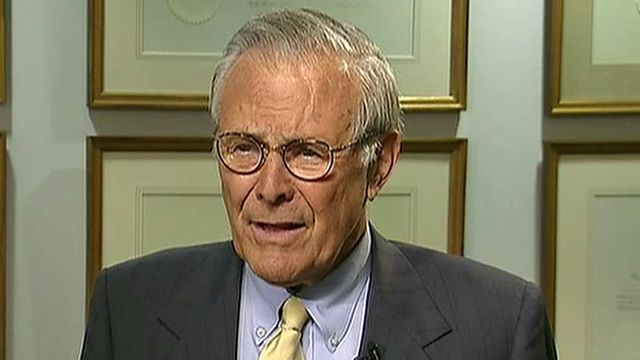
Former defense secretary Donald Rumsfeld goes 'On the Record'
- Duration 16:29
- Date Aug 2, 2012
You're watching...
Former defense secretary Donald Rumsfeld goes 'On the Record'
Also in this playlist...
Auto-advance: ON
Auto-advanceThis transcript is automatically generated
Right now -- former secretary of defense Donald Rumsfeld comes out swinging it congress he says congress is failing to do its job.
What -- why does he say that we spoke -- secretary Rumsfeld earlier today.
Mr.
second nice to see you sir thank you good to be with I big fight or sequestration.
What -- -- I think it's -- the idea of sequestering -- -- They -- hundreds of billions of dollars is fundamentally wrong if it's poor government.
And if if it does fall the way it looks like it could.
And it hits the Department of Defense it would be a monumental.
You say monumental mistake -- -- government.
It was agreed to by both parties.
A year ago where -- serve relinquish teen and there are obligations the people being blasier how to describe it because everyone knew this day would -- Sure and it hasn't come though.
It's close that it isn't there yet and what they did was kick the can.
And they didn't kick it very well we're very far.
And and haven't performed their responsibilities.
In the congress of the United States to pass responsible budgets that are thoughtful and -- intended.
This is a year stopgap excuse for a failure to you to do their job.
Cap hasn't -- -- used to be in congress is now has congress changed or is this sort of you know.
Cognition and the presidents like to move kick things down the -- event.
Well if it is there's a pattern in the country if you can't solve a problem create a commission or if you can't solve a problem kick the can down the road.
And that's not good I I think government and politics have changed it changed.
Partly because of television mean that it it you know when back in there.
Early days they didn't have television partly because of of gerrymandering in the house representative.
Where today -- Republican.
That the feature so solid in general for Republicans or Democrats that a Republican doesn't have to worry about -- Democrat competing.
They have to worry more about someone from the right a Democrat.
Don't have to worry about a Republican committee a Democrat -- have to worry about someone way from the left.
So that the pressure is -- -- polarized things.
And television has that effect and money I mean if you if you're if you have to raise that amount of money to stay in office.
Then what you people do is they devote a larger amount of time to raising money.
And the way you raise money has to be on television and to be seen to be noticed.
And to do that generally you have to say something that.
Dramatic you know the rule would be if it leads -- -- you have to think something that against it grabs attention.
And -- you find people behaving in a way it's designed to grab attention so they can raise money for -- perpetuate themselves now.
If sequestration is ultimately resolved that this a deal that's met -- you're still harm.
In this long delay this been going on for essentially a year is -- and certainly have a cost on our.
Our ability plan for military.
Yes it does.
-- for one for one thing we've made this mistake before we after a major conflict where a war to Vietnam Korea you name it the other end of the Cold War.
We've pared back dramatically.
And it's easy to do you can pare back in a month or six months.
To build back -- years -- investment it takes time it takes training people.
And and and the thing that worries me the most about today is the projection of America as a country -- week.
And that is behaving in a way that is.
Not going to be good for our future you you cannot have that kind of debt and those kinds of death.
And not send a signal to the world that we're behaving a lot like Europe.
And that model is not a model that works.
And you can't be cutting -- half a trillion dollars out of the defense budget.
And then have Seacrest -- and come along with the possibility of another half a trillion dollars.
And not recognize that you're telling the world America is.
Pulling back that America is not going to be a contributor for peace and stability in the world.
And the question is -- who is what country is gonna step in because vacuums get filled.
Which -- may issue of you Ron and -- and Israel United States and insistent many people the world -- -- Enron's marching towards nuclear weapons.
I'm second banana was just in Israel -- -- is just -- Israel Netanyahu prime minister of Israel says that these sanctions have had an effect.
On the economy in Iran.
But not on their desire our progress towards a nuclear weapon where where do you think this Iran issue has -- it.
Well I think it the prime minister of Israel.
Netanyahu is probably correct in their intelligence on Iran -- excellent.
Sanctions -- to work very well over a long period of time.
And they do have the effect tending to.
Damage and hurt the people as opposed to the government the people in the government tend to be able to manage their affairs -- go on.
The sanctions in for example in Iraq and -- hurt the Iraqi People but didn't bother Saddam Hussein he kept building palaces and importing weapons and doing what -- -- it.
We keep hearing that at all options on the table.
But I have no sense of terms of time -- you know I know it.
No sense of the timing I can say this I think any prime minister of Israel.
Who gets up every morning and and -- in the newspaper that the leadership in Iran says that.
The Israeli state should be annihilated.
Eradicated.
Incinerated.
Have to know that it's that prime minister's responsibility to -- that that doesn't happen.
So what should your what do you recommend and what do you think should be the US response that if you will if Israel goes solo and a -- support -- -- -- we say essentially you know we're with you we're not gonna have vote against you for instance you Leonard are -- -- Help supply military.
Support what what do you think.
Well I guess it depends on who's in the White House if -- in the White House sleep we historically have looked at Israel -- them.
Very important relationship we have been cooperative and we've assisted them -- various types of technology and weaponry.
If I were in the Israeli government I don't think I would notify the United States government of any intent to do anything about Israel about -- I think I think that.
-- relationship with the United States is such that.
It conceivably could leak out of the United States government that he call him that he plans to do something on Iran.
So my guess is given the pattern of leaks out of the White House.
That any prime minister of of Israel would not call the United States and and in give clear intentions as to what they planted.
There's -- knock on their times about six months goes and I know where came from -- -- you know one of those was Washington stories.
Which said that day Israel palate couldn't go along that didn't have the ability to fly all the way to Iran and and destroyed the bunker -- -- the nuclear.
Weapons area it's just under thirty feet of kind of concrete and then make it back.
That they need our help do you think -- -- has the capability of going along.
First of all -- I don't think that Israel has to destroy.
All of Iran nuclear capability.
I think what you're talking about is correct there's undoubtedly.
Iran is a game -- sophisticated country.
They must have multiple sites they must have deeply buried site and I'm sure -- really know precisely which I don't what they currently have.
And all the Israelis need to do was -- them.
They know they don't need.
You don't need to do something like that a 100% like they were able to do in -- in Iraq.
When they had their bombing raid and took out the Iraqi nuclear field or in theory where they took out the Syrian nuclear field.
They did it pretty much a 100% each case.
I don't think that that I think -- delay is works to Israel's -- I have no idea what Israel's punitive.
And I -- well I guess then and I guess that at least a question of how.
Devastating the leak was that we -- that that we are involved in partnership with Israel with.
The cyber.
The cyber worm in an effort to make get to.
Every leak out of the White House.
Is a signal to other countries be very careful.
About cooperating with the United States of America because if you do.
You very likely will end up running the risk at least of compromising.
Your country's relationship with the United States here compromising intelligence information that you need to defend your people.
And as a foreign country -- foreign -- you run the risk of compromising for -- There every every country and every potential person we try to recruit to assistance.
Looks at these leaks and says to themselves.
That's not a reliable partner.
Are these -- any different wash and always.
-- full of leaks -- the leaks that have come out recently.
This White House or this administration aware they originate them there's a investigation -- -- are these links of any different.
Quality or more serious or less serious is that Washington as -- No it's more series these leaks have have been.
Early and specific.
And damaging to our relationship.
Syria.
If they were second offense or president or not what we be doing much and I think that we would need to be.
Looking very carefully at who the rebels are.
Where they shipped across the spectrum from people who might be better than.
The current regime to people who might be as bad or worse than the current regime.
And I personally believe we should be providing Covert assistance to me.
People in that mix of rebels.
Who we believe would provide -- any better leadership.
Syria and Iran are link at the hip.
They are terribly damaging to our country they support Hamas they support Hezbollah they support other terrorist organizations.
They are harmful to us in Iraq are harmful to us and Afghanistan.
And and they are harmful in the region.
And and to change that regime is -- more important than what went on in -- Because of the damage that that Syria and Iran together.
-- to the United States of America.
He sent -- to single out which web rebel group does what because I know -- was recently in Israel.
And they are very concerned that there -- the regime fall.
That that Hezbollah -- -- hold of the -- chemical biological weapons sent a rebel group with great sympathy to Hezbollah Paris has look at me is isn't that an.
It that easy do down to identify which rebels who want to help which not.
No you can identify who we who's better to help.
Not we're not talking about -- for perfection.
Against something terrible we're talking about gradations.
And and it is possible -- to identify people that would be preferable.
Two others.
On the other hand it is impossible.
To determine how it'll come out.
Because you don't know what the dynamic -- and hand.
Leadership is important.
Support is important assistance intelligence.
Weapons and the like I think that.
We should be providing that kind of Covert assistance.
And I think we should be trying to figure out who they are but I think you have to be realistic.
What -- the the people that of the best organized for most disciplined are also probably near flawless.
And the the Muslim Brotherhood and the people who are the toughest and and the most brutal.
And and it they can be a relatively small minority.
In the spectrum of people opposing -- Assad regime you can have a majority of those people opposing the Assad regime.
-- people that are not -- flops but they still lose.
-- you can't tell how that's gonna come out.
And after our interview sector Rumsfeld took us on a tour of his office but it's not just any office -- looks more like -- museum of the United States history with a few personal touch is -- and.
That was -- candidates share from the Gerald.
George W bush administration and it put your jobs on the back a little brass plate there and it said it kind of makes me look like I couldn't hold a job.
-- -- -- -- -- -- -- -- -- -- -- -- -- -- -- -- -- -- -- -- -- -- -- -- -- -- -- There's a piece in the oval office for I did not lifted you offices was sent me president and they apparently redid the form.
Hear your friend Henrik Justin -- in.
Invasion back in 1974.
-- -- a lot of us and there's George Herbert Walker Bush and Kissinger.
He'll probably.
Don't show -- some of those folks.
I was chairman of Tuskegee institute hundredth anniversary and they gave me this Booker T.
Washington picture that's a a piece of the plane that the Pentagon that I picked up there that morning.
And brought -- me.
Into the office and once they heard ahead in the office it turned out it was the property of American Airlines -- -- to -- their permission to.
The -- crashing into buildings can feel it -- it will surely going to keep notes anchor and we could be seeing two planes flew into the portraits that -- and when it hit the Pentagon it was clear that we've been -- and the only question what was it was a truck.
Does she wouldn't when it was it picked this up and different from the get together today they greeted with signs so many copies for each other and and present and forward -- A look at things have Richard Nixon and decided he didn't want to lose faded ink it's faded beyond this is -- it and think -- -- was.
Herbert walker bush.
This wouldn't have a nice competition -- -- -- and Pulitzer Prize winning photographer from him.
Here's our place in Mexico that's where we live and that's our donkey -- we don't use fancy names American.
There's an Iraqi bill signed by allowing players -- -- in balance.
Karzai and his missile.
And intercepted a photograph.
Bullet principle.
It can be done picture of a pin and refused to sign -- the civil rights bills back in the nineteen sixteenths.
And this is that can that we -- to sign the defense appropriation bill in 1976.
This is your office it is they're my they're my Dachshund.
Eight -- -- this and wasn't sure what adjusters on the left and Wrigley name for Wrigley Field is on the right.
Because hope springs eternal we're still hoping that maybe.
The cubs might win that game or two sometime don't give back and this is your desk you don't you don't sit -- you -- yes I think and a there and work there I have since 1960s.
And I'm -- discovering that people are writing things about that that's supposed to be good for you.
To stand -- tell me about it felt.
This situation fellow central -- where you met him in there were delighted to meet you and and to visit the studio.
We now have had 62.
We bring them over for that period of weeks.
Group of -- twice a year.
And set -- up with people like you -- -- Scalia or.
Gary Becker a Nobel laureate under the Washington Post I think -- and -- people to meet and get an understanding of the United States.
And I get them off on the record hats he did they all locked out of there to return to their countries weren't on holiday into it has but I thought that -- don't get -- -- see our full interview with secretary Rumsfeld and Greta wire.