You're watching...
What does Mars rover mission hope to accomplish?
Details
-
Description
NASA's lead mechanical engineer describes importance of journey to Red Planet
- Duration 3:09
- Date Aug 6, 2012
You're watching...
NASA's lead mechanical engineer describes importance of journey to Red Planet
Also in this playlist...
Auto-advance: ON
Auto-advanceThis transcript is automatically generated
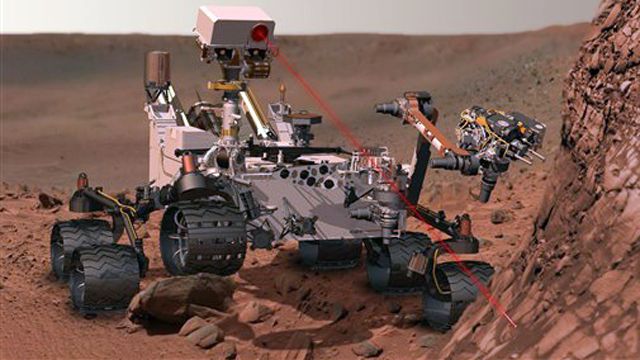
NASA says it's getting ready to broadcast even more pictures from Mars -- the rover curiosity landed last night.
Check out the reaction in mission control as the rover beamed back its first signals.
-- -- -- -- It's like they're happy about this.
The cheers followed a risky landing and NASA called seven minutes of terror.
The rover flew through the atmosphere at some thirteen thousand miles an hour the so called sky crane they've lowered it to the surface of the Mars were told.
Curiosity then sit back its first images NASA engineers say this is a picture of the rovers shadow.
Inside a martian crater.
NASA spent two and one half billion dollars on this mission.
Scientists say curiosities to discoveries could pay off.
Perhaps even clearing the way to put the first person on Mars let's bring in NASA's Adams stilts and are now.
He's the lead mechanical engineer for this clearly very risky operation sir congratulations why was it's so tough.
What thank you very much.
Curiosities -- -- bigger than anything we put on the service of any planet.
And getting her safely to the surface was a very hard job and required to -- For those who look at the checkbook for the country say we're out of money why did we need to spend -- -- -- -- -- bill.
Well Tom.
You know exploration.
Is a fundamentally.
Human thing and more importantly it's -- fundamentally American thing.
And -- seven dollars for every man woman and child.
The price of a movie.
And it's a movie I think the American people want to think.
You when you find of movie theater around these -- for seven bucks I want to go to it could -- but before the books all in all seriousness.
The object of being on Mars besides getting a person there that isn't everything really bit.
Put a person there what are we hoping to learn -- how willing to better ourselves.
Now we have some exciting science that would do with that we're planning to do on Mars -- asking the question.
Could life have existed.
Or does it still exist on Mars which has kind of a profound implication as to whether we're alone or not.
And and I'm assuming that we're hoping to learn something about something here in -- to be be really cool to know if there was life ever on Mars or if there's.
Every view is that life on Mars now or whatever but -- -- being cool how does that help.
We know.
Most many of the questions that we ask many of questions that we ask if humans that have developed things like the television that I'm speaking to you through that camera.
They didn't come out of question -- the sincerely we knew the answers were practical they came out of our innate human curiosity and -- wondering what was around the next corner.
That's how we.
Came to the west here in the United States and that's why we're on Mars today -- -- -- saying well we'll look forward to seeing those pictures with you and everybody else in the world and congratulations on and -- But a historic -- Thank you very much we're very proud of that you are good luck and thank.