You're watching...

Mars bears striking resemblance to Earth in new pics

Details

  • Description

    Evidence that planet can support life?

  • Duration 3:14
  • Date

Clips

Also in this playlist...

Latest Tech

Auto-advance: ON

Auto-advance

Transcript

This transcript is automatically generated

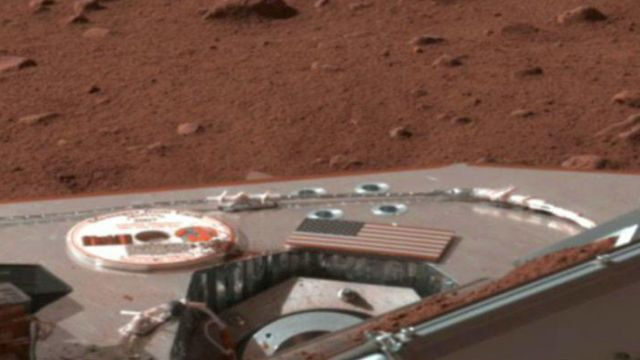
NASA's curiosity rover is hard at work on Mars it just send back some of the sharpest pictures yet from the surface of the red planet.

For many the most striking feature is how much these images look like earth what does this say about the possibility of life on Mars.

And the chance that maybe humans could live there -- some day well let's bring in former NASA astronaut Tom Jones.

He's -- Fox News contributor and the author of sky walking and astronauts memoir thanks for joining us.

-- pentium for the pictures looks so much like earth one NASA scientists actually said you would really be forgiven this is a quote if you thought NASA was trying to pull a fast one and we actually put a rover in the Mojave Desert -- -- the picture.

So basically.

Mars looks just like California is this -- further evidence that life exists there or did.

Well I think that they chose this landing -- in gale crater just because.

And it's earth like qualities that was so we might expect that similarity in -- they wanted a place where rocks had -- -- layers laid down by ancient water deposits.

And that might point us to the presence of organic chemicals that are the precursors to life or traces of past life.

And so this earth like landscape is just what is most interesting about Mars has got.

The most earth like climate probably an -- -- past if life got started here isn't certainly did it also arise on -- were looking for that evidence now.

And as an astronaut yourself this rover is going to be there for two years what are you most interested what are the questions you most want answered.

Well we're looking for evidence that that ancient past of Mars.

It exhibited the right temperature and pressure and chemical conditions to support life.

And we know how tenacious -- is on earth once it got started here expanded to every nook and cranny on the surface and well below the surface of this planet.

So if life got started on Mars billions of years ago and even though the climate conditions there have changed since then -- made -- this dry desert climate.

That life might still be hanging on their today.

And so for astronaut the idea might be to partner with the machines like curiosity.

And -- the human exploring skills of biologists and chemists and geologists to really get to the bottom of this question about biology on Mars are we alone.

-- we had other rovers on Mars spirit Phoenix an opportunity what makes curiosity so different.

Well in each of these missions to Mars over the last twenty years with pathfinder and Mars exploration -- spirit and opportunity in a Phoenix polar Lander.

We've addressed a series of more difficult questions about Mars and -- geologic past and curiosity now without laboratory that it's carrying can address.

The search for the chemistry.

That's necessary for life to exist or have existed in the past and -- for the first time we can analyze for organic chemicals carbon and oxygen and hydrogen compounds that are necessary.

If you've got life as we understand it.

And we can also analyze the very minerals and that bedrock that we see in these latest pictures.

To find out whether that exhibits the right temperature and climatic conditions for supporting life as we understand it.

So it's really just zeroing in.

On evidence for life.

In mars' past or not might be the driver for sending humans there one day.

To really get to the bottom of those questions that would be exciting all right Tom Jones thank you so much.

This month.