You're watching...

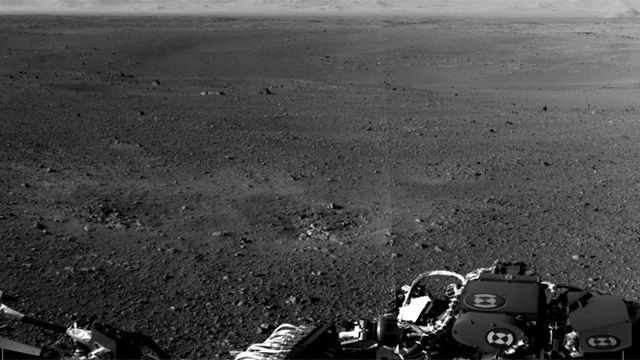
Curiosity rover sends back new images of Mars surface

Details

  • Description

    What do pictures reveal?

  • Duration 4:12
  • Date

Clips

Also in this playlist...

Editor's Picks

Auto-advance: ON

Auto-advance

Transcript

This transcript is automatically generated

The curiosity rover sending back remarkable new images from Mars these are some of the sharpest color pictures of the red planet -- -- calling images like these crucial to understanding the martian landscape.

A -- looks similar to deserts right here on earth curiosity is giving us an up close look at the gale crater where it landed.

And a news conference that started at the top of the hour NASA scientists say curiosity elated at the bottom final from its target inside the crater.

After journey of more than 356.

Million miles.

So what are NASA scientists most excited about now let's bring in Tom Jones a former NASA astronaut and Fox's contributor.

And Derrick -- the chief astronomer and planetarium program director at Philadelphia's Franklin institute science museum gentlemen welcome to you both.

Thank you for having me.

-- -- All right so why the -- is at the pictures are even more colorful they're more variations than they expected -- what does that say you about what we're learning about the surface there.

But was starting to be able to identify something about what the surface composition is -- what kind of minerals we see in different places across the surface.

And it begins to give us some targets of opportunity for study right there at that location.

We've also been able to identify that the superficial.

Sort of muffin here if you can if you can say of the -- -- right there on the surface is a right over some bedrock so right nearby there's some bedrock that perhaps curiosity could examine also.

It's not how much of six -- is it for NASA that after sending something reader 56 million miles elated within a mile at its target I mean this is we saw -- celebration when attached -- successful this has got to be.

Huge encouragement to NASA folks.

It is that it and this is the F precise target that they guys were aiming for on Mars NASA team that Jet Propulsion Laboratory.

Was using the precision targeting capability of Mars science lab curiosity.

To get right inside this crater that holds these sedimentary rocks that perhaps hold clues to early biology on Mars.

And -- this latest generation of capability that allow us to go into that's.

Otherwise hazardous crater and pinpoint a safe landing site.

And -- that we understand that it as you -- they'll -- taking samples will be reading knows we understand this is at least a two year mission although with the equipment holds up and that the data transfer holds up we know it could be even longer.

What do you think that we'll learn are they looking for signs of life signs of water what can we discern from the samples.

I think the really cool way that -- pursuing a question about life on Mars is a really good way to do it and that is to chase the water.

Can we find environments on Mars that might have been wet in the past that may have been conducive to the development of life.

-- there would be nothing wrong with actually finding conditions still that might be conducive to life on Mars.

But what they're really aiming force trying to figure out if there -- environments.

That way they can figure -- perhaps what kind of microbial life might be found on Mars.

And then begin to target that kind of investigation as well it's not though that we're expecting to see.

The real martian moons ago -- quote in this particular instance.

But we are looking for those environments and a step by step methodical method to be able to tie down the right answer is.

For sure.

It's -- how could this lay ground work this successful mission and the data that's glean from it for future NASA developments.

Well what NASA would like to do is follow up eventually with a sample return mission.

So that involves a very complicated series of spacecraft where -- rover like curiosity collects rocks on the surface.

But then it has to be close enough to a Lander that can help take on those samples and then blast the back into space returned to earth.

How -- -- on the surface have to take place -- this precision targeting that we've seen with curiosity.

Is a very good step forward for actually being able to pull off a sample return mission -- the problem is paying for it.

And a budget for NASA right now don't support this next step.

And I hope that those will be restored.

-- -- Tom and Derek -- -- your your comparable lady go it says provoked -- wrap up we think you look for sharing your expertise in these fascinating pictures.

Does every day something new -- back from Mars thank you both.

Thank you seven.

Well she's an -- Olympic --