You're watching...
How home-made prosthesis help people with mobility problems
Details
-
Description
Ivan Owen tells us how his project aims to make inexpensive prosthetics
- Duration 7:24
- Date Oct 22, 2012
You're watching...
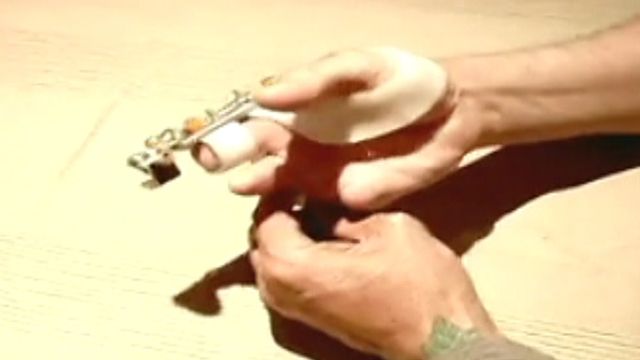
Ivan Owen tells us how his project aims to make inexpensive prosthetics
Also in this playlist...
Auto-advance: ON
Auto-advanceThis transcript is automatically generated
-- -- welcome back to fox highlights we appreciate you sticking around and next we have inspiring story.
About -- is to make inexpensive prosthetics.
For those who are are stricken with with with a -- perhaps that they have lost -- either -- tragic injury.
Or in an accident and an interesting way at how this all came about.
Ivan Allen who is joining me now originally developed a working mechanical -- hands.
However it was supposed to be used as part -- costume.
But then when apparently you uploaded a video of the device on to -- -- You were contacted by someone far away who saw how this homemade prosthetic actually could benefit.
Himself and an -- personal just tell me what what happened here because I hear I read the story and I'm thinking why what how did this.
Just -- the thing -- that -- Julian for someone to say thank you refer for having me on today.
That you're correct in -- the first thing that I built was.
There was it was there was basically a giant costume -- socially puppets.
That there's a very large oversized hand.
Hooks -- the before -- on the where his fingers.
I control the movements of the hand and this had listened to guide mainly did for fun.
But then I was contacted by a man named Richard -- us from South Africa who saw it.
And it's basically asked me if I would be interest in partnering with him on a project but he had started.
Which was developing a prototype for.
-- -- mechanical replacement for fingers -- -- lost.
And it was a very short email just a picture of his hand he's missing four fingers on his right hand.
And then did he had inquired as to whether or not I'd be interest in and joining him.
On that journey -- I was very very intrigued and so we've been working on a sense of.
OK so for people are wondering OK so you're not an amputee.
Used to working -- -- -- hands you happened to go which is interesting have been fascinated with hands which is why you thought to do this right.
And you've been a musician since you were nine years old -- musicians use their hands.
So you're not a doctor your not a scientist you heard someone who has.
The fascination with -- but yet has has -- has come up with something that is quite incredible.
Well and -- -- that the financing is I had that fascination when I was young and I I honestly I would even sometimes kind of daydream about cyber not a technology grain on the of course let's not the -- we ended up going by -- There is interesting because it wasn't until Richard contacted me it.
That.
I I made the connection between the the thing I've made for -- -- and it's potential real world application.
Our Richard was relieved that it is that it is the driving force behind it sounds.
It's been it's it's been a very interest and -- to to get to know him and to work on this together.
From those early beginnings of that initial fascination as you said.
This has been it's it's pretty incredible connection I'm I've been very very pleased to have the opportunity -- -- one -- our guard.
People spend so much money on prosthetics and these large companies obviously as you know manufacture them.
And they charge a boatload of money I want to show some video actually of you.
Trying on your prosthetic that you developed that was originally.
Set out to be part of a -- -- now could potentially change lives if we have that video can we roll it.
I was told -- -- the video there says.
Right.
What could use.
-- here is here's Richard actually trying on the prospects he's missing a few fingers.
-- -- holding on to that the peace what did you explain to us what we're looking up.
Imperial -- looking at here and and one of the first things I'd like to note that's very impressive is Richard actually constructed that completely by himself.
-- based upon all the designs that we've come up together.
So you know you he's a very very brilliant individual and a very mechanically inclined so even with his reduced functionality.
He.
Took you know and pushed through it and -- and build -- -- what you see there.
And essentially it it's completely body powered we're using honestly -- this technologies that are much rather old technologies just look at -- based on the principles of leverage and pulleys.
And so when he moves what's remaining of his index finger.
It activates the device and causes some of -- mechanical portion of the finger to.
To bend and as you can see it it increases in the dexterity on the accuracy with which -- can interact with every day off -- It's okay that's a video that he actually took in South Africa and you have a video that you films.
Have you actually testing one of the prototypes by having it.
Following minute the motion of one of your fingers so you're you're doing here we were just explaining why you.
Further elaborate.
-- that is correct one of the challenges has -- because -- separated by 101000 miles.
We've had to come up with creative ways to.
To share our designs with each other and then test those designs in real time.
-- you know because I have all my fingers of the what I have to do is come up with systems that can allow me to test it by.
Using the portion of the same portion of the finger that Richard -- and then that way we can kind of tested -- see what works what what -- and what needs refinement.
And that's been one of the ways that we have been kind of getting around the the vast separation of.
Well I mean I think eventually you're gonna be -- have you been approached by a large car corporations and then.
In your ideas here because I mean how much would it cost if you were to market -- -- You know that that's an interest in question because we we really haven't been -- had to have any pictures from large companies.
And the reason why is because -- Richard and I have already given away the rights to the design.
We we're doing this is an open source public domain.
Idea because our our vision for this is that we we don't want to to be profitable.
We'd like this to be as accessible as possible.
That's that's the goal.
Is so you know our long term plans would like to start a nonprofit organization and the states and also in South Africa.
To to further this effort to.
-- to be able to basically educated on how to build the systems so that buildup and the results of this isn't something the people on the website and exactly people can actually make these at home.
Wow exactly if the guy and that the goal is -- -- -- they either they themselves can build it or if they have this a little functionality left but they aren't able to.
But perhaps they know -- -- I could assist them what that.
Some may you know.
So that cuts that's the ultimate goal and hope they know when we're getting closer -- day.
Where are showing the website there and I just want to Tim mentioned the -- the website address it's coming up short handed.
Dot com there's a blog also to keep everyone.
Up to date and you and Richard are working in person from the United States in South Africa.
But despite the there's 101000.
Mile separation between the two -- quite incredible.
That people that are in the same room can't communicate let alone having the fact that you guys are able to do this is amazing.
Thank you so much in.