You're watching...

True size of the national debt

Details

  • Description

    Calculating the reality of U.S. economy

  • Duration 5:12
  • Date

Clips

Also in this playlist...

Editor's Picks

Auto-advance: ON

Auto-advance

Transcript

This transcript is automatically generated

Well behind urgent battle to avoid that fiscal cliff.

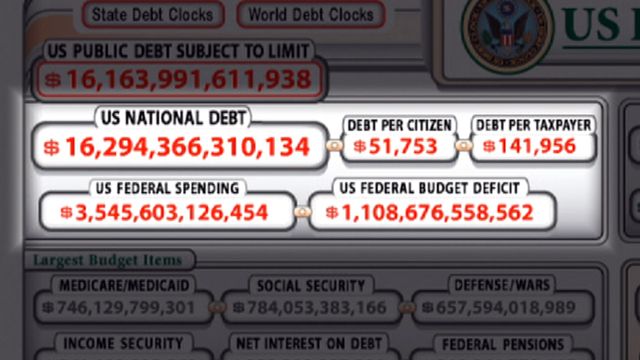
-- is the growing national debt here's the number that most people talk about we certainly do a lot.

It's around sixteen trillion dollars above that but our next guest says.

That figure really only hints at the true size of America's former congressman Bill Archer was the chairman of the house maids.

And means committee he just -- an article.

After the Wall Street Journal today that talks about that so congressman sixteen trillion dollars you say that doesn't tell the full story what debts.

No -- doesn't Jana because the way that the federal government keeps its books.

Does not include.

The promises.

Which are now made to the American people for all of the entitlements mainly.

Medicare and Social Security.

And when you look at that.

Over the future.

-- like can add another 86 trillion dollars of obligations.

And that is not included.

Wow -- eighty and 86 trillion dollars is difficult even conceptualize.

Sixteen trillion dollars is tough enough and so disown -- you know we have this straight.

Sixteen trillion dollars is what we alike are IOUs.

Right now that you're saying and it -- seventy trillion dollars on top of that.

Is what we will know if things don't change.

Absolutely and and it's coming at us.

Inexorably.

And unfortunately the American people do not understand all of -- us but we're heading in the same direction as Greece and and a lot of the other European countries except it is going to be -- Massey.

As it develops that even the world capital structure will not be enough to accommodated.

You confronted the same as she wrote about this and wants -- journal today when you when you served in House of Representatives and he served a long time 1970.

-- to 2001 -- spent a great deal of time.

And service which we appreciate congressman why can't why can't we get our hands around -- reality this and why can't changes -- made what do you think is really the obstacle.

Here -- the changes are that that the American people really do not want to make sacrifice.

Today.

And politically it is very very difficult to touch some of these areas which the American people have become dependent on.

And the idea is always conveyed that someone else is gonna play for it.

The idea -- conveyed to people a day out here and over and over again on television where you pay for your Medicare benefits so you should get them and it should not be reformed.

But the reality is that the American people and their lifetimes.

Only pay about half or maybe even lesson and -- half of what they will expect to withdraw in the way of benefits.

After they get on Medicare.

There's -- odd thing if I could that we actually have a screen that shows a little bit about what you're talking about about how much we might pay and and what we actually use as far as money.

What we're getting our screen out and urban institute you can see in the year 22 -- -- per two earner couple that's making just under 90000 dollars.

I had -- -- the -- their annual salary over their lifetime they'll pay a 153000.

Dollars and -- Medicare.

But they'll likely use you know -- no more than double that.

In in the benefits that they're going to need in their retirement but -- like to take you up an issue that you said that you know the American people aren't willing to changing it even among you know my friends today.

We we actually don't really think that some of these entitlements are cutting -- simply based on the number -- seems like there's an opportunity here.

To make a change in in this path to get off this -- from 86 trillion dollars is gonna lead -- to that.

What do you think it's going to be -- what rakes the deadlock.

Well.

Well I think what will -- break the deadlock sadly enough will be one we're unable to borrow enough money to meet all of these commitments.

At an -- straight that we can afford.

And we will get there if we -- and when we get there not.

Well if there -- sure -- -- -- by the time you get there because once interest rates begin to go up.

And people began to say wait a minute we don't wanna hold any more US debt the Chinese -- already backing off from it.

Then.

It's very very difficult to solve the problem we can solve it today if -- willing to make some.

Relatively.

Small changes and -- -- Medicare and Social Security.

But you saw the -- the Democrat the leader of the senate.

Who they said we're not gonna touch Medicare.

As a part of the ultimate solution to solving the -- problem.

So that the Democrats have over and over again -- we do not want to touch entitlements.

And the irony is that.

When you elected the massive massive nature of these figures.

There's not going to be enough taxes to pay for them.

My -- and that's with the Republicans say when the Republicans say they're not going to tax tax rates says seems like there's a standoff there between.

-- to non negotiable is the probably I need to be negotiated in the one where are the other congressman is nice to have you on the program but -- -- -- I -- -- thank you thank you.