You're watching...

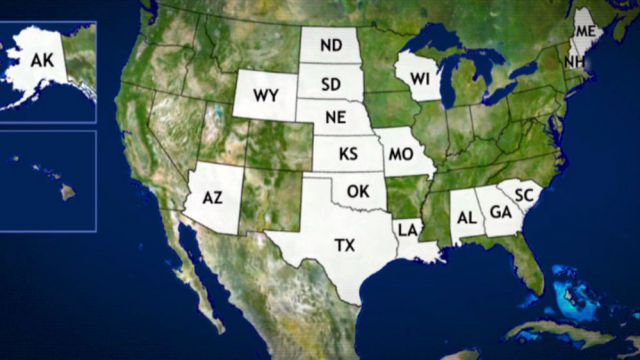
17 states reject new insurance exchanges under ObamaCare

Details

  • Description

    Georgia Gov. Nathan Deal on why his state is against health care requirement

  • Duration 4:47
  • Date

Clips

Also in this playlist...

America's Newsroom

Auto-advance: ON

Auto-advance

Transcript

This transcript is automatically generated

-- -- Arizona just announcing it will not create a state insurance exchange under the new health care law.

That's an exchange a marketplace for people go to pick and choose what coverage they want.

Seventeen states and are refusing to set of those exchanges and that means.

That'll be -- to the federal government to do it for them -- Georgia governor Nathan Deal is one of the governors who is that you were rejected the exchange.

He is our guest live now out of Atlanta answered good morning -- you governor thank you for your time.

Good morning nice to be -- you were on the record about a week ago -- just use your words here.

We have no interest in spending our tax dollars -- exchange at -- state based in name only putting me back.

Well it appears that everything will be dictated by the federal government.

The flexibility that states that ask for appears not to be exist and in their proposals.

We've asked questions a number of us governors have sent official questions to the secretary.

How severely is asking the kind of information that we need answers to.

And we've received virtually none of those and often there are several reasons why.

I think you find states rejecting it first of all he is the calls it is an unknown figure.

And all of us are struggling to meet our current obligations under Medicaid.

And to add up factor that is an unknown.

Quantity.

Is simply something that is not accept our governor I -- -- go through a series of questions here in the three minister we have OK you know your detractors say sure they say are just plan politics.

What do you say to them.

I say absolutely not you know historically.

The regulation of insurance has been a state function that's why we have state insurance commissioners we -- have a federal insurance commissioner.

We will have won of course maybe not in name but in practicality.

It is not politics it is the cost.

And the question of state control over an issue that's so important to citizens of our states and so -- seventeen some suggest this -- could climb well -- twenty.

Some people even suggesting 25 might be the number in the end but you you're doing it because you think you're saving taxpayer dollars in your state.

How much money do you think you're saving taxpayers because this decision.

What it is an unknown amount first of all we do not know what -- requirements are going to be for administrative cost.

It is obviously in the millions of dollars every year.

And certainly something that our state budget can out of -- okay now -- the services for the people who live in your state.

Will they now be worse off than perhaps somebody who's living -- -- else that actually has one of these exchanges.

I don't see how that is the issue if they have an insurance policy.

And if all insurance policies are going to have to meet the criteria of the federal government.

Then if they have a policy that is issued by state exchange or a federal exchange.

Presumably their benefits would be -- -- -- -- if the federal government is slow to set -- one of these exchanges you know there there's there's a group of people who will be without insurance.

They just back to the question are they worse off or not because they live in Georgia.

I don't think there will be any worse off the federal government is always said if the states do not establish the exchanges that they would do so.

I think the reality is that they are not prepared to do that.

Because late to do not know what it's -- -- call I think you're right about that and based on the reporting we're getting fourteen months away the federal government's a long way from making this happen.

What do you believe happens to the overall law.

-- states like Georgia and sixteen plus others.

Refused to go along with this aspect of -- Well I don't know of course that's going to be up to congress as to whether or not they come back in and try to tweak it to the -- states the kind of flexibility that we've all asked for.

I do not see that in the short term I think it's going to be a situation where if the federal government cannot make it work.

Then the practicality is going to dictate that they have to be changing -- -- even some Democrats this week for suggesting that some of the should be in negotiations over the fiscal cliff to try and can prove it before we get too far down the road you think it's likely.

Well I don't know I think the up fiscal cliff issues are certainly at this point bigger than perhaps this one is in the short term.

But in the long term because implementation greatest point fourteen it will certainly be a factor to be considered.

I do not see how you of soul of these calls a long -- it's.

The expanded Medicaid rolls that that the act content Alaska governor thank you for your time Nathan Deal Republican out of Georgia appreciate you sharing your.

Opinions with us thank you -- Like -- all right --