You're watching...

'Brain pacemaker' tested on Alzheimer's patients

Details

  • Description

    Researchers cautiously optimistic on new treatment

  • Duration 1:58
  • Date

Clips

Also in this playlist...

Editor's Picks

Auto-advance: ON

Auto-advance

Transcript

This transcript is automatically generated

Looks like there's new hope tonight for alzheimer's patients and their families researchers report they are cautiously optimistic.

About a new treatment for the cruel disease that robs people of their memories.

They claim that they're saying promising results as they put it including slight memory improvements among their -- suspects.

Chris Allen has more from our LA newsroom this afternoon out of district the work traits.

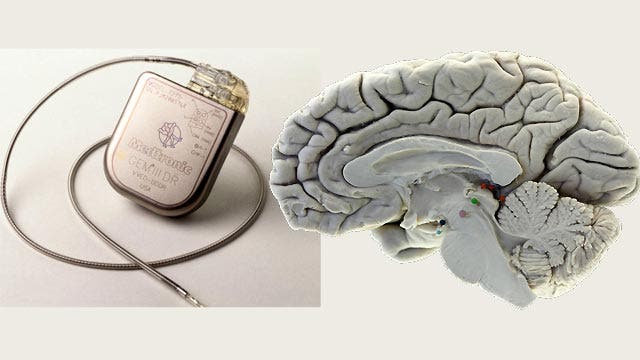
It's similar to a pacemaker for your hardship bullies for your brain what they do is they implant -- device in the chest and then two wires actually go up the rule -- this -- and then into the skull and then they go along the wiring of the brain in the natural wiring that no wires deliver electrical charge.

Into the parts of the brain that you use for learning and for memory.

Here's a doctor list.

What's exciting is.

Our understanding of how memory works fits well with how this surgery -- -- or hoping to see.

He is improve memory and that people don't decline as fast as they would without the treatment.

Now so far six Canadian patients have gotten the implant and shown slight memory improvement but big time improvement when it comes to brain metabolism which is what you lose when you get alzheimer's.

The first US patient.

Got this device implanted today -- while it is the thinking that this might eventually replace alzheimer's drugs.

Now they're actually -- use this kind of along with the drugs the truth says the alzheimer's drugs have not work nearly as well as researchers had hoped five point two million Americans currently have alzheimer's and that's just those over 65 it doesn't include early onset alzheimer's and by 25 do you see there could be up to sixteen million Americans.

Women have a one in five risk mostly because they live longer than men men have a one in ten wrist but again with treatments like we're seeing today.

Those numbers could change dramatically.

-- we can hope Trace Gallagher an LA Trace thanks.