You're watching...

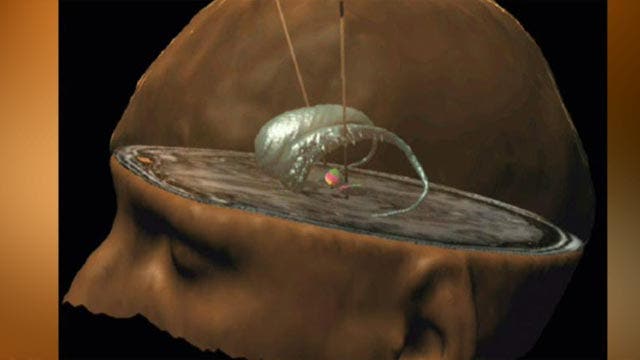
How does 'brain pacemaker' for Alzheimer's work?

Details

  • Description

    Johns Hopkins researchers experimenting with device

  • Duration 2:38
  • Date

Clips

Also in this playlist...

Studio B

Auto-advance: ON

Auto-advance

Transcript

This transcript is automatically generated

Researchers at Johns Hopkins University say that they have successfully implanted the first pacemaker.

For the brain.

As a possible treatment for alzheimer's.

Doctors say the device sends electrical impulses to the area of the brain that feeds memory.

In an effort to stimulate them -- -- memory loss.

If this trial is successful it could be a major victory against alzheimer's.

Experts say one in eight Americans.

Over the age of sixty viable eventually develop the disease.

One of the doctors overseeing -- clinical trial joins us now doctor Paul Rosenberg is an associate professor of psychiatry and behavioral studies at Johns Hopkins.

At the school of medicine -- -- good afternoon congratulations and thank you.

Thanks for having -- chat tell us what this thing is and how this thing works if you would.

So this is that's very similar it was surgery that's used routinely now.

In severe Parkinson's disease.

What you do is you -- the neurosurgeon.

Drills drills to -- little skull.

And guides to very thin wires to each side of the brain.

And then those wires attached to other wires which go under your skin.

And eventually go to what looks like a pacemaker a thriller like a battery sits just under your shoulder -- And what the battery does is it sends electrical impulses through the wires.

And -- impulse is actually drive the brain may actually increase the neural activity the electrical activity of the brain.

Does this -- over 80000 times in Parkinson's disease.

We're starting to use it for alzheimer's and the differences were stimulated different part of the brain -- stimulating a part of the brain that we know.

It's involved in memory circuit so -- hammer different different Nelson.

Statement this is -- the team at Johns Hopkins the first to perform this thing.

I wonder the degree to which you think isn't gonna have a real impact on patients' lives.

How did it it might well have a real impact.

There's a couple things that could come out of this.

Obviously we're hoping that the -- that the that the surgery works.

-- we have some preliminary data from an open label trial that means everybody got the stimulation.

Done in Toronto and we we not only found some evidence of memory improvement.

But we also found some evidence that we might be slowing down the that that the decline in the disease what we're doing now is a controlled trial.

Half the people we'll get the stimulator turned on immediately.

And the other half we'll wait a year before we turn it on and it was a controlled trials so I don't know.

Who's got it turned audio patient doesn't know I'm -- I'm down as time -- thanks a lot.