You're watching...

Fiscal cliff by the numbers

Details

  • Description

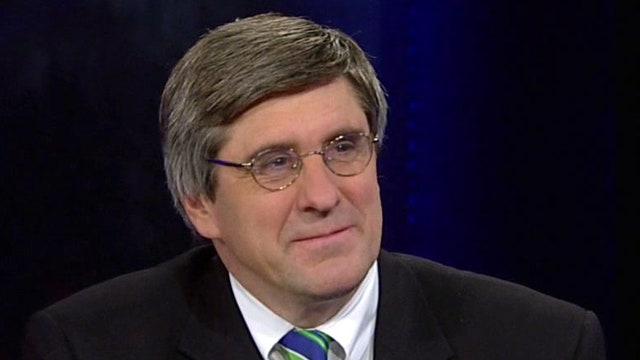
    Wall Street Journal's Steve Moore explains

  • Duration 4:42
  • Date

Clips

Also in this playlist...

Powerful Politics

Auto-advance: ON

Auto-advance

Transcript

This transcript is automatically generated

While much of the conversation Washington regarding fiscal -- is solely focused on tax rates or how the federal government can bring in more revenue from Yale.

What are the other side of the equation cutting back on spending and -- all this money.

Wall Street Journal senior economic writer Steve -- -- to talk about that and also to help us separate fact from fiction when it comes all these numbers we're hearing about in the debates he thinks the kind of.

Shannon featherweight thank you for asking that question about the spending -- out of the ledger because.

The last two or three weeks -- this whole discussion about race attack -- and almost no discussion about where it what are we gonna do about reducing the -- -- -- the outcome rather -- -- Well let's start there if if we stopped overspending at this point why did it take for the government to get lined up to get rid of this debt and the deficit issue that we -- You know we've dug ourselves -- the such a deep hole when I when I first came to Washington we talked about the budget deficit in the billions of the colors now we talk about the -- and some dollars and part of the problem is -- these numbers are so gigantic it's hard even fathom how big they are but the trillion dollars by the way is a million million dollars and our national data sixteen trillion dollars -- -- -- away.

About one point one trillion dollars a year now here's the problem the president faces in my opinion.

Even if he gets his tax increase -- the -- in the negotiations next few weeks and he may very well.

That's still leaves him with about a trillion dollar budget deficits out.

Even if we do these tax increases Mr.

President what comes next and I think that's.

Really where we have to start addressing the spending side of the equation and the conversation a lot of folks don't wanna have a right out and and Democrats why does it mean right the Republicans don't wanna cut the military part of the budget the -- -- Democrats don't wanna cut any of entitlements.

And his group like -- -- but we've got to get serious about this and the way I like to put -- is if you look at businesses of the last four partners and households to.

In this recession what do they do they sucked in their stomach tighten their belt they got rid of extraneous -- That hasn't happened at the federal level in -- federal -- -- operator 40% even as the private sector has.

Has got more efficient so I'm a big believer we have to get really serious quickly about cutting spending.

Absolutely are you you touched on this we talked about -- the -- -- get everything he wants as far as getting additional revenue from high income earners by our research what it shows us that that and that would only fund the government for eight days.

-- not a basic this whole argument.

There were -- in Washington about how about that what about the other 350 days of the year and you're right this just doesn't bring -- you know the reason that -- is there just aren't that many people who -- who make more than 250 or 500000 dollars or not that many millionaires -- avenue Warren -- out there.

So the truth is if you want if anybody believes.

That you're gonna deal with this deficit crisis by raising taxes on the top two or 3% the map really just -- now about.

Arts and -- -- we have right now let's talk about.

Death by the numbers how much does every American oh right now we have this worked up and it looks at the answers I don't know if I can do that now -- a 52000.

Dollars per American right now if you look at what our -- -- -- our population so that means that just sitting at this table you and hire are on the hook for 100000 dollars and.

And by the way that means of course for a family of four that's.

200000 dollar so the way I like to put this when I give talks to -- this is like a second mortgage we have and we -- -- and -- -- in the we have mortgage and I aren't that.

And the problem as you know when you ask me how long it will take to -- -- our debt.

We have to stop borrowing before we can get to the point were even paying right that's an -- he.

You know when you ask me about that -- fifty years before we actually payoff -- that the first step is stop borrowing and that and that of course means stop overspending our.

Really quickly we'll have a little bit of time yeah this is kind of a difficult one to get to what we hear the White House constantly say they want an -- -- If taxes are going up on anybody it's -- -- be -- top 2% and that they're going to quote save the other 98% from a tax increase.

But not all Americans pay federal taxes so -- -- federal income taxes so to say that you're gonna stop major tax increase for 90% Americans.

Not -- -- the whole -- no I don't think so in fact.

I'll make a prediction you can you can have been a year from now on -- -- -- if I'm right I think what's gonna happen is they're gonna have those tax increases on the rich.

And then and -- three to six months later you know what's gonna happen -- that say oh my gosh where we didn't raise the money without right out of it happened how come after the middle class and that's I think appoint Republicans have to make is.

Look at -- good to deal with this by raising taxes you can't get that money from only rich people you have to go after that other money except night.

I think that means probably an energy tax maybe -- gasoline tax.

The president has talked about carbon tax all of those things I think -- them beyond the on the shelf next -- Everyone in their pocketbooks Steve Moore always good to have you help us break down these numbers and a sentence them to -- you graduate you.

Right regularly.