You're watching...
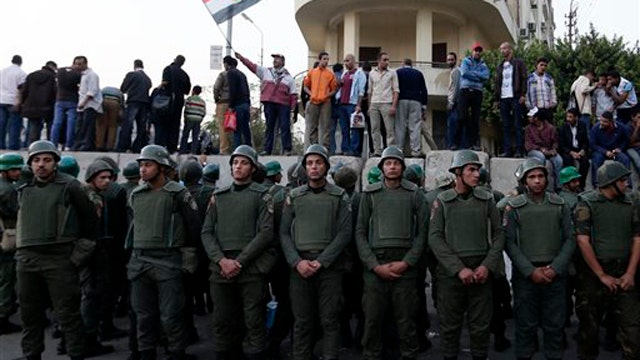
Assessing US plans to send military aid to Egypt
Details
-
Description
Should we continue will sending help?
- Duration 5:04
- Date Dec 10, 2012
You're watching...
Should we continue will sending help?
Also in this playlist...
Auto-advance: ON
Auto-advanceThis transcript is automatically generated
All right now that it -- overseas as the crisis in protests worsening.
It comes in the form of equipment like 200 Abrams tanks and an entire squadron of F this F sixteen fighter jets.
This is all part of a one point three billion dollar military a deal that's already been earmarked for -- Officials fear canceling it what it meant job losses here at home and losses in major penalties for broken contracts upwards of billions of dollars.
But arms shipment comes as Egypt's new president Mohamed -- essentially cracks down.
On his opposition in a move creating some -- even -- instability in this country.
So is this a good idea if you this type of -- Michael -- is a former senior director Middle Eastern affairs the National Security Council also managing director.
For the Washington Institute for Near East Policy so Mike what do you think about that.
-- got to remember that this aid dates back to the Camp David accords between Egypt and Israel and the theory behind the aid which is long standing.
Is that number one it preserves good relations between the Pentagon in the Egyptian military.
And especially at a time of real crisis and chaos in Egypt that those those ties could come in handy as a pentagon things that they did during the revolution in 2011 in Egypt.
And second that it also ensures that Egypt will actually adhere to the peace treaty -- Israel.
Now whether you believe these things are true -- depends on number one do you think the military is still an independent actor and Egypt.
Or do you think that now it's sort of side sort of subjugated to the Muslim Brotherhood and president -- -- And second do you think that Egypt is really gonna walk away from this peace treaty with Israel which is in its own interest simply if we walk away from the -- So let's pick apart a couple of those points do you believe that -- can be trusted as a true ally of the United States.
I think the jury is out again if you see what he's doing now.
He's acted sort of responsibly in the region so far brokering a Gaza cease fire there's some counterterrorism cooperation.
But it seems that sort of like Cosmo borrowed before and he's hoping no doubt will it's sort of get him off the hook.
When it comes -- his domestic activities which he's engaged in now.
So would we potentially are -- someone.
That is neither friend -- -- and you need but a question mark.
They are -- question mark and and I think you have to you have to keep in mind of the USC's this assistance as for the military.
Not for president more -- again whether or not that's a valid distinction is up in the air I think many people would say -- that.
A government which acts in an extremist way at home is ultimately not going to act responsibly in international affairs just look at say Pakistan for example.
Or look at other governments -- around this region which are extremists in nature.
And it's in Jersey mention Pakistan because of our aid that Aussie goes to that country and what has to wonder in foreign policy discussions the year ahead.
What kind of -- need to be attacks if you believe they should be Michael with this aid in the years to count how do you think we should navigate that.
Well I think -- one lesson of Pakistan -- that when there's an opportunity to change when there's opportunity for a new modus Vivendi.
You need to seize upon that because it's awfully difficult the change these things down the road they opportunities don't come very often.
And as we look at how to change -- -- I think we have to recognize -- tanks and jets.
Are really more of a payoff for the Egyptian military than they are real solution to the region's security problems which are things like.
Arms smuggling and counterterrorism.
And if we keep these military aid programs in place they need to address those threats not be sort of this outdated way of doing things we've always.
That they've -- military though it is separate from Morrissey and the potential we're still again navigating that relationship and we support about 80% in the military.
-- procurement in Egypt right now.
How do we do that because we're dealing with -- more directly are we dealing with the military commanders behind closed doors to -- haven't.
A different type -- relationship with the military right now -- can they be trusted not to turn those weapons against -- or arm off so our ally Israel.
I think I think you know what the Obama ministries and wants to do right now is sort of get through this very turbulent period of the moment so you're not gonna see a change in this -- I think right now I think what they want to see is how does a military behave for example.
During this referendum out of a -- after the referendum -- and I think our beat.
Well I think that what's what the concern is here is that it looks like Morse is trying to ram this constitution through this in the constitution was asserted islamists and its character and concentrate power in the hands of the president.
You -- to the opposition is it maybe boycotting this referendum on Saturday -- maybe protesting.
And so we'll see is a military going to for example crack down on the opposition.
And sort of help this constitution get through and -- sort of undemocratic way.
I think that would raise real concerns about their independence from this from the Muslim Brotherhood and from president -- -- as an interesting point because we remember watching the military.
With the overthrow eventually Mubarak and how their role should -- shifted during those protests -- and how it could be seen as a tipping -- you mention Michael.
A great to have your insights as always thank you so much.