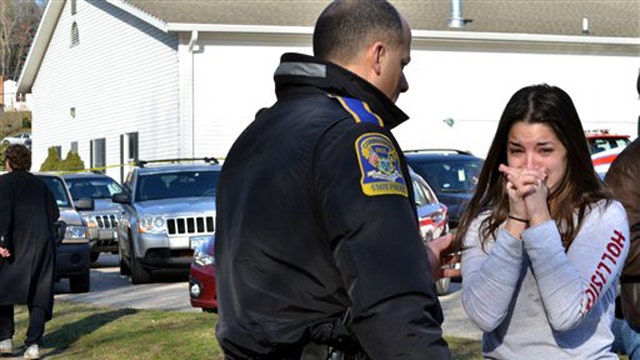
You're watching...
How do parents explain shooting tragedy to their kids?
Details
-
Description
Child psychiatrist Dr. Alvin Poussaint weighs in
- Duration 5:45
- Date Dec 15, 2012
You're watching...
Child psychiatrist Dr. Alvin Poussaint weighs in
Also in this playlist...
Auto-advance: ON
Auto-advanceThis transcript is automatically generated
Well your child didn't have to be at the scene of yesterday's horrific school shooting just hearing about it -- watching images on television can be traumatize and as well.
How can we explain what's happening -- children nationally recognized child psychiatrist doctor album -- on from Harvard Medical School.
Is joining us now and shares is valuable insights on ways to offer youngsters comfort.
And hope at a time when so many of us are struggling to find answers to the senseless tragedy.
After -- not great to have you here thank you so much for joining us today.
Thank you.
If your child says I'm really scared isn't it the worst thing you can say is there's no need to be scared should we acknowledge their feelings.
Absolutely.
I think the first thing we should do is listen to the children react to their fear they agree they're being scared they're being anxious they're being depressed.
There wanting to be comforted and and and -- that's also very important and for the parents just kind of stand by a lot of those children.
And children around the country because of what happened in Connecticut.
Going to be having nightmares tonight sleep problems may be eating problems may be a lot of physical complaints stomach aches upsets.
I think parents have to be.
Very alert to that.
And know that they have to be reassuring to the children as much as possible.
Many of them around the country not just that again in Connecticut I'm not going to want to go to school on Monday perhaps because they don't feel safe.
They're not clear why this happened and whether it could happen in their school was as well.
And so they're gonna have some anxiety.
And parents may have to support them and reassure them.
That there -- safe in this school.
Now right now people are not feeling that way but putting it in perspective.
These occurrences.
Are relatively rare if you look at them so it happen it's awful.
It's tragic it's painful particularly for the Connecticut people who -- this is going to be with them for the rest of their lives.
But I think we should that.
His -- other children in country know that they have relatively.
Safe.
And that the parents will protect them to school do all that they can to protect them to police will do all that they can to protect them and so far.
And looking at it in the long term.
It has been working well but we still -- god by these awful horrific.
Tragedies that damage.
Not only the communities in the children.
But also the entire country.
Indeed you've done some groundbreaking work with the young people particularly when it comes to issues about violence.
How do you engage teenagers for example in this conversation.
Well I think teenagers -- pretty much have a regular discussion.
About the violence they're going to be as puzzle as as adults.
But I think we also have to explain to two teenagers and children.
That we have to do all that we can to prevent violence you know since these things the shootings starting decades and decades ago.
That we have.
Violence prevention programs conflict resolution programs we have programs that teach children tolerance anti bullying programs so that young people don't develop the kind of -- hate.
And fury and frustration.
That needs someone to commit a crime as horrific as this one.
So that I think we still should focus on out.
Violence prevention efforts and I think -- whole issue of gun control should come -- parents should participate in in that other citizens.
What kind of controls do we need that might minimize his chances.
Of something like this occur.
And I think that things we can do like right now.
We have close to 300 million guns in circulation in civilian hands that -- that's like one gun for every.
Man woman and child in the country if you have that many guns in circulation you can be sure -- there's going to be some people we don't have to talk about motivation.
We can talk about the fact that they a certain number of deranged people on that same mentally ill because that's you know.
Kind of controversial issue but this certainly.
Deranged people who do something like this in my definition.
These people are suffering from mental disorders of various types.
Being expressed in different ways -- -- so I think as.
I was I do you think the young people.
May have a tendency to become immune to some of this violence if we continue if they continue to see these stories.
That we've seen over the last several months of -- shooting after another.
Well yes yes they can in fact one of the things that we know is when children watch a lot of the violence on television and the movies and even in video games they've become a bit numb to at all.
As if it's not really happening as -- they really don't appreciate what.
Death and killing killing his so yes that can happen and even yesterday some of the kids were acting a bit numb to all the violence.
Remember which children -- violence.
Probably nearly every day.
On the 6 o'clock news as well as in.
Use in video games as well as on television and in the movies.
And so it's like it's like an every day kind of manner and the younger ones -- even quite sure when people -- killed that that day.
Yes so that would we have to -- we have to continue the discussion.
And that and make it a positive one.
It to try to do something about these horrific events apps.
-- Leo it's great to have you here sir today thank you so much for sharing insights we are.
Certainly grateful to have you on today and of course this is something that we're going to be talking about some time appreciate it.
Thank you.