You're watching...

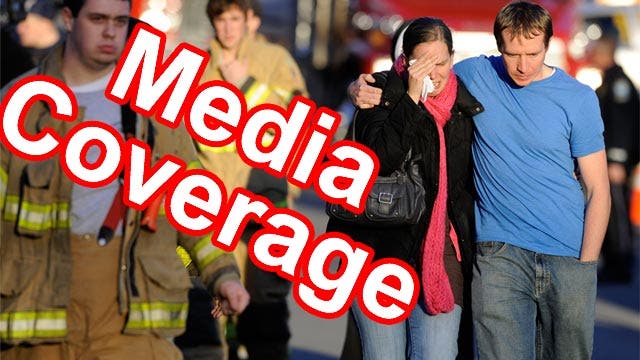
Discussion of media coverage of Sandy Hook shooting

Details

  • Description

    All-Star panel weighs in

  • Duration 4:03
  • Date

Clips

Also in this playlist...

Editor's Picks

Auto-advance: ON

Auto-advance

Transcript

This transcript is automatically generated

Sometimes we take viewers' questions and comments we bring them to you.

This is from -- -- Leibowitz who writes quote I would like to hear some discussion regarding the media coverage.

The terrible school shooting.

An indescribable it's sad situation in Connecticut if special report won't do it no one will.

I cannot be the only one to finding endless coverage troubling for what it says about the media and its viewers.

We seem to be a society which insists on concrete answers rather than.

Coping with the incomprehensible.

Which personifies through.

Vicarious experience seeking tragic catharsis without giving due respect to reality.

Thinking this way does does not lessen the horror of what has happened in sandy hook.

And what is happening to those involved simply acknowledges.

That no amount of TV coverage can lessen or make observers a part of it.

And that only are respectful sympathy is appropriate.

It has happened to them not to us Gillian thank you for the -- we're back with the panel hands.

The audible two addressed the media coverage of this -- Look in some way it's like that it.

It's classic question posed by the Holocaust for example.

So you -- -- basically wrote the books early after the Holocaust really the only appropriate answer site.

There's nothing you can say Edwards there will be adequate to the task -- in some ways it diminishes it just by speaking about so that's always the problem.

On the other hand silence is not an answer that society can except.

It has to talk about it has to discuss it and in cases where it's not only in the past but it may lie in the future these kind of mass killings.

You have to talk about it too because of the politics what which you can do.

So I do agree with the -- in some sense.

If there's an over emphasis and I think the blanket coverage is perhaps too much you know people say what do we tell our children -- I would.

You can shut off the -- who doesn't have to invade the life.

I was three year old who seek to -- a nine year old.

You know living in a different party United States but in the end it will panic because that's that's the kind of global culture that we live -- And if it's going to let let's talk about it let's be reasonable.

About solutions that might work.

Tomorrow nonstop coverage you know look -- -- running -- comedian does is too much -- -- almost everything the media doesn't any extreme covering any kind of harmful horrible violent or extreme situation -- just by definition too much.

Because there's so much media.

I mean the funny thing so there's going for -- today there's a million channels that's on the Internet and this is the kind of thing that people can understand and relate to and they can't get enough of it.

I I sympathize with the viewer I don't know what we can do about it you've got to warn appropriately you've got to try to figure out what you can do to just prevent something like this from happening.

In the future.

But.

You know I think that respect for the families is the bottom line here.

Steve you have and I think for me the question is not that it's being covered but how it's being covered.

And I remember back when I was in journalism schools is a long time ago and our original reporting and writing one class one of the assignments was to go out and find Indian newspaper the family of someone who had just been killed just died.

And set up an interview and I went to the professor's -- I'm not gonna do that assignment I'm not comfortable doing that particularly foreign journalism school class.

And I had a personal experience dealing with this back in the gulf -- one of my good friends was killed.

In the fighting over in Saudi Arabia and his his house became a camp out.

For these news cameras and we were so angry.

At the reporters who were there all the time you know the second walked out of the front -- and they were there with a microphone in your face.

But I will say that after covering 9/11 as being in New York the twelfth.

You you you get a different sense to a certain extent their family members who want to tell their story and want that person to be remembered it to be remembered in the particular way that they're telling the story.

Balance that's what we're trying to do here and -- -- -- well on special report.