You're watching...
How can America better address mental illness?
Details
-
Description
Former Homeland Security Secretary Tom Ridge weighs in on issue
- Duration 6:50
- Date Dec 18, 2012
You're watching...
Former Homeland Security Secretary Tom Ridge weighs in on issue
Also in this playlist...
Auto-advance: ON
Auto-advanceThis transcript is automatically generated
When there's so many new right.
Now about how schools and how society.
Can better address the issue of mental illness in light of the tragic school shooting in Connecticut.
-- lands that reportedly suffered from mental illness issues we're still learning to what extent they existed and for how long.
They existed but he is clearly not the only.
Gunmen in these kinds of random mass shootings that we have seen who battled mental disorders.
-- and talk about that and how about this from Connecticut senator Joseph Lieberman.
Who says that he believes that family and friends need to get involved in these situations early on.
We've got to ask.
Parents friends school officials if you see a child a young person.
That really looks like they're potentially.
A true really troublesome.
Get them mental health help and then we -- ask ourselves -- -- as a society.
Is there -- enough mental health help available for these kids.
Yep boy that is becoming.
The big important question in all of this -- one of them clearly I'm joined by former Pennsylvania governor Tom Ridge who served as our country's first Homeland Security secretary.
And a walk on good morning good to have you here today.
-- it's always good to join him -- are we doing that can have a discussion about that horrific events that the elementary school you know it it is so.
The gut wrenching.
When you when you look deeper into this story and and particularly.
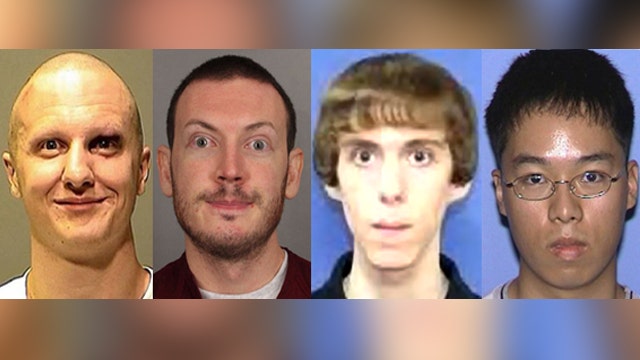
With this issue of mental illness how want to pull up onto the screen picture.
Of several of these young men and there's a profile that emerges it in that.
Common qualities.
All 125 years old.
You've got show from the Virginia Tech shooting.
You have -- lands on the left from Connecticut.
You have -- locked -- -- from the Tucson shooting.
And James Holmes.
From the -- wore Colorado shooting and you know there are a lot of similar characteristics.
In these young -- all of them.
Had intervention from school psychologists.
Several of them took medication on an off.
What does this tell us about what we're not doing right in terms of treating.
These issues.
Well for so I think it's very important that the discussion around what to do.
Focuses not just on the Second Amendment precisely on the profile and the trouble profiles.
But so many of these -- into your point which is well stated in in very important in the national discussion.
You take a look at the incident and come back and take a look at the individuals and there is well it's not universally applied there are many many instances where these young man.
And had serious mental health problems -- And when I served on the Virginia Tech panel was quite obvious that it show himself had a -- deteriorating mental condition.
That was recognized early on in grade school and high school followed all the way through recognized by teachers recognized by a special justice.
That he was a potential danger of harming himself from the community -- yet the treatment was inadequate to end this so.
-- this is reminiscent of this some of the challenges we have -- up Homeland Security balancing individual rights with the need for the communities to be safe and secure so it's it's not just the Second Amendment there's not a right of privacy and that is something that we have to look at very carefully because the cut.
-- is not identified in the constitution but it's -- it's a right that people of the -- that the lawyers and and the Supreme Court have -- for a long time but we gotta find the right balance.
Firearms in the hands of mentally disabled the mentally challenged individuals -- is that they not be it may be at the epicenter a lot of the problems we've had.
You know you you take a look at mental health and the history -- -- in this country.
And we've gotten away from the time when we had institutions and people were committed to an institution if their families could not deal with them.
Now that understandably.
Ran into some bad situations where people were committed they were in institutions that were horrible.
That were you know offensive to everybody sensibility and then we got into a time period.
Where we wanted to sort of mainstream everybody everybody should be able to live in society and you know.
And have the same opportunities everyone else has.
And now you got a situation where in -- there's -- very poignant blog that went out this morning by a woman who is struggling with a child who she says.
Is the next Adam -- -- okay.
And the desperation that this mother feels in the lack of ability to get help I want to read some of this mother's.
Blog to -- this morning.
She says no one wants to send a thirteen year old genius who loves Harry Potter and his snuggle animal collection to jail.
But our society with its state run mental illness and it's broken health care system does not provide us with other options.
Then another tortured soul shoots up a fast food restaurant a mall a kindergarten classroom.
And she goes on to say we wring our hands and say something must be done this -- mother has shown up at a hospital.
And hit I need help someone please take my child he's threatening to kill my other children and me.
And then the next day his docile and happy and saying mommy I'm going to be better I promise what what are we offer this woman.
Well first of all she's a heroin in my mind because that she's a -- in a very public way.
The situation that frankly a lot of parents are probably would be very difficult for them to raise and that is the public recognition.
That their son has a mental health challenge and and she also used the word is very appropriate that's why it needs to be part of the national discussion -- -- ties.
Young people -- mental health problems instead of reaching out and trying to help them and clearly clearly.
The mental health that community is have been adequately staffed and adequately funded for a long time.
Not that everybody needs to be institutionalized -- not everyone necessarily needs to be put on some kind of drug regiment.
But the fact of the matter remains at various degrees of mental health -- have to be recognize and have to be dealt with and I love Joseph Lieberman's call for parents and friends.
To recognize these problems and try to direct these young people to help.
The pattern of activity the report and a lot of these individuals have been involved in these.
Mass murders have talked about suicide they've talked about killing other people we can you think in this day in age in this generation you want to snitch on your buddy who just talked about doing something like that it's a cultural problem and it's something that we and -- mental health problem we better address it soon and seriously.
And -- -- -- -- is that if someone hasn't been charged with any crime as -- Lanza was not he -- -- even on the radar.
Of the law enforcement people in his neighborhood in his town.
Eat eat your you have very little recourse as a parent in terms of helping -- break -- -- you know -- -- don't -- you're gonna get it fixed -- if you have a child.
Who is threatening to kill your other children.
Or anyone else you have very little recourse is really an important topic that we need to -- Address your thanks so much after talking about islands this morning Tom Ridge a totally to his ideas are bankrupt entity when your family's.