You're watching...

What does 'dangerous' national debt level mean for America?

Details

  • Description

    Growing concerns about speed of borrowing

  • Duration 5:05
  • Date

Clips

Also in this playlist...

America's Newsroom

Auto-advance: ON

Auto-advance

Transcript

This transcript is automatically generated

Growing concerns about the skyrocketing.

National debt -- -- that number to the right of me just taken away over the last several years.

Right now every household in America.

-- a 140000.

Dollars if you break it down that way of our sixteen trillion dollar national that.

And with trillion dollar budget deficits.

-- gonna -- up right back with Callaway has five.

And with a look at this frightening situation paid out.

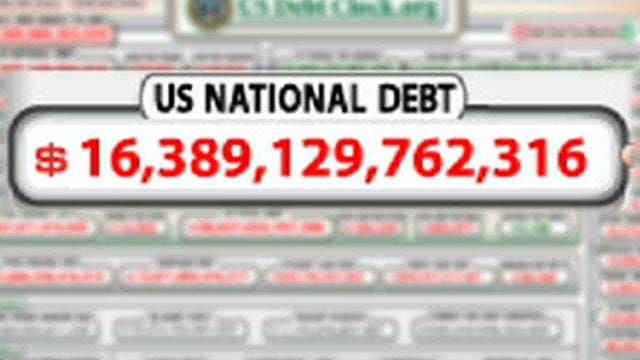
Hey Martha you know -- we blew right on past that sixteen trillion dollar debt number that we focus so much attention on earlier this year we are well on our way out to seventeen trillion dollars in debt.

Here's a live look at the -- clock again which now stands -- -- 161000000000289.

Billion plus.

It means that every US household holds a owes a 140000.

Dollars of data -- so huge.

It dwarfs anything in history even though Americans of earlier generations were alarmed at their government's reckless spending.

In 1835 under president Andrew Jackson the -- was a mere 34000.

Dollars.

Under Abraham Lincoln and 1865 and risen to three billion dollars in 1929 at the time of the stock market crash it had risen to seventeen billion.

And then towards the end of World War II was 259.

Billion.

But all those numbers pale in comparison to today's debt under President Obama more than all the previous presidents.

-- -- -- That it's a pretty picture.

Not that I -- thank you very much -- -- -- Callaway in Washington you know at some of these warnings have been national debt is nearing dangerous levels here to explain what that means Stephen Moore senior writer cannot senior economic writer.

For the Wall Street Journal what does that mean -- the warnings -- Steve.

I've felt like you know the the amazing thing about this doubt -- I was thinking when I first came to Washington.

Which was in the early 1980s that gut level was about 2.5 trillion dollars.

-- sixteen point two -- up and by the way every president going back to it at Dwight Eisenhower has promised that they were going to be out of the budget and we and the debt keeps getting bigger and bigger -- -- the real tragedy is that over the last five years.

The debt has increased by almost six trillion dollars that's more money then went borrowed from 1776.

Through the year nineteenth answers they so if they had ever traveling -- What's the danger in this economically speaking for us.

I think the dangerous to Paul -- one is that if you look at the budget right now.

If we continue on this pace of borrowing which were expected to do trillion dollar deficits for as as far as the eye can see.

We're looking at somewhere in the neighborhood.

Of a trillion dollars cost each year bell.

-- only servicing deduct the interest payments on the -- which means.

That that that current that taxpayers won't get anything in return any government services they'll be paying taxes just a paper -- past fiscal sense.

I think that's the big problem the other related problem -- Is think about what happens to be interest rates start to rise as you know interest rates are as low as they've been since the Great Depression now no economist -- -- Thinks that rates are gonna stayed -- while.

As interest rates start to rise over the next 235 years guess who's gonna pay the highest -- for that.

The biggest -- in the world the US government so I think those of the danger.

Every house on the US it was a 140000 dollars of this every council.

The country borrow six billion every day -- by the time is our hands full borrow 239.

Million dollars.

And the crime here is that for every dollar -- revenue the government brings in it spends two dollars.

And six cents.

And now -- -- have you heard any serious discussion.

About reversing this trend because that's what you're talking about a little while waiting.

That's what we've been -- about the last month but I often is these fiscal -- negotiations.

But here's the kind of frightening thing about that spell it let's say the President Obama and John Boehner and the Republicans reach a deal and they're able to cut.

You know one or two trillion dollars from the data over the next ten years which is kind of the upper limit of what electing you -- but I -- you don't just think about we just said.

-- two trillion over ten years -- which is nothing what does it probably.

Yeah that does nothing and we were supposed to borrow another eight trillion dollars and ten years will dog got nothing to reduce our national debt.

And so you know we're not we're not even treading water -- here -- we're losing ground year after year it's gonna require from some.

Fairly steep reductions in spending and the other thing we have to do is accelerate economic growth in this country you know -- -- last week.

Let me just make one other point -- we saw last week that the that the Federal Reserve is pumping.

You know record amounts of money into the economy one of the things that we're doing now for the first time in our nation's history.

Is that that that treasury is borrowing all this money and bill guess who's buying all the -- it's actually the bad reserve bank and wherever they get.

Get the money to -- the -- -- they print that so we're printing money to pay are done for the first time in our nation's history and when you know the problem is here you can't agree to cut spending in the government is broken.

Stephen Moore thank you.

In Oxford journals to come to this plan a plan BC.

-- them -- a -- and you.