You're watching...

The biggest court cases of 2012

Details

  • Description

    Legal year in review

  • Duration 6:31
  • Date

Clips

Also in this playlist...

America's News HQ

Auto-advance: ON

Auto-advance

Transcript

This transcript is automatically generated

Now national health care and Lindsay Lohan -- takes 2012 was a big year for the courts.

In January the Supreme Court ruled that before the government places a GPS tracking device in your vehicle it has to get a search warrant and then.

Four months later it ruled that children conceived through in vitro fertilization after the death of a parent are not automatically entitled to survivor benefits.

And then of course in -- the High Court gave final approval -- president Obama's health care law.

For look back at the most notable cases of the year.

And also what the court could look like from here Doug burns a former federal prosecutor and criminal defense attorney.

And John Manuel -- a criminal defense attorney as well fortunately I don't need any criminal defense today.

Guys thank you so much I know that you can also talk a lot about the Supreme Court because.

People may not realize that these High Court cases really influence those who -- practicing -- day -- day.

Doug what do you see is some of the significant -- tell me your thoughts first on the health care.

Well the health care ruling was very ashamed because I've called that aren't going to be any sort of -- head -- all the reporters ran out of the building say.

It's been struck down it's been struck down because what happened was in the opinion Jamie as -- remember it was struck down on commerce clause grounds.

And on what we -- all the necessary and proper clause grounds it had to be yes and that exactly and then there was on -- page ten or wherever -- that it was being upheld as a tax which I agree with.

But you know the long and short of it is it's the same.

Analysis that we rendered all year long which is it's 4700 pages long I'm not so sure that anybody really understands that I asked a good friend of mine who's a practicing physician.

-- it could explain the basics of the you know health care law he looked at me blankly so you know hope.

Believe it look like the tax code yeah exactly bottom line is note to law students you read the last three pages of the decision before you read the first three but I got grass.

John what do you think about the court agreeing to take up to gay marriage cases what could be the impact of that.

Well they they've they've court as a balancing act to do obviously Fiore the person homosexuality.

And would like your rights there's an equal protection clause of the constitution.

So the courts actually going to be visiting this and applying to balancing test to what if any rights.

Gay people in and gay marriages have and applied accordingly so it's going to be interesting to see.

How this court -- -- and interpret.

That classification of people us -- specifically homosexuals and and what they wanna do which is get there full rights as anyone of us.

Some members of society have that's gonna be -- but going back to the Obama cause the L Obama healthcare act I thought that was a particularly interesting ruling from the court.

I disagree I think -- tenth amendment belong to the states so you know I stand aside from my colleague mr.

burns on that want.

Now when you're entitled to your opinion certainly.

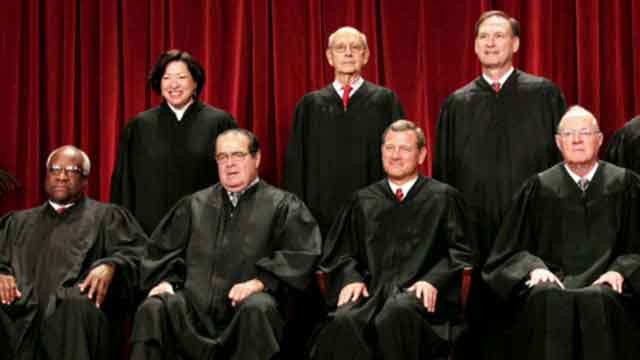
I want to ask you though wouldn't say it's interesting take a look at those two cases and contrast the makeup of the court right now in the fact that in a second Obama term.

Yes.

President Obama could appoint as many as two new justices -- could happen.

Second really changed the complexion of the quarry I still at Kennedy as a swing right what it what do you think it'll look like.

Well course it depends who lives I mean Ruth Bader Ginsburg obviously everybody is saying well most likely be the next justice to leave the court.

-- if that case if that happens he's made -- ideologically it's a swap in a sense.

And then what you're getting at -- in your right is you know what about the next seat that becomes vacant.

You know will there be some type of ideological.

Shift I mean I can't resist the editorial that it's unfortunate that.

People view the court as being somewhat of a political institution in the sense that the justices rule and fairly consistent patterns but the reality is.

The cases that get to the Supreme Court are so close and the standards are so wide open that that's why you see those tendencies.

John do you think that Justice Roberts could.

Make any court make up work in terms of really interpreting the constitution.

In the way that it was meant to buy our net.

That four.

Fathers -- This is what I learned.

From -- Obama.

That case I learned that the Supreme Court is unpredictable.

As we discussed earlier everybody thought it was gonna go one way and went the other.

Robert surprise assault -- his decision and which side he went on.

So it's really hard to tell it and again you know.

Obama does get the opportunity pick one if not two of the Supreme Court members -- based on what we saw with the Supreme Court in the Obama.

Health care act again that we we don't know -- -- supreme court's gonna go to dynamic is different in every case facts are very individual.

And obviously unique and every case so it's really hard to tell and predict these types -- out comes John what other.

Case struck me this year is being interesting for the court to -- to begin with and a decision that came out that really was thought provoking for you is a very experienced attorney.

I I -- the Jones case was good requiring the GPS the warrants.

On the GPS us -- -- cases.

Specifically use US Supreme Court said look if you're gonna follow somebody gonna put a GPS system.

All on their car you're gonna need search warrant and as a criminal offense charity obviously I -- that decision because.

It is an intrusion on your fourth amendment rights specifically the right to privacy.

And and again it's a slippery slope at the US Supreme Court denied that and said they don't need a warrant then what else could the US what else -- our government do.

Tell us as far as our privacy rights are concerned -- I -- that decision.

And I was very happy about the ruling on not one.

You know Doug -- -- former prosecutor I was not.

I am surprised that you didn't need a search warrant.

-- in order to place to GPS device -- why did it make it dug up to the Supreme Court well I think.

Historically they would put some kind of you know when I was in the US attorney's office like a bird dog device which wasn't GPS per say but allowed for some tracking.

But I think that when it got to the level.

And and John's right where they could literally you know see on the screen exactly where you war as he says I mean you're looking at sort of a Big Brother concept.

-- and I think under the Fourth Amendment the court correctly.

Ruled that you need to search warrant.

-- which in simple English means you've got to establish some kind of level of probable cause that the person is violating some law before you can do that and I agree that it.

That that's a good standard yes I can't tell you came in on Christmas -- really appreciate it's one of the most interesting legal segments I've ever had the pleasure of doing thank you both very much thank you Jamie.