You're watching...
Wounded warrior gets new lease on life
Details
-
Description
Medical and technological advances help quadruple amputee get back on track
- Duration 8:20
- Date Dec 26, 2012
You're watching...
Medical and technological advances help quadruple amputee get back on track
Also in this playlist...
Auto-advance: ON
Auto-advanceThis transcript is automatically generated
Many of our returning men and women in uniform are coming home from war with invisible scars however.
The wounds of the man you were about to meet -- very very obvious but then again.
So is his perseverance and truly inspirational lease on life here's national security correspondent Jennifer Griffin.
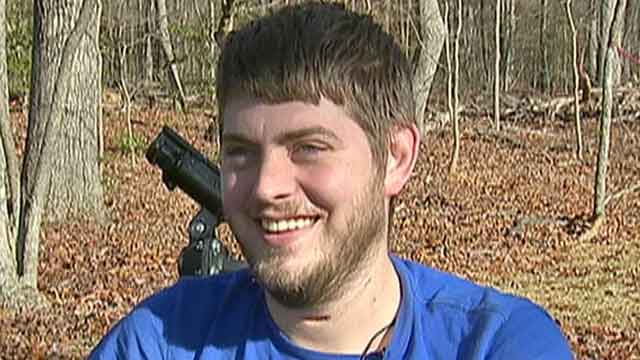
Marine sergeant John peck is one of five quadruple amputees to emerge from the last eleven years of war.
He is overcoming what has become one of the signature wounds facing American war fighters since nine elevenths.
I was injured may 24 2010.
In Helmand Afghanistan.
I want to go turn around took I think it was my left.
Foot forward and next thing I know as I'm basically being flung through the air and I land -- -- that like mud and sand dirt whatever was in my eyes just basically could not see at this point.
I can make out like little bit of color in a little bit of shapes and everything.
And just basically telling us on one guy here I don't wind died here when you wake up two and a half -- -- and and basically found out that don't have unusually someone.
-- -- him.
-- -- Much less than three years later he's sky diving.
Accessing -- -- and jump off a -- that sounds fun.
-- Whitewater rafting cliff jumping.
-- Welcome back in previous wars Jon peck never would -- survived but he did.
This is the story of how he and so many wounded warriors like him.
Are adapting to their new lives how the signature wounds from Afghanistan and Iraq IED or roadside bomb blast.
That -- lead to amputations in traumatic brain injuries.
Forced the medical field and technology to evolve.
And how that technology is now serving the newly injured war fighter.
Tech has had 29 surgeries in two and a half years from can't keep up.
Now he lives on a wooded patch of land with his mom Lisa in rural Virginia.
Two weeks ago the nonprofit group started by veterans called independents fun.
Gave John a new lease on life and a chance to do something that a standard wheelchair can't do head outside and off road.
Into the forest where many of these warriors grew up hunting and fishing.
-- can now drive something known as attract chair.
A new technology developed by a couple in Minnesota that allows the wheelchair to function like an all terrain vehicle.
Twice -- ITV's.
Mean I guess I would.
Fiscally conservatives -- really -- a tank 27 year old Jon -- looks like a boy who was given his first DMX bike for Christmas.
-- My darkest fears could.
As -- divorce his young wife left him -- -- and hang with the injuries.
To want to me for the for me being six foot tall and having muscles and everything like that once I got injured she couldn't hang with that I was just a very angry and spiteful person that -- want to be around people -- include myself.
But his mom Lisa was with him every step of the way from the first moment she heard he'd been hit it I don't remember a lot of that day.
But -- what I've been told is site pulled into the driveway.
And tuning from my car apart from that the car and he asked what do they do my baby I was told him all of us like that.
He and I could get through anything together -- we stuck together.
And first -- -- central and -- I'm here.
It's okay.
You can get through this -- And we have.
If it wasn't for her being here I didn't I would probably -- saying.
Come -- -- and a -- -- -- served in Vietnam he would have ended up like that character lieutenant -- From the movie Forrest Gump.
Angry and alone.
Ironically it was a group of residents from Buford South Carolina where that Hollywood -- was shot and a former New York firefighter who impersonate Elvis.
Who raise the money that allowed -- to have this wheelchair that cost 151000 dollars and which the veterans administration can't afford to buy.
For amputees like sergeant.
Pack you're missing you know Monica needs help 24 hours a day can't do that basically anything for himself I have every day for -- -- they care about what I need to do.
And I have my prosthetic arm on I mean if I can make meals for most part and be myself and just because were -- doesn't mean we're not capable of doing things.
Jon -- in the military doctors at Walter Reed and save Temps are rewriting this chapter of the battlefield medicine.
Doctors like colonel Rocco.
2003 where he conducted brain surgery in an army field -- It was quite an education we're out in the desert.
South of pollution -- about fifteen miles west of Baghdad.
We're in the open desert area with limits resources and that's unheard of to be able to get the nurse surgical care -- that close in the battle line.
An -- -- has conducted 600 brain surgeries in the past twelve years making him one of the leading neurosurgeons in the world.
He has written a book on decompress -- -- out -- me so much so that would congresswoman Gabby Giffords was shot.
Her civilian doctor called Walter Reed and doctor -- for advice.
The biggest thing that we're doing differently now is not trying to remove every single -- of bone or every single piece of metal that penetrates into the cranial vault compare to previous conflicts.
We're doing much larger incision to that we will leave half this -- offer anywhere between.
Four to six months this much longer than civilian sector because we have other problems to deal with in terms of infection.
Too late swelling.
During those twelve years while limb prosthetics have improved dramatically for the wounded warrior.
So have school prosthetics.
Going from plastic to a new and improved titanium.
That resist infection and allows better facial reconstruction for the patient one of doctor -- -- patients now works for him.
Lieutenant colonel Eric -- is a former special operator medic.
Who was blown up by an anti tank mine in Afghanistan in January 2009.
His skull was smashed when he was thrown into a concrete.
-- that's like swimming with.
Half full suit of clothing on you can do it but you're not as efficient and you're slower and takes a hard time to get there in -- awkward.
So until the -- the brain actually catches up with what she wanted to deal.
There's a there's a significant amount of frustration.
Because you know what you can do -- you just -- don't quite know how to get there I could not filter in other words with a final injury.
Talking to you right now -- Deb bright light.
-- that air conditioner going on right now I couldn't concentrate.
Now Erik Cole is on a medical fellowship at Walter -- studying ways to deal with chronic pain.
He himself a traumatic brain injury survivor is now investigating how to prevent brain trauma and post traumatic stress syndrome.
By a nest that I think.
The warrior on the battlefield flocking to nurse rather than using morphine which has been the battlefield drug of choice since the civil war.
For Lisa pack the medical advances gave her back her only son I just kept reminding myself that.
I've got him he's got me she sat by his bedside at Walter Reed for two and a half months.
With her hand on his chest so that he could feel her presence until he woke up.
I would take my iPod in there and I would -- -- one year but in his ear when your body and mind and I would -- To the music.
To -- he knew that I was there and every day for two and a half months I would go and sit in his room and I would just play my hand on his shoulder or on his chest and I just talked him just like.
I knew we could hear me I still -- you here you still have work to do.
Finished a got a lot of good you're still young.
Hang in there.
Hang in there he did and now like so many warriors on the mend he is getting his life back on track.
Yeah I don't have arms and heavily exposed like stuff could be -- I mean I could have no mobility whatsoever.
Stuff can always be worse there's always something worse -- going out in Washington Jennifer Griffin Fox News.