You're watching...

Group confronts lawmakers on spending crisis

Details

  • Description

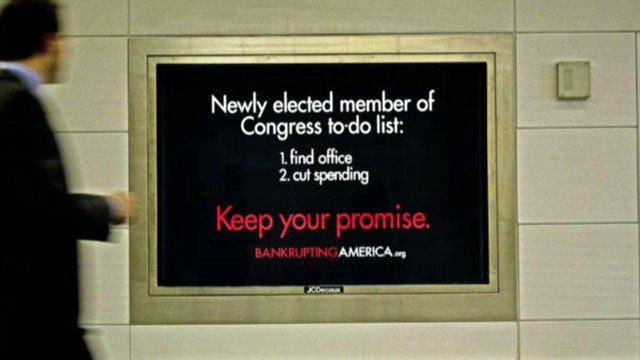
    Posts ads around Washington D.C.

  • Duration 3:19
  • Date

Clips

Also in this playlist...

Latest News

Auto-advance: ON

Auto-advance

Transcript

This transcript is automatically generated

And welcome back -- critics say the deal to avoid fiscal cliff does little to avoid -- piling on public debt and one group is letting lawmakers know about the -- Ads like these all over Washington DC they're aimed at telling members of the ruling class one thing.

Talk is cheap.

Overspending is not bankrupting Americans a project of the public notice a group that teaches complex budget and regulatory issues to the public.

-- Hammel is its executive director Gretchen good morning.

So.

How will these ads convinced people that overspending really is a problem I -- people have a theoretical concern for the government spending too much money but.

Sometimes hard to convince them that it's going to affect them how -- -- says make the difference.

Mean we had a debate over the course of the past few months has largely been around taxes and been about revenue.

But what the problem -- is spending it it all comes back to how much we're spending and how the government has been overspending they've been overspending by trillion dollars for the past four years.

And it really comes down to fixing that source of the problem in that inning and we -- Ads will help educate Americans about what's going on.

But also hold our members accountable these ads -- on Capitol Hill and they have a lot of quotes from.

-- bomb that from president George W.

Bush talking about the promises they made it had spending.

And they didn't.

Yet when -- these ads go up to go up before the fiscal cliff talks or just afterwards.

They -- actually on New Year's Eve and it's basically just to remind every one of all the campaign promises that they made over the course of the past year.

I mean look at President Obama -- four.

And we'll just take him as an example when he first came into big office back in 2009 the -- with ten trillion dollars and he promised to cut it.

I half before the end of its first term and here we are.

Sixteen point four trillion dollars later saying think for George study -- he came into office back in 2001 when the debt with -- trillion dollars said he would had a I two trillion dollars.

And didn't quite get that -- So you make a point that you don't often hear made at least among.

Small government advocates in Washington which is this is a bipartisan problem spent yet it is not just the Obama administration has been going on for some time.

Having going on very very long time both parties are responsible for it.

And I think this is an issue that we have to forget who that messenger kids.

At the end -- -- -- this burden will -- on the American public and to raise taxes on the American people is the easy way out.

But the problem is is that you cannot tax your way out of this he -- every 100%.

And we would still have a -- -- sixteen point four trillion dollars that's going to be growing to 21 trillion dollars by the end of the next five years have you heard from any members of congress.

Having you know signs every week we heard -- a few staffers -- they have to weeded them out and and you you know we encourage every -- use the hash -- talk is cheap.

But they're getting the attention and we hope they continue to get the attention I've got the rest of the month as the inauguration is coming.

-- ever around and they only problem is and we wish they can get a little bit more attention -- and fortunately.

And you know Rex Ryan -- -- was already taken.

I thought I thought that's that's a shame regrets and -- from Washington thanks Gretchen.

Think do you think that's well --