You're watching...

Will WH employ 'zero option' in Afghanistan?

Details

  • Description

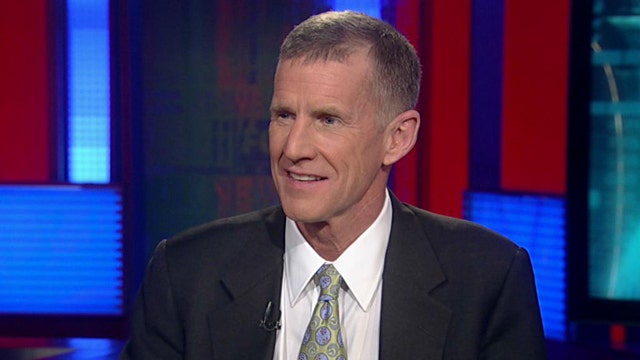
    Retired Gen. Stanley McChrystal weighs in

  • Duration 9:18
  • Date

Clips

Also in this playlist...

Your World

Auto-advance: ON

Auto-advance

Transcript

This transcript is automatically generated

What we know the Obama administration wants to pull most troops out of Afghanistan after Saudi -- scene.

But every single one.

Apparently it's mauling what is being called the zero option now despite the top commander -- the ground in Afghanistan.

Being no fan of that option it's -- story of rising tensions in this region my guest knows very well.

Retired four star general Stanley McChrystal describing what he terms a deficit of trust between pentagon leaders and political leaders in his new book.

My share of the task on.

Certain kind of had a general has insisted that a police when we stand -- -- I can't courts.

-- -- -- -- -- -- -- He's someone to stick with -- General very good thanks revenue what do you think of -- zero option thing is I was just -- here.

Well one of the things I -- on the ground in Afghanistan for a lot of -- the promises I made to myself when I became -- -- retired general is don't second guess commanders on the ground on specifics.

What I will say is that.

A lot of Americans have almost forgotten why we went to Afghanistan we went.

After 9/11.

Because al-Qaeda was here -- it was in our interest up because -- Afghans Estes to.

And so when we winning and we up into the Taliban government and I think we.

Incurred some responsibility to help Afghanistan.

Set itself on the right course and -- we largely done that it's not perfect but -- war.

Women have rights that they didn't have before there -- something like six million females in school that wouldn't be if we had left.

It the way it was.

But it we drop and leave now -- -- signal through there and -- but what happens to its well I think that.

President Obama offered a strategic partnership to.

Two Afghanistan back in 2009 when he offers of troops I think that's important I think they need to know that we are partners.

Whether it's a certain number or amount of money or whatever I think it's the idea that we are their ally we are their partner.

And we'll be there to help them navigate away when he first got there what.

2002 I first arrived in 2000 differences in ten years ago along attitude a lot of Americans as you know and you're.

I was -- WS when guys are great students and history and that's what's really masterful in his book.

So.

We've done our duty.

And we've done all we can do it's up to then find -- would be.

Well it's -- our duty it's partly how were American strategic interest when we when we arrived in 2002 Afghanistan have already been torn by twenty.

Three years of -- in this society was turned upside down it's psychologically traumatize you said we didn't appreciate that.

Don't think we understood it -- until we understood that we couldn't appreciated the complexities the damage and the things that were going on inside Afghanistan I think.

We were way too.

Superficial.

In the way we look and dealt with the problem over time I think we began to appreciate better and in overtime as we do.

But now I think it's important we understand -- stuff 34 years.

That they've essentially had war in their territory they're trying to get moving in the right direction.

But it's very very difficult and I think that it's an -- interest America's.

To have stability in the region to have a sense.

In that very critical region of the world that things can go in the right direction and then it not revert back to.

What people would call on governed territory where places like al-Qaeda and other groups can.

Can go and you get the sense that Ron Paul here not too long or general sign on.

Good money after -- disaster.

Ten years.

Disaster.

-- -- -- I would take a different view I went to cover university one day and I was -- to give and take with students and they're the future of Afghanistan and they were college students of one of the students a female is give me a hard time about it what I wouldn't do it right -- a commander -- half.

Which was great but then another student got up and reminded her that if I wasn't there she would be it would be in school.

And that's the kind of thing I think we need to remember it hasn't been wasted money it hasn't been sacrificed American lives it has been very hard.

But I think that as we -- the way ahead we can't keep a lot of combat troops there that's not appropriate Afghans don't want them.

But I think what they do want is the sense of a shoulder.

Near them the idea that you've got an ally and a -- it's a tough -- a lot of Americans general just don't trust the -- they don't trust neighboring Pakistan.

They don't trust president Hamid Karzai's coming here you were -- in the bump it.

You think he was -- to -- elected there was no.

Stealing -- selection was elected.

-- -- a lot of folks they they just don't trust me just tell us.

It's it's very difficult President Karzai is the elected leader of a country with which were partners and we have to respect that we can view.

Our partner nations is something that we can call all the shots that's not what we want with a partner.

We want a sovereign nation that can be strong enough and so I think we need to look at it that way and act that we and I think that's the effort of our current policy is trying to implement.

I'm just this president even wants to be in this region it is critical about the bellicose nature of the bush years and the president so George Bush.

And that he wanted to reverse that he was kind of stuck with these -- coming and and he couldn't get quicker lead.

I think all Americans.

Certainly when they look at the region now.

It's where the terrorist type tax from 9/11 animated from which had a very difficult decade plus there would you have done it -- -- -- -- -- I thought a lot about this.

I would have acted a little differently but only with hindsight the first thing I would have done this in 101000 Americans to language school.

And I -- taken 101000 young Americans studying a language I -- started our wider effort.

To study the history stated the culture understand me because.

The entire region is so complex that every time.

You pull one however it doesn't respond the way you expect something else happens and we've got to understand it.

Better before week we act now you have to act as well I'm not saying do nothing what I'm saying is.

This is one of those places where you it takes tremendous thought tremendous career in acting.

Tom obviously it wants to know about the famous Rolling Stone it's and what came to light in that charge in that magazine and one that would -- resignation.

Was that your colleagues were critically administration.

And making fun of it.

The irony here is that -- report on this later exonerated.

So -- these conclusions came out quietly almost a year -- the tornado controversy.

The articles created.

But they were important -- they may be more important also that month.

Would except.

First Lady Michelle Obama's request to serve my country again this time on the board of advisors for joining forces whether -- initiative service members of the feminist but that was very.

That exonerates and everyone remembers the Rolling Stone article.

The whether or not I agreed.

With the tone and and fairness of the article the simple elegance of command.

Means to me I'm responsible a controversy bruise that threatens the mission.

And I am responsible for.

Yet and I -- -- for doing whatever is best for the mission was that your men in an -- today.

And -- very critical.

Of the president.

It almost wouldn't matter because I accept responsibility for that controversy and I've moved on you voted for -- 2000 -- did.

Did you vote for him -- -- well I'm -- private citizen now and I don't talk about who I voted for you didn't and I don't talk about.

You think he's a -- president.

I think presidents that job a president is a hard job extraordinary as he can hear in this region.

And war on terror the president you know one of the things I don't do in life is very president's.

Who did you have a better relationship.

But a very good relationship with both presidents I had -- and I believe I still have a good relationship with President Obama I've seen him cents.

Our last meeting in the Oval Office I -- on the joining forces initiative at the request of the First Lady and doctor but I can't.

To this sensitive because you came into that meeting without your resignation letter so he could've accepted or rejected he accepted it.

We surprises.

No I.

I had gone into the meeting expecting that he would accept it.

We had a professional conversation but I think what happens in the Oval Office I certainly would respect that privacy.

I he decided to accept.

My resignation and and I told him I was happy to do.

Either go back or or hadn't accepted whatever was best for the mission and I think that's important OK general.

You could stick around here and pay -- bills.

-- we thought about some changes right now Ian.

In the entire makeup of the president's foreign policy team.

And what happens there a stick around with more without General McChrystal.

On news that an American ambassador of course by now you know killed.

And now the lone suspect in that attack read how is the administration handling has been Ghazi bass.

And could it spill -- into a general Middle East quagmire.

Most of us.