You're watching...

New brain scan offers hope for PTSD, depression

Details

  • Description

    How does latest technology work?

  • Duration 4:53
  • Date

Clips

Also in this playlist...

Editor's Picks

Auto-advance: ON

Auto-advance

Transcript

This transcript is automatically generated

As a result.

The scars -- PD ST may be invisible but all too real for the brave men and women who feel its impact every day.

Now -- doctors are researching a promising new treatment that could help take the trial and error out of treating PT SD.

I spoke with spoke with some of those on the front lines of this research.

And when -- it their way.

I try to hide it I cannot think about it his.

I gotta stay a 100% yeah I gotta I gotta thank you for good example.

The war in Iraq is over Afghanistan winding down.

Yet the troops returning home still fight battles of their own and too often on their own.

Post traumatic stress disorder PT SD instead try not to think about it.

The problem so widespread and treatment so frequently mishandled.

That last -- Defense Secretary Leon Panetta ordered all military services to conduct an extensive review of mental health diagnoses.

Learn what we try to do is.

Two.

Do mental health assessments both before and after deployments.

So that we can -- in -- -- and try to treat somebody who might have a problem specifically.

With a PT EST we've done about 600 thousands of these assessments.

One intractable problem how do you treat wounds of war that fester inside the brain.

Now doctors at Walter Reed military medical center are trying a new system that shows promise.

It was actually like changing for me.

If I can help just one person avoid the battles that I went through to get the right medication it's worth it.

Brian Harvey is a civilian who spent seven desperate years trying to find something to help cure what doctors had diagnosed as bipolar disorder.

I went through three different doctors.

And four different drug combinations.

I kept on changing trying to find something that -- workers it wasn't working.

This is the system Brian found the one he says has saved his marriage maybe is life so let's see how this brains -- process works trying to clear up some of the mysteries.

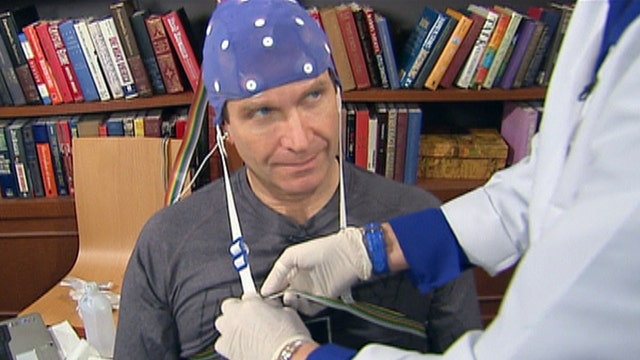
I'll be the Guinea -- Known as central nervous system response or CNN it's simply cap with electrodes -- during a twenty minute session to record brain waves.

The individual's brain wave pattern is then compared with a database to find which specific mood altering drugs would likely be most beneficial.

Doctor William Richardson and army veteran and New Jersey psychiatrist.

Says the technology all -- eliminates the trial and error drug testing he used to have to employ.

Other potentials fabulous the potential is to help.

All the soldiers that have.

Psychiatric illness I mean we can run this test on them.

And and really be able to come up with at least an 80% accuracy rate of the medications that are likely to work.

Well man behind the company pushing this technology is with us now George carpenter president and CEO of CNS response.

The cap I was wearing standard -- and Cephalon Graham you've been around for years exactly but you found a way.

To take the information that comes out of it.

And help -- can you explain -- the company was created by doctors and they thought that.

You know they've got a 130 medications to choose from and no guidance on which will work for your particular brain so it's guesswork there it is trial and -- that's the dominant therapy and so instead of guessing.

They said let's see if we can collect data from the EG.

That you -- that core relates to medication outcomes of patients staring out -- what's now the largest bring database of its kind.

I'm -- and improves to the three times the outcomes the doctors get.

-- those therapies yet -- -- does and says it's it's 80% correct in his experience at at finding medications that will help.

Deal with you know the problems that might be inside the head exactly everyone reacts differently to medications and we want to know your brain -- countries the only.

Area of medicine that doesn't have a test.

So now they finally have something that they can do.

To objectively rather than subjectively figure out what's gonna work we mentioned Walter Reed is is testing -- -- -- you guys are training some of the doctors there.

People who who might suffer from you know.

Depression that kind of thing ordinary civilians can take this -- well absolutely there's been about 121000 of them done and it's been around since the year 2000.

The real key for Ross is.

It takes about seventeen years to get a new technology adopted by doctors and we've got to do a better job you know suicide -- school shootings.

During -- stay out we see the results of treatment failure in mental health -- we just got to get better.

At finding new technologies like this and bring them to the doctor it.

It costs about 400 bucks to take the test does insurance cover.

Most insurance does not cover on the military were really be the first pair that's paying for this UnitedHealth care is reviewed it and -- looks like they'll permit.

It's so exciting exciting stuff especially for troops thanks -- George for perfect thank you and we'll be right back.