You're watching...

The race to find life under Antarctica

Details

  • Description

    Montana State University leads US project

  • Duration 3:47
  • Date

Clips

Also in this playlist...

Editor's Picks

Auto-advance: ON

Auto-advance

Transcript

This transcript is automatically generated

It's a new Cold War and the coldest place on earth with the US Russia and Great Britain facing off in a race to find life under Antarctica.

Montana State University heading up the US project at lake will ends.

Where they hope to uncover microbial life hidden under the frozen -- land scientists say it's like exploring another planet.

And the discoveries could lead to clues about what forms of life may be lurking in outer space on Mars Saturn yeah.

-- calculated so scientific knowledge editor of foxnews.com at pelican need to have some new documentary movie -- music under that it's it's really cool I'm sorry.

You have to do with one at least fair enough I would -- OK so who's winning this race if it's between US Russia great Britain and what do they hope to find it.

I'm glad he's in races not really a war -- -- assured it's not a war were not at war but it it is exactly that though it's a it's a race to battle they're fighting to get down in the bottom of these lakes.

Right now it looks -- the US is ahead.

The Russians made a big breakthrough -- their project last year.

But didn't find what they're looking for.

And then the British project was working earlier this year encountered some technical difficulties in December.

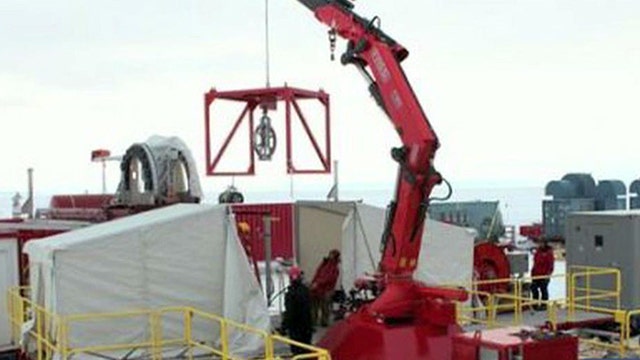
So really we're the only game right now on the quest for life underneath Antarctica so we're looking for life all right -- talk about the discovery process -- we're showing these pictures lots of big machinery out there.

On the ice in what became slushy snow because it's after all it's summer there are two flights -- bombing twenty degrees yes.

Yeah it's fascinating actually -- the ice cap over Antarctica is.

Varies in thickness is maybe two miles in some -- it's only a mile deep and other places the lifted the the US project is trying to dig into equivalents for about a half mile deep.

But that's solid ice frozen at what negative fifty degrees Fahrenheit.

So they had to specially constructed ice drilled a hot water maestro that -- this tiny foot wide hole straight down the water.

And then we get down there you reach this place that's never seen sunlight.

A microbial community that has never been exposed we don't know exactly what it is they don't even if there's oxygen in the water so what sort of life it is.

Who really knows so then if they do find like on their Jeremy Finley.

Well if it's exposing new form of what we've never seen one of the things -- -- are always wondering about is is their life elsewhere in the universe -- life elsewhere here on earth.

But I think it's gonna give us an indication what life.

On Mars -- -- astronomy the -- of those other planets might look like just some strange new iPhone we've never really seen.

-- -- -- I understand that also while they're there are looking for life possibly there's also they're searching for some sort of answers perhaps is -- Why the planet is getting warmer.

And yet they're learning about the plan warming and the reason -- Montana state also these are geologists are looking at how the the ice is shifting up there one of the other big aspects this project saying that.

The these underwater leaks that they discovered actually the lubricant weirdly enough that the ice is shifting along on top of the of the rocky under cropping of Antarctica.

So a lot of different aspects of the project life.

Geology.

A -- -- -- different things going on to this this is been going on for a few years now raked in in -- the races were calling it is it over when someone discovers.

Life for they'd give up.

Well at the quest for knowledge so as soon as we should listen and learn something them and it certainly is -- a successful project.

You're right though they -- working together there's a small community of scientists that have been just focused on Antarctica.

For years now I've been -- -- myself for years I find it incredibly fascinating.

So hopefully I do you -- is a fascinating.

Well there's so many extremes here it's the coldest place on earth it's -- it's never been seen before it like -- never seen sunlight before and just.

The magnitude of the project and -- a -- this one's only a hole that's a mile deep.

But or I'm sorry a half mile deep to the other holes or even deeper than that to gets these ice cores yeah this fascinating is I think is it's not very easy to get down there.

Quick question for at least which is how many microscopes and you have when you were -- I think -- in order to all right Gary Kaplan thank -- -- but she's done.