You're watching...
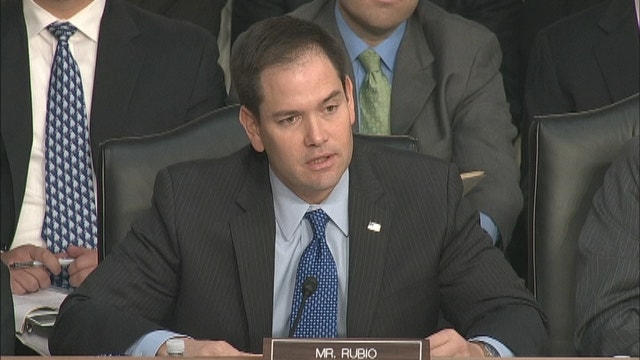
Marco Rubio Questions Clinton on Benghazi
Details
-
Description
Sen. Marco Rubio questions Clinton about Benghazi terrorist attacks.
- Duration 5:06
- Date Jan 23, 2013
You're watching...
Sen. Marco Rubio questions Clinton about Benghazi terrorist attacks.
Also in this playlist...
Auto-advance: ON
Auto-advanceThis transcript is automatically generated
That's secretary and we all wish that we missed and never happens in this hearing would never happen but it's good we're glad to see you here -- and wish you all the best and secondarily -- want to share.
Send it to my other colleagues have tremendous respect for the hard work and service that you put in on behalf of our country -- of member of this chamber and then obviously now on.
And the role you have one of the things that I'm most interest in exploring -- -- a little bit is how information flows.
Within the State Department and in particular and in hindsight looking for -- we can prevent some of this happening and so.
I was curious about a number of things the first thought that were you ever asked to participate in any sort of internal inner agency.
Meeting with the written before this attack with the parts of the deteriorating security situation in Libya.
Says.
Later you know again -- night.
I appreciate.
Your your kind words you know I and I reiterate my taking responsibility.
And as I have already.
-- with specific security requests they didn't come to me I had no knowledge of them.
With regard to the situation.
In Libya.
Not just eastern Libya across Libya.
There were a number of conversations and meetings to try to see what we could do.
While Libya went through this transition from.
Transitional government to interim government to elections to try to get in there and help them with security because.
It was clear that that was going to be won their highest.
Needs once they finally got stabilized so.
You know there for a number of meetings and and I personally I went to Libya in October 2011 I spoke with.
The then leadership I met with them in international settings.
We sent teams out both.
A civilian and military.
Experts try to help them.
Until recently while they were going -- their transitions it was a very difficult.
Conversation because they didn't have.
You know the authority they thought but now we're beginning and we have a long list.
Ways that we're trying to help improve security in Libya present.
We'll -- due October 2011 -- at that meeting did debt -- this issue come up with regards to the against inability of the Libyan government to protect their.
Diplomatic institutions that issue come up but on that conversation.
Well we we obviously talked at great -- a great deal about the deteriorating.
On.
-- environments -- in Libya on.
One of the reasons we had our own people on the ground and why we work out looking to.
Try to figure out how to better protect Ben Ghazi and how to have understandings with those in the annex is because.
It's a host country responsibility but.
You know they were not in a position.
To do.
What we would expect from an organized country but they did have the malicious and that you know the February 17 that brigade.
Had proven.
To be responsive in in the past prior to -- 9/11 other militias in.
Tripoli has proven to being responsive you know I when I landed in Tripoli I was met by -- in -- militia.
That was -- the welcome might have all these guys dressed completely in black holding their automatic weapons that was my welcoming party so.
We knew that we are piecing together.
What a host nation was not yet able to do.
Rights but and then there was another meeting on March 2004 also just to be clear and October 2011 and again in march of 2000 probably that was here with the prime minister.
And neither one of these meetings was that was -- -- specific conversation between you and them with regards to concerns that we had.
That of the not just the deteriorating security situation but the inability of them as a host country to meet their obligations to provide security -- -- or.
Of course -- absolutely I mean this was a constant conversations senator.
-- and what I found with the Libyans was.
Willingness.
But not capacity.
You know.
In Tunisia as I told you they had capacity but I had that call and just talent we had to get that capacity out there.
Because you know they are worse they're still trying to figure out how to be a state without being a security state.
With Cairo we -- that call and tell egyptians get your people out there so with Libya was different the Libyans were very responsive.
-- willing but no levers DePaul and what we've been trying to do and you know we need your help to help us pay for what we're trying to do we are trying to help them build.
A decent security force to try to rein in the militias as best they can't so this was a constant conversation.
-- before the attack and Ben -- what had we done specifically to help them build their security capacities.
Well there's a long list and I I'll be happy to provide that to you because it is filled with.
You know training with.
Equipment.
With the kind of planning that they had not done before.