You're watching...

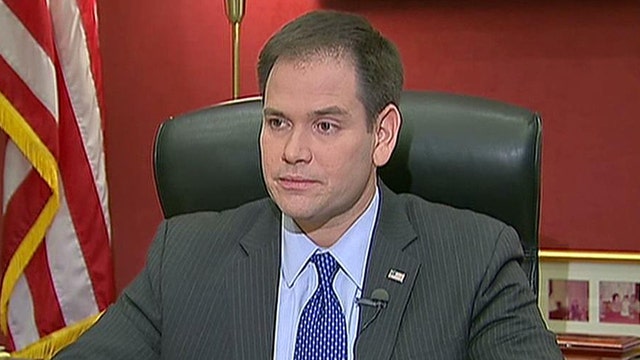
Rubio 'On the Record,' Pt. 1: Benghazi and Clinton

Details

  • Description

    Fla. senator sounds off on secretary of state's long-awaited testimony on the Benghazi terror attacks

  • Duration 6:45
  • Date

Clips

Also in this playlist...

Can't-Miss Interviews

Auto-advance: ON

Auto-advance

Transcript

This transcript is automatically generated

Marco Rubio -- grilling secretary of state Clinton about the deteriorating security for Americans in Libya.

Long before the September 11 attack or -- questions answered by the secretary of state we spoke with senator rubio a short time ago.

The part that I wanted to focus in on was how information flows in the State Department how is -- possible.

That you have meetings with the prime minister you visit Libya the issue of -- security at the consulate isn't raised to a level of alert how is it possible that you're the sitting secretary of state.

Your staff isn't coming to you and saying we have a problem you know there's been 200 attacks the brits have pulled out of Ben Ghazi.

How is it possible that there weren't meetings convened specifically about this topic.

Given all the flow of information and the answer is do those meetings that happen or they didn't and we've got a problem within the State Department in terms of how information flows.

So to me it's not just about assigning blame it's about figuring out what went wrong internally so that this never happens again you get that -- Well I think what we found out was -- Secretary Clinton met with the prime minister and the issue of security was touched but not.

Deeply and and again I don't understand how that's possible it was October 2011 well.

-- -- -- and live Libya sources both I mean he can't October 2011 she visited Libya and then again in march of 2012 the prime minister came to Washington.

And I both occasions she admitted that she talked about security in the security situation.

So -- there was awareness at that level -- secretary level of the Department of State.

That we have a serious security problem that we were counting on militias for example.

To provide for the consulate or to provide and Ben -- what normally is the responsibility of an organized government to do.

And down and I think that's what she kind of told us that in fact I think in her answer to one of my questions she said.

That these militias in the past -- proven reliable I think in hindsight obviously that's not the case.

But again the point is that you take its totality of the -- -- were asked here's what's very clear he had all this information coming in.

From different sources to the State Department to basically said Libya is dangerous -- Gaza in particular is dangerous in fact it's so dangerous that other countries have pulled their mission out.

But the United States did not respond to that was of sufficient enough security or an extraction plan to get our people out of there.

And you know at the end of the day that's just bad decision.

She says she said a couple of times both here and I think on the house side that one of the problems that distinct parts -- is that they -- -- asked for money had been authorized but that there were some sort of financial -- Or -- want to transfer from one particular area state farm to another and that there impediments to connect.

What she correct that.

That they have been underfunded for security.

We'll -- to separate issues.

As far as money that's already been allocated in there are impediments to that money being moved from one used to another we need to look at that most of them makes sense to do that the money is our vision -- -- read about that -- but the second part is that I have enough money for security while again here's what happened you have these requests for security.

No one came to -- -- -- we have these specific risks in Libya -- very dangerous and we're gonna have to close down -- will have to close down an ungodly place.

Unless you provide more money for security there.

You look at the end of the day it's about resource allocation the truth is.

They didn't believe.

They didn't believe that they needed more.

Upgrades and on -- -- you look at some of the statements they made.

In the early hours in the early days after the attack they talked about how heavily fortified it was how much security -- invested in there so they bragged about how much they have put in there.

At initially I mean now on hindsight it's clear that -- have nearly enough.

So that wasn't a posture at the time they're -- of the time was not give us more money or something really bad is going to happen that maybe their posture now on hindsight.

And and ultimately mean that that this is a time of limited resources but they couldn't press the case of things that we were in danger of something like this happening was she -- it.

Why I'm like a chance to try to answer questions to the questions that whereas I think -- tell machine okay I will tell whether some of the things she said -- out to be sure and I mean these things have a way of washing themselves out to say the opposite -- -- here and accused secretary line.

I'm gonna tell you I'm concerned about some of -- answers the reason why I'm concerned about some of -- I still do not understand.

How it can be that a high profile -- like Libya with the amount of dangerous situations that are ready occurred with all the information coming into the government to the US.

That in Libya not only was it a dangerous place have been Gaza in particular was dangerous and that there were Islamist fundamentalist radical elements that -- organizing and training in the vicinity.

How -- all of that out there someone didn't look at all that and say we have a problem we need to address very quickly.

We need to provide more security for the consulate.

Perhaps maybe even closer for a period of time we'd have a military -- on standby to extract people why there weren't more resources pressed she was clearly aware that Libya was very dangerous place.

And and I think as time goes on we are going to learn more about who knew what -- what here's what I don't believe I don't believe that the only people who were aware.

Of what a bad situation that was where in the mid level people -- resigned.

I think that it was clear from her testimony today that she was aware of how Libya was although obviously you know as she says that there's no way she could have known -- was -- -- in this.

It from if I get -- says that my main concern was.

It was the process of information.

And they should find out -- what happened how it happened so that doesn't happen again all winners if things -- happened.

Either the information didn't get to where needed to go where the information got to where it needed to go but the response is not appropriate.

Both are bad and we investigate that so that doesn't happen again after the second there was some question that by you by others about.

-- ambassador rice.

And about what how the administration disseminate information.

In the hours and days and weeks without giving any problem was there any question but -- -- and who and why is that important now.

Well it's important for two reasons number one I thought others I knew others as other senators are gonna handle those questions -- did a very good job over raising that issue.

John McCain made a great point today when he said people don't bring RPG's and don't bring the kind of weaponry that was used in this attack.

To a spontaneous demonstration.

But here's why it's relevant because the secretary went to -- -- well why does this matter here's why it matters because when they put out word that this was not a terrorist attack it was the sprung out of -- spontaneous uprising if furthered the narrative that somehow Qaeda was in disarray that we -- by.

You know the elimination of bin Laden had made this extraordinary you know.

Reduction in the risk in the area as it turns out not only was that not true in Libya but we're now seeing it's not true and other parts of North Africa.

As well and the fundamental question as the days of the administration really believe that because -- they did they badly miscalculated or.

That they know wasn't true but for political reasons did not want that narrative out there.

That's the -- -- whether they were winning the war on terror they were eliminating these groups and they were no longer capable of carrying attacks against the US it was one or the other.

Either they were wrong they -- wrong that that.

You know radical terrorists were not capable of carrying out an attack or they knew that they could.

But -- don't want to admit it because it went against their political narrative during election season so it's one of those two and we're not happy with either one.