You're watching...

Does President Obama want second Bill of Rights?

Details

  • Description

    Peter Johnson, Jr. weighs in

  • Duration 3:43
  • Date

Clips

Also in this playlist...

Latest Opinion

Auto-advance: ON

Auto-advance

Transcript

This transcript is automatically generated

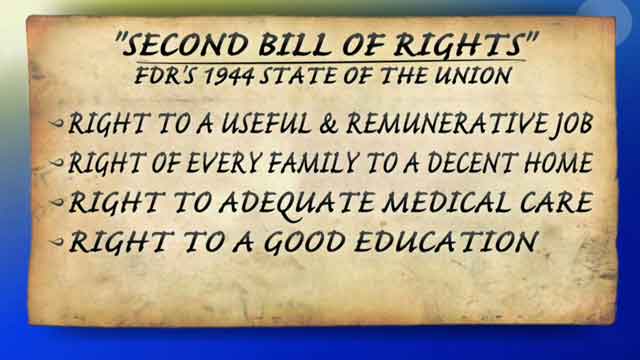
Here's something we think you don't know in 1944 president Franklin Delano Roosevelt made a radical move proposing a second bill of rights.

And -- -- certain economic -- to become accepted.

That's so I haven't.

This second bill of rights.

None of which a -- basis of security and prosperity.

Can be established for -- -- regardless of straight from.

Or race or -- So what was inside that second bill of rights the right to a useful job a decent home adequate medical care and -- good education among other things.

Are you entitled to those rights the same way you were entitled to free speech.

The president's former regulatory czar -- on -- now claims the president is committed to.

Making FDR's dreams come true here to comment Fox News legal analyst Peter Johnson junior.

-- -- he's written an article only says the president is really enumerated.

In his first -- on its inaugural dress a second bill of rights -- of Franklin Roosevelt.

And when Franklin Roosevelt proposed that it was really dramatic.

It was part of a national service program it was a part of a massive.

Tax increase in a very large budget.

Which the congress decided not to pass.

The president vetoed it and in the congress overrode it.

And so it was a matter of great concern even in 1944.

In the midst of the war in the midst of the great new deal.

That allegedly provided so many jobs to so many millions.

Of Americans.

The second civil rights according to -- some -- according to some of the professors that were teaching at Harvard when the president was there.

And what the south African constitution holes which allegedly is based on these concepts -- -- is this social economic.

Set of rights the first bill of rights the first ten amendments the constitution our political or negative rights.

What they are saying now is that each and every American should be -- -- so she'll.

Economic rights so when you're born you have a right to a job when -- born -- right to a home.

When you're born you have a right to three square and the government must provide those things.

To -- as a result of that that was Franklin Roosevelt really revolutionary.

Proposals -- in 1944 and so said it was based on socialistic.

Principles that have been -- put forward.

But in this than its Soviet they have thirty's you know this goes so far beyond a chicken in every pot and a car in every garage it's you have a right to.

Everything it it is and it in South Africa we've seen what's what's happened.

There in chaos some the United States Supreme Court justices think that is it that is the model that we should be looking forward to in the future.

A lot of folks in the passages in the bill of rights is basically racist document.

And adopting -- didn't understand or protect women are Indians right in this country in some ways it it it may have been.

But through decisions.

Of the United States Supreme Court and amend the bill of rights have been incorporated to protect.

All Americans what -- honesty and these folks at Harvard and -- -- every talks about is protection from the date of birth.

State.

Empowered protection.

That basically you get everything you need and it's a guaranteed.

The United States of America -- it going forward so it's a radical new proposal -- it was what I government could and should be.

It's interesting stuff and a lot of people haven't heard about it all right -- we're examining great analysis gives you much are it's.