You're watching...

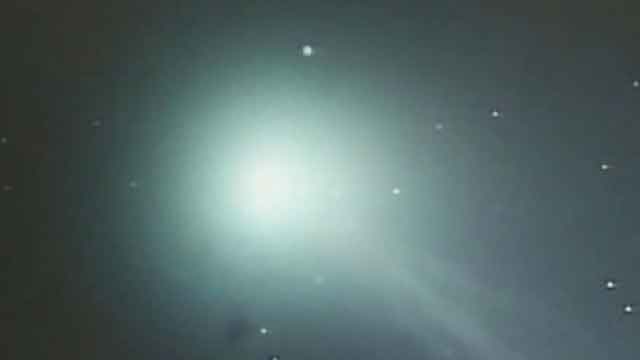
Comet flyby to be seen from Earth

Details

  • Description

    Is 2013 the 'year of the comets'?

  • Duration 3:32
  • Date

Clips

Also in this playlist...

Happening Now

Auto-advance: ON

Auto-advance

Transcript

This transcript is automatically generated

There's an incredible site in this guy and you can see it beginning tonight a rare comment makes its debut in the Northern Hemisphere.

Visible to -- they got it will give you the best view you could have in years.

In fact some astronomers are calling 2013 the year of the comet as they identify more and more of these snow ball's flying through space.

Does it -- raise questions about our safety here on -- Doctor Derek -- is -- astronomer of the Franklin institute planetarium.

Doctor -- you know we saw -- couple weeks ago mid February the fifteenth.

That that meteorite that came crashing to earth over Russia scared so many people heard a bunch people broke windows.

Now we've got this comment come in nearby.

Are we seeing more of this space activity or are we just getting better at finding.

Well I think you're right on account number two we're getting better at finding it and we're getting better at seeing it obviously from what we saw that asteroid last month so many people had dashboard cams that gave us great views.

So it is more so that we're getting better -- identifying these things and letting people know about it we have such a great network of communication these days so a comet is mostly ice and gas right is it if if one -- to hit the earth would there be the kind of impact that we saw from that asteroid.

Well it could be devastating if one did hit the -- even though they are made of gas they are also bound up with rock and dust and dirt.

And the velocity at which they travel could be a problem for us because they have a lot of energy to dissipate so.

It's not so much the mass of the comet it is a rather low mass puts the velocity that would give us the force that would cause a lot of damage -- don't really have very much history though of -- crashing into the planet though.

35 miles a second is what I hear this thing is flying -- I'm told that Mars.

Might actually be a little bit of danger from this thing there is a very slight possibility that this thing could impact mark.

Yes that would be on its next go round actually so why.

It isn't really something that we should be concerned about you know there are these close passages among the -- of these other objects these smaller solar system bodies.

-- comets and asteroids and such.

But we're becoming good enough at predicting their orbital -- to know when they really are going to hit and what it's just going to be a close pass.

And so far the one for Mars looks like it's just a close pass.

No reason for any concern there.

We have a graphic that shows how this thing will be seen rising in the night sky.

Starting on well on March 7 it is visible now in the Northern Hemisphere where should people look and when should they look if they wanna catch -- -- you up.

-- the comets gonna be visible over on the western side of this guy in the evening about thirty minutes after sunset so that makes it convenient just that this guy's getting dark.

The difficulty will be spotting it it will appear SA brightest object sort of a Fuzzy ball if you will over on the western side.

And what are the best things to do is to look -- -- over the weekend as the sky clears up for many of us.

And then next week on Tuesday you'll be just to the left of a thin crescent moon.

And it will be just about at its -- so that'll be a good time to look for them with binoculars that'll be a great help also.

It looks like kind of a patent badminton shuttle cock in the sky there out of the way the professor doctor -- -- always good to have -- thanks for the information.

Thank you very much John -- -- season.