You're watching...
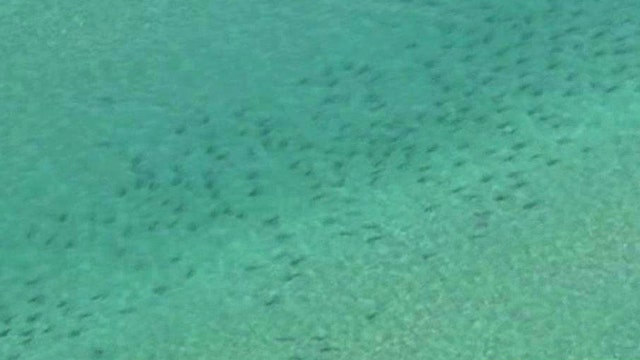
Following shark migration off Florida coast
Details
-
Description
Shark expert Greg Marshall explains
- Duration 4:35
- Date Mar 8, 2013
You're watching...
Shark expert Greg Marshall explains
Also in this playlist...
Auto-advance: ON
Auto-advanceThis transcript is automatically generated
Well right now some unwelcome guests first spring break some beaches in South Florida are reopening today after sharks are spotted just feeds off shore and we're not talking about a few sharks here and there.
We're talking about thousands of sharks coming close in the short part of a migration that takes place until late this year but.
That's what they're doing and then check this -- researchers are -- -- and tagged a great white off the coast in Jacksonville.
While -- her they named her.
Lydia good name pretty name more.
A pretty shark I guess when it's far away from you scientists say she's the first great white to be captured and tagged off -- -- And now with the ability to tracker and they're just -- letter.
I go right back into the ocean and watch for her heading close in the short which is what they would be concerned about.
That's bringing great Marshall a shark expert who has dedicated to -- any time you're spending exploring in documenting life in the ocean has any series.
Off so I kingdom of the oceans that premieres this Sunday I'm not geo wild -- -- -- five years Craig.
Any close calls but the best -- five years.
Well -- pencil and -- -- care -- as close calls and that's a wonderful wonderful experience was the experiences -- sharks.
Of course you know the hair on the back -- next except for -- -- when we get a little bit too close but.
I guess the closest since them I've ever come as one of my colleague of mine now was unfortunately stuff hit by a -- one time will it's very very rare.
-- -- -- No bytes bytes ironically and 20/20 five years is a long time to be paying an hour sharks and maybe proves the point that you know.
In the grand scheme of things maybe not so dangerous but Craig is is it a good idea that they close -- the beaches and some of these areas while this shark migration is happening.
It's just it's just sensible really.
-- the fact is that didn't shark attacks are very very rare extremely rare maybe one in the United States every year that that occurs and -- results of fatality.
Com so it's extremely rare but it means very sensible just take precautions and not be in the water when there are lots and lots of short -- -- -- us.
They're taking a look at some of these sharks in this night migration.
I'm black tips and Spinner is not great light -- he tell us about the black tips and spinners and why they're migrating and that's -- Well they're they're relatively small trucks -- -- great voice lead up to 2041 feet long these sharks maximum.
Maximum length from these guys probably.
Ten feet but normally -- only about five or six people so these are small sharks and the reason that the migrating right now is because they're following the food.
Not hearing stuff Sar -- mackerel are moving up the coast right now sort of between Florida and am done in the Bahamas there.
To become constricted in this narrow Alley right there.
And the sharks just following along due to have a -- -- how little they stay in these these big months before they disperse.
What actually has -- -- moving north -- continental shelf starts to broaden out right above all Palm Beach or so.
It's it was a move north into you know South Carolina North Carolina they'll begin to spread out much more widely.
And then where they had and we just want to know when we're planning our feature making sense.
Well you know the great thing is that we don't really know these kind of -- -- the cool thing is that.
The great white sharks we now have the ability to deploy satellite tags on them.
But for these smaller sharks it's a little bit more difficult to know exactly where to go in because they're -- really not big enough to carry the satellite technology to great -- great white sharks are so.
You know it's a bit of a mystery to goes far north of North Carolina we know that they can't be found this far north as Cape Cod.
-- but they're generally further offshore there because the continental shelf as much wider.
I was able to scuba dive with a few -- black tips.
A little while ago it's -- it's amazing to see them in the water it is a little scary it the same time so as you mentioned some precaution.
You know -- is it is widely used you have this new series as watching what can you tell us about it that they and that the kingdom of the ocean and.
Well the key thing to remember is that it's it's a true National Geographic blue chip.
Natural history series.
Actually fantastic and from everything off from emperor penguins in the Antarctic to the greatest animal leave in the oceans of the great blue -- Tom spectacular wildlife spectacular behavior natural history so I think it's it's what people expect of National Geographic and the that -- while channel.
But sounds like you've had quite the adventurous life -- -- we look for having me back to talk about some more beer ventures in the future thanks so much -- -- today.
How much lieutenant thank you and just remind you can catch the first episode of -- and show this weekend kingdom of the oceans sending march 10 at 8 PM eastern.
And Pacific I'm Nat -- why that looks great.
-- -- -- --