You're watching...

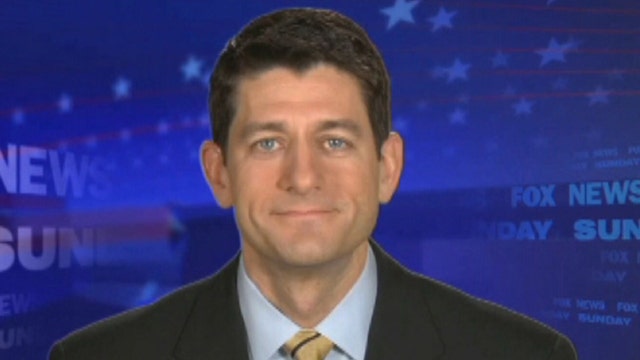
Rep. Paul Ryan previews his new budget

Details

  • Description

    House Budget Committee chair on 'Fox News Sunday'

  • Duration 17:45
  • Date

Clips

Also in this playlist...

Editor's Picks

Auto-advance: ON

Auto-advance

Transcript

This transcript is automatically generated

And hello again from Fox News in Washington.

President Obama calls some -- thought later of the Republican Party.

And this lake House Budget Committee chair Paul Ryan will plot out a plan that would balance the federal budget in ten years.

On the heels of a private lunch with the president on Thursday congressman Ryan joins us to discuss all -- and congressman welcome back.

They threaten to good morning Chris the plan.

That you're gonna release Tuesday it would balance the budget in ten years not 25 years like your last one how do you do that you have to make even.

Tougher deeper spending cuts.

Actually not really up we always got close to balancing the budget but not quite there.

We don't have to do too much simply because the new CBO baseline makes it easier because the -- based on reflects the fiscal cliff which is higher revenues and lower spending.

Making it easier to balance we extend the DC -- -- budget control act caps out another two years.

We asked that all federal employees.

-- actually have their pension contributions.

Like those in the private sector at the end of the budget window.

So we don't have to do huge things to get to balance because of the new baseline.

The point is we think we -- the American people balanced budget.

We want to respect hardworking taxpayers.

And we think we have a responsible plan to balance the budget.

Which the reason we do a balanced budget is not make the numbers simply add up.

It leads to a healthy growing economy that creates jobs it's a means to an end and the means is to get through eight.

Good growing economy create jobs and opportunity.

I'm glad the Senate's doing a budget it's the first time in four years our concern is that they may never even proposed ever balance the budget and we think that's irresponsible.

Let's look and congressmen and a couple of the reasons that you don't have to make big changes in this new budget to balance -- in ten years.

You include the 600 billion dollars as you just mentioned in tax increases.

That came from raising rates from the fiscal left of that you also include.

716.

Billion dollars in Medicare costs through Obama care that you opposed in this last campaign.

Question is it fair to say but at least those parts of the president's policies.

Make it easier to balance the budget.

It it is fair to say that what we also saves and the rate of what Medicare from obamacare -- to remember all that money that was taken from.

Medicare.

Was to pay for obamacare we say we get rid of obamacare we and the -- and we apply those savings to Medicare to make Medicare more solvent extend the solvency of Medicare trust fund.

And we don't want to -- fiscal cliff.

That current law that's not going to change and we also proposed -- -- tax reform which we think.

With this current revenue line.

We can have a very pro growth tax reform system to bring all rates down it's good for economic growth it's good for job creation and hardworking taxpayers.

By having less loopholes in the tax code.

No more crony politics.

Stop picking winners and losers approval to actually form.

Those things are still achievable and we achieved that in this budget and we do reflect those realities that you just mentioned.

It in your last budget you cut spending about five trillion dollars over ten years.

How much you cut spending in this new budget.

Basically the same bought five trillion dollars.

Instead of growing spending at four point 9% a year which is the average under the current path we're on we -- spending.

About 3.4 percent each year over the next decade -- -- -- on a path to balance.

And the result is about five trillion dollar spending cuts so when you talk about cots you don't about -- in the -- -- growth not actual absolute cots.

Exactly and set us -- 46 straight -- -- the next ten years we'll spend 41.

That means -- spending -- average 3.4 percent a year instead of growing -- on average four point 9% a year which is the path we Iran.

Which takes us away from ever balancing the budget which produces that debt crisis that's the problem the president has us on a path.

Toward a debt crisis that hurts everybody to bring this to a recession.

That gives is that European kind of an experience which we want to avoid we want people going back to work we want higher wages more jobs growing economy.

We get that by balancing the budget.

Well in other two sides of this argument across the president would say that all of these spending cuts of the sequester and the -- that you're going to a proposed in the short term could actually hurt this kind of slightly improving recovery.

And throw us back into recession let me ask about a couple of -- was a -- -- That's -- made last year Tommy if they're not in this new -- I assume that they are.

You cut Medicaid by 778.

Billion dollars over the next ten years.

You -- a 134 billion from food stamps you've got a 166.

Billion from education training and social services.

Democrats say that that that makes you the party of austerity that one this is gonna hurt people who depend on these programs and to.

They say that not -- and spur growth it's gonna hurt -- Well we have 49 different job training programs for across nine different government agencies.

Lots of bureaucracies they don't work.

What we proposed to consolidate these programs in a flexible grants to go back to the states to actually get people on -- -- jobs in the training so they can get back to work.

So we get rid of the bureaucracy in Washington we send the money back to the states.

So that people can actually get the skills they need to get the jobs they want and food stamps but basically say yeah actually have to qualify for the food stamp program to get food stamp benefits.

With our reforms food stamps would have grown by 260%.

Over the last ten years and had 270%.

Like they did grow.

And with respect to Medicaid we think the -- -- expansion of Medicaid is reckless.

Were pushing people twenty million people and a program that's failing.

More more doctors and hospitals don't even take the program so we want to reform Medicaid by giving states the ability to customize the Medicaid program.

To meet the unique needs of their Medicaid population that but the -- regularly -- that we think will make the -- better but can you honestly say dubbed by turning Medicaid into a block grant and giving it to the states that you can cut 770.

Billion dollars out of that program over the next ten years that's gonna have no impact on legitimate recipients.

These are increases that have not come yet so by repealing obamacare and the Medicaid expansions which haven't occurred yet.

We are basically preventing an explosion of a program that is already failing source saying don't grow this program through obamacare because it doesn't work.

Prevent that -- from -- -- because it's not gonna work it's gonna hurt people were trying to help it's gonna hurt hospitals in states.

And give the states the tools that they're asking for.

Indiana's a perfect example.

They have a fantastic Medicaid program that Mitch -- treated in Indiana that is popular and successful that's working well.

But obamacare prevents it from going forward we want to give states like Indiana states like Wisconsin the tools they need to make these benefits work for their populations.

And we don't want to push more people into a failing program.

And by not.

Pushing people to this -- program would you say these kinds of -- I I I -- gonna pick up on this because I must say I didn't understand this are you saying that as part of your budget you would repeal you assume the repeal of obamacare.

Yes.

Well that's not gonna happen.

Well we believe it -- that's the point that's what's but this is what budgeting is all about race it's about making tough choices.

To fix our country's problems we believe that Obama care is a program that will not work we believe Obama -- will actually lead.

To hospitals and doctors and health care providers turning people away it's a program that basically puts Medicare under the control of fifteen people on -- board.

That would determine what kind of benefits people get that's -- rationing board.

However you slice it we don't think health -- going to be improved in this country we think it's going to look very ugly over the next couple of years.

And that's why we're gonna propose replacing obamacare with patient centered health care -- -- better health care system for everybody for the poor.

For people in the states for Medicare so that we can actually have affordable health insurance for everybody including people with preexisting conditions.

Without costly government takeovers which would obamacare represented -- yes our budget does.

Promote report repealing obamacare replacing with a better system.

-- I I want to pick up on this Medicare because what you would say is that starting.

With people who are now 54.

And you reportedly wanted to raise it to 56 but then there was some political push back the starting with people who are now 54 that you would start to give them when they become -- -- -- A government subsidy about -- whatever you -- -- premium supports to help them pay for their health care cost now.

You know I don't have to tell you do this is a big issue in the campaign to -- Romney Ryan vs Obama.

Biden they think they want and they think that's one of the reasons they -- And there -- as -- the congress and a lot of independent studies that site if you put this into a fact that not a fact will be a that seniors will end up having to pay more of the -- -- of their health care cost.

Well first of all it's not about.

Sure extreme sport that's very different about Jersey go to your mailbox get a check and go buy something that's -- saying we're saying.

Let's convert Medicare into a system that works like the one I have is a congressman's federal employees.

You -- list of guaranteed coverage options including traditional Medicare.

For your future health care needs Medicare subsidize your plan based on who you -- total subsidy for the poor and the sick.

Less of a subsidy for wealthy seniors.

Doing it this way harnessing the power choice in competition with the senior gets to choose her benefit that's comprehensive.

Is the best way to save Medicare for future generations this guarantees that Medicare does not change.

For people in or near retirement and also guarantees for those of us who were under the age of 55.

That we actually have a Medicare program when we retire.

The problem is Medicare is going broke.

The other problem is Obama -- does such damage to Medicare that is it it damaged the program for current seniors we don't want that to happen.

That's -- proposing these reforms would save and strengthen the Medicare program.

-- just from my mom but from my generation as well and -- would argue against -- your premise that we lost this issue in the campaign we won the senior vote.

I did dozens of Medicare town hall meetings in states like Florida explaining how these are the best reforms to save and -- in the Medicare program.

And we're very confident that this is the way to go it has bipartisan support.

It's an idea -- came from Democrats in the first place and we think it's really the best way to go because if they get it.

The alternative here.

Of having a choice -- system we get to choose the plan to meet your need.

Is fifteen bureaucrats making these decisions in Washington which are the new -- -- board which we repeal in this budget.

Well that this brings us to the -- that you're out on Thursday with President Obama in the White House and I want to explore the question as to whether there's the basis.

For a compromise here -- I got SIA I I don't hear it so far let me let me start -- -- From your view after having lunch with -- president do you think that he is so called charm offensive.

Is sincere.

That he's really looking for compromises on issues that still seem like there's a big divide.

What do you think it's more political theater to at least appear to be reaching out.

I think the answer that question will be determined based on how he conducts himself in the coming weeks and months.

This is the first -- I've ever had.

A conversation with the president lasted more than say two minutes or televised exchanges so I've never really had a conversation with them.

On these issues before.

I'm excited that we had this conversation we had a very frank exchange we we come from different perspectives I ran against him in the last election.

So we exchanged very different frank candid views of one another that we're very different.

But at least we have this conversation.

And I think to answer your question will be determined by how he conducts himself in the coming weeks and months.

Will -- resume the campaign mode will he resume attacks from Republicans and impugning -- motives will he resume what what is long believed.

To be a plan to win -- -- -- fourteen elections for.

Will he sincerely change in trying to find common ground try and work with Republicans to get something done that's what we hope happens but luckily I didn't down payment on the -- crisis.

Let me pick up on that you talk about coming from different perspectives one of the last times.

That you and the president went -- to gather was that two years ago almost exactly two years ago when your last -- -- budget that -- had come out.

And with you -- the audience the president took a part.

The proposed spending cuts you weren't wanted to -- Nikola.

-- -- kinds of cuts that tell us we can't afford.

The America.

That I believe them.

And I think you believe.

I believe it paints a vision of our future that is deeply pessimist.

The vision is talking about of course is the Ryan budget did that come up at the -- congressman.

They didn't but that's where that's basically rush saying if you impugn people's motives.

If you say these draconian cuts which by the way we're increasing spending by an average rate of 3.4 percent a year.

That does no good to get to common ground that makes it impossible for parties to come together to bridge the gaps and so if that kind of rhetoric resumes.

Then -- know that this was for show and it wasn't sincere I hope that this is sincere we have very good frank exchange.

But the proof will be in the coming weeks as to whether or not it's a real sincere outreach to find common ground look Chris I think there are things that we can do you.

That don't offend either party's philosophy.

That doesn't require some of the surrendered the principles.

To make a good down payment on getting this debt and deficit under control but let me ask what I would like to achieve -- -- up -- that would -- congressman because I mean there are some very basic disagreements that remain the president.

Would like to raise 600 billion dollars at least an out of revenue by clearing out so many of the deductions and and loopholes for upper income people.

You want not -- and -- that structural will -- to entitlements.

Did you get a sense first of all are you willing to give up one to get the other and if you get the sense he was.

Well look we already had a tax increase we think it's unfair to ask hard working taxpayers to pay more so Washington can spend more.

We think we should balance the budget we have a spending problem not a tax no that's what -- -- -- we do we do have a different so there so we do have a difference of opinion on that the other problem is this.

By continuing to raise taxes to fuel more spending.

You'll never get tax reform which is critical.

For economic growth and job creation.

And so yes we have an impasse right now which is the president wants to continue raising taxes.

Not for deficit reduction but to fuel more spending.

And we see tax reform as an incredibly important goal.

In in policy to getting pro growth economics to getting business is growing again and hiring people tax -- to us.

Is an economic growth generating exercise tax reform -- the president so far.

He has to be a spending growth exercise to spend money revenue generating exercise so father time -- there but so bottom line -- we -- -- -- violence what do you think if we just did raise taxes but not let me ask you as.

Bottom line what do you think of the chances of a big deal this year.

To try to get the deficit under -- -- I think it's -- to determine to be determined by the temperament and the posture that the president and almost take over the next few weeks.

We have a spending problem and I like to think we can find common ground and where and how to cut spending and -- -- entitlement reforms.

Will the president take our premium support program a -- -- Medicaid.

My guess is he won't we think that's the best way to make these programs work better.

But are there things you can do short of that that gets you closer balancing the budget.

But delays of debt crisis from -- this country yes I think there are and I do believe that there's a consensus protection on -- a lot of moderate Democrats especially in the senate.

That are in favor of lowering tax rates by closing loopholes that's what we're proposing.

Stop picking winners and -- in Washington.

Let people keep more of their hard earned money you don't lose revenue for the federal government and you make it easier for small businesses to create jobs and hire more workers.

Congress and there's a bipartisan consensus for that I am hoping the president comes to join that can send congress -- domain in Iraq I got a couple of more questions political questions to ask -- very little time.

Did you come away from your experiences they vice presidential candidate.

In 28 at 2012 thinking that the prospect of running for president for two years.

Would be appalling -- -- I think -- collection.

Actually I enjoyed the experience it made it more realistic in my mind it's something that I.

Much better understand and Jane and I were talking about the -- of the day we look back it is a very positive experience we actually enjoyed it we got to meet.

Hundreds of thousands of people who care so much about the country.

And we learned a lot I just about the great greatness of this country how hard working people are want to get ahead.

In any different so actually I -- I thought at a very pleasant exercise to be candid with you and and finally what's more attractive to you as you sit here today.

Running for president or staying in the house doing the important work you do there and maybe Sunday becoming speaker.

Yes so I have no plans B and house elected leadership if I wanted to be an elected leadership what speaker I -- run for these jobs years ago I've always believed a better place for me isn't policy leadership like the -- chairman.

With respect to running for president I honestly think.

That we have a problem right now that's a budget mess that's a debt crisis coming on the chairman of the Budget Committee.

I -- represent the first -- Wisconsin I should focus on -- That's to me the most important thing and I shouldn't be clouding my judgment today.

By thinking about some political thing for years from now I should not be clouding my judgment by thinking how does this position -- to run for president I don't think.

Do what you think is right how can I help Wisconsin how can I close this budget gap and then when we're through that moment I'm gonna give serious thought to these other things but not until then.

Congressman Ryan we want to thank you so much for joining us today and we will of course be tracking weather this time there really -- a grand bargain thanks there.

Thanks Chris.