You're watching...
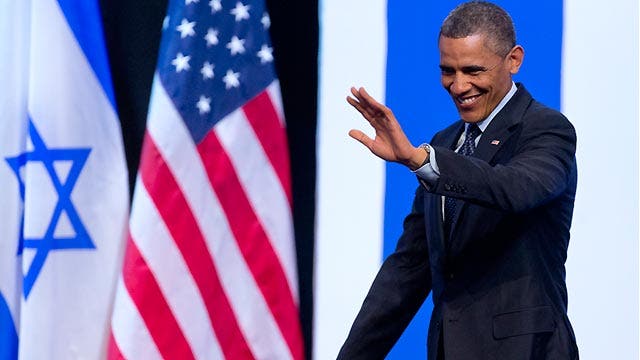
How President Obama's Mideast trip impacts peace process
Details
-
Description
Insight from PJ Crowley, former assistant secretary of state
- Duration 3:25
- Date Mar 21, 2013
You're watching...
Insight from PJ Crowley, former assistant secretary of state
Also in this playlist...
Auto-advance: ON
Auto-advanceThis transcript is automatically generated
Great so what if anything will the president -- me.
To the stalled peace talks that spring and PJ Crowley the former assistant secretary of state now a professor George Washington University.
In DC PJ did see is always myself and I don't know if I ever remember things being as difficult and the situation is tenuous as it is all across that region now how.
How important moment was this for the president and did he rise to it.
Well certainly.
You know the president's trip comes off of an Israeli election where.
Israeli and Palestinian negotiations were not a major factor so I think you'll buy it particularly in his conversation with college students.
Bringing this back and that the locals fear reminding people that notwithstanding the urgency of Syria.
And the incredible -- complexity of the situation with Iran.
That this has to be -- part of the agenda yeah for the prime minister the president but realistically you heard from their positions -- the last couple days particularly today.
Where President Abbas continued to insist.
That there has to be a settlement moratorium.
Before negotiations -- this has been you know their position last two or three years.
It's not a position that a weaker Israeli government coming off that election is going to be able to accomplish -- On Iran.
The president said yesterday that there's not a lot of daylight between his position and and prime -- Benjamin Netanyahu and then Netanyahu explained.
Where the daylight is did it sound that you like he's telegraphing as he has been that Israel may go it alone on -- Well as the president has insisted -- Israel has its own right to self defense obviously it looks that.
And understandably looks at Iran -- from being in the neighborhood a with a greater sense of bird -- -- then we might.
I think they have the same strategic objective.
And the president's been clear and the prime minister has noted that.
That the United States will prevent Iran from gaining an actual nuclear weapon I thought the prime minister -- little bit more flexibility.
Than perhaps he did a year ago.
He accepted the fact that if Iran makes a decision.
You know to build a weapon they haven't done that.
Yet that it was still take some time.
You know for for that to happen and and time for either Israel or the United States or both.
You know to respond so I actually think that from this trip there's a greater convergence not only of interest but rhetoric that we've seen say in the past year.
I was gonna ask you finally about the rhetoric coming from Iran these these threats are actually promises to -- Haifa and Tel Aviv off the map and in the result.
In the event of a strike and admit it specific directs an inflammatory.
By it is an escalation from what they've sunk they've said before.
Clearly I think it has -- an understanding that should military action be necessary.
They're what absolutely.
Be a response.
You know from Iran that would be expected either directed at Israel or other interest of the US interest.
Around the world somewhat surprised at that now we have yet coming up in the next couple weeks one or two meetings between technical experts.
And diplomats to see if there's any further movement on the negotiating front but clearly as if this rhetoric continues to escalate.
-- once the -- election is done in June you you'll be approaching this kind of make or break point.
Where diplomacy doesn't yield any clear results you -- woman -- will shift towards other options -- -- difficult times are ahead PJ Crowley going to be thank you.
-- up.