You're watching...

Rise of Freedom: Ground Zero From the Ground Up

Details

  • Description

    Ground Zero findings help unearth the history of Manhattan Island

  • Duration 3:49
  • Date

Clips

Also in this playlist...

Rise of Freedom

Auto-advance: ON

Auto-advance

Transcript

This transcript is automatically generated

Users.

Now the rise of freedom our cameras have been following the progress at the World Trade Center and we plan to be -- for years to come.

Watching skyscrapers -- from the ground up.

But the American ingenuity behind their creation would not be possible if not for some early Americans who actually built the land itself.

Shepard Smith reports.

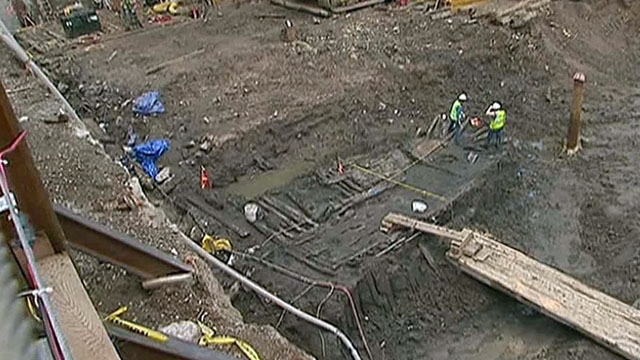
It was a groundbreaking discovery for archaeologists working at the World Trade Center site.

We notice aid courtesy -- in America.

And immediately thought oh my god that looks -- the -- of the said.

-- ship found nearly four blocks inland.

Proof there was once zero ground at ground zero.

To explain we peel back for centuries of changing landscape.

To a time when the footprints of the Twin Towers would be underwater.

Early colonial has created delay and not to make more space but to make more money they where there from the beginning to make a buck.

Historian Sarah Henry says it started in the 60s80s.

When the Dutch spotted untapped Manhattan real estate.

DT waterfront property that appeared when the rivers tide was out the begin to sell that and that's when the real landfill begins.

Archaeologists can Trace the landfills progression both below and above ground.

The original shoreline.

At the time that the first colonists got here was it about Greenwich streets the right here at the left of the south -- footprint.

They would have been -- coming out into the water from the shoreline.

Those peers -- -- streets the water between them became city blocks.

So hold it all in place colonialists laid a grid of retaining walls like underground log cabins.

Filling them up with earth from leveled skills and a lot of garbage.

There were no laws regulating what you could throw into the landfills -- -- throwing anything.

The neighbors police complained about how it smelled horrible.

Despite the smell the landfill was critical of the shipping industry during America's infancy.

By increasing the commercial property act.

The waterfront they can just keep growing economy that was quickly becoming one of the most important in.

Colonial America it.

By 1776.

The British had completed the -- and where the Twin Towers would be built.

Works stopped during the revolutionary war then Americans picked up where the brits left off.

In the eighteen hundreds most of the hills in Manhattan were obliterated to create the current New York City street grid.

The debris from -- the -- It was used to enlarge the infrastructure the entire shoreline.

That push the port -- deeper water making it an ideal harbor for bigger and bigger ships.

New York is now not only the most important port in the United States it's on its way to becoming the most important port in the entire world.

For more than a hundred years all of lower Manhattan grew up instead of out.

Both -- ground was broken for the Twin Towers in the 1960s.

Dirt from the -- was re used to create battery Park City.

It was the last time a landfill was used to expand Manhattan.

One World Trade Center stands northwest of the footprints of the Twin Towers early Americans completed that part of the landfill.

After declaring independence from England in 1776.

And the new tower.

We'll stand 17176.

Feet tall.

We'll have another story next week about all that symbolism that went into the design.

Of that building in you can catch up on all of our stories from our rise of -- series.

On our web site that's foxnews.com.

Slash freedom.

While.